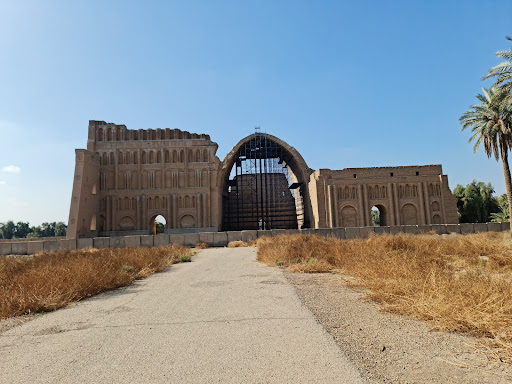
The Arch of Ctesiphon (Taq Kasra), located 40 km south of Baghdad, was built in the 6th century CE. It is the largest brick vault and the largest free-standing arch in the world built before the modern era. A part of a Sasanian palace complex, it stands at 37 meters high and 26 meters wide, making it an exceptional monument of great historical and cultural significance.
The ancient Persian capital of Ctesifon, located on the east bank of the Tiger River, served as the last capital of the Persian Empire from 226 until the Persian Empire fell in 637 during the Arab conquest of Persia • Taki-Kisra was part of a maiestic vault hall. which served as a palace for the kings who ruled the Persian Empire, but after the Arabs captured Ctesiphon, it was used as a mosque for a while and the whole city was abandoned.
There was a time when a great Empire was expanding from Mesopotamia to India and whose own Kings praised the supreme God Ahura Mazdā and his prophet Zarathustra, such was the fabulous Persian Empire.
Late 6th century AD C. it was however very different from that of Ciro the Great, in fact a new dynasty had been implanted, that of the Sasanids, and the Christian influence had spread also in those territories, yet at least in rituals there was still a link with the great Empire of Darius and Serse.
But the Persians had at that time another enemy to face: the Romans of the East. For centuries the two worlds had collided with no particular results, remaining pinned on the Syrian and Armenian lines and also both suffered crises and problems.
The Romans had to deal with numerous invasions from the North by so-called barbarians, while the Persians were subject to constant dynastic crises.
But in 590 history took another road and gave one last glory to the secular Persian Empire. Became a Great King the son of the last Great King, Hormizd IV, his name was Cosroe Il. Given his young age he had to seek support from his paternal uncles, Vinduyih and Vistahm, but General Bahram Chobin, who had already come into conflict with his father, usurped his kingdom.
Cosroe turned to his rival Roman Emperor Maurizio in order to regain the kingdom and thanks to the help of the Byzantines he regained it the next year, in 591.
But Cosroe had every intention of expanding and enlarge his Empire as in antiquity and, in 602, his benefactor Maurizio was killed by Seal and with the excuse of revenge he invaded the Roman Empire of the East, thus conquering all of Asia Minor, Egypt and putting Constantinople under siege.
In the meantime, he had his uncles eliminated in fear that they would replace him. His armies, led by General Shahrbaraz, allied with Slavs and Avars, were on the verge of folding the Romans, but new Emperor Heraclius I turned the tables and defeated the Persians several times. Cosroe was murdered by his son Sherõe,...
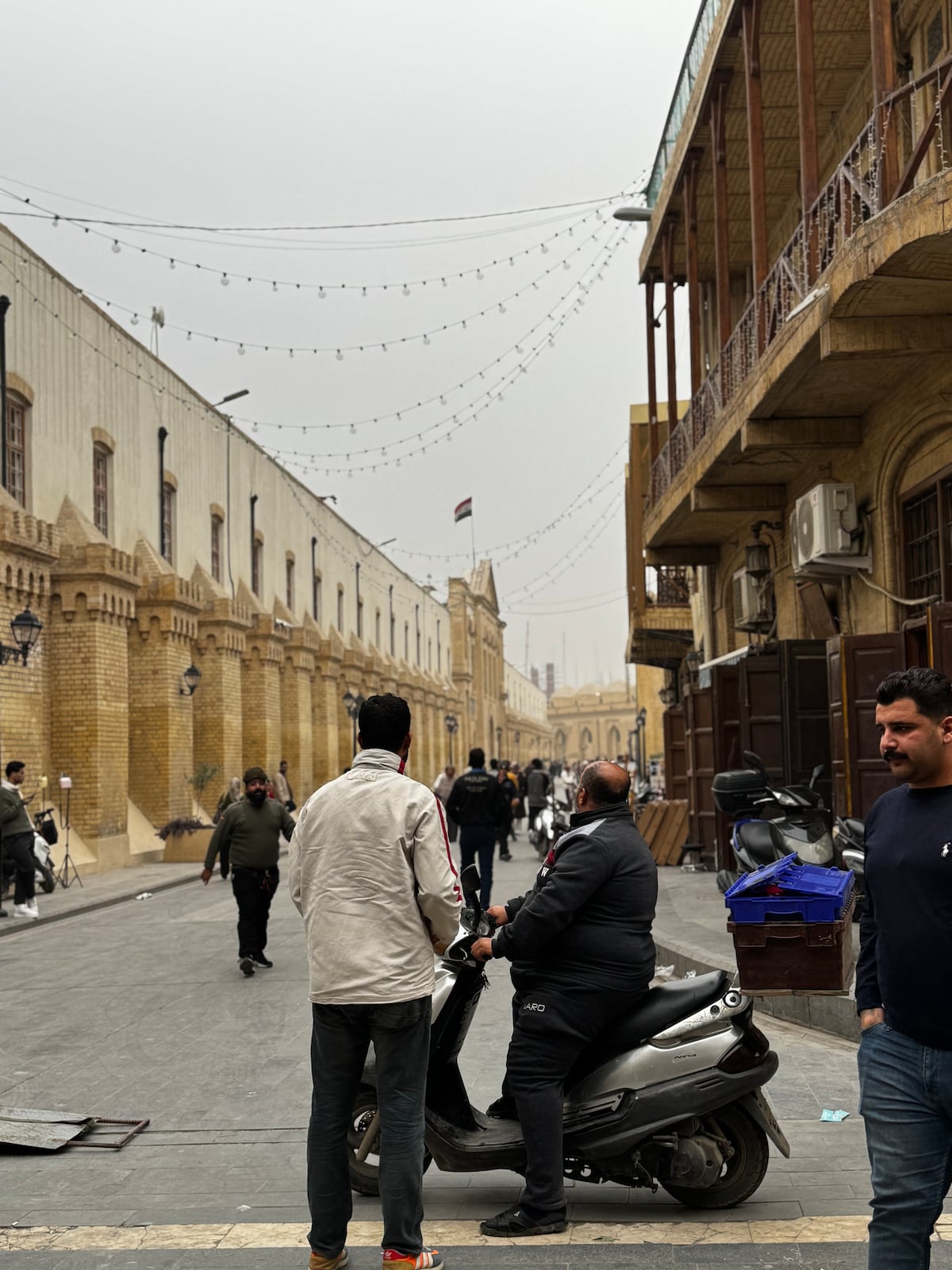
Read moreIwan Al-Madaen (Iwan Kesra or Taq Kesra) (in Persian: Iwan Khusraw), as it is known locally, is the remnant from one of Kusra Anusherwan's palaces, located south of Baghdad, in the site of the city of Katsifon, which is located in the Al-Madaen district that is administratively attached to the governorate of Baghdad, and is known locally and in the public B (Salman Pak) in the name of the famous companion Salman Al-Faris buried there.
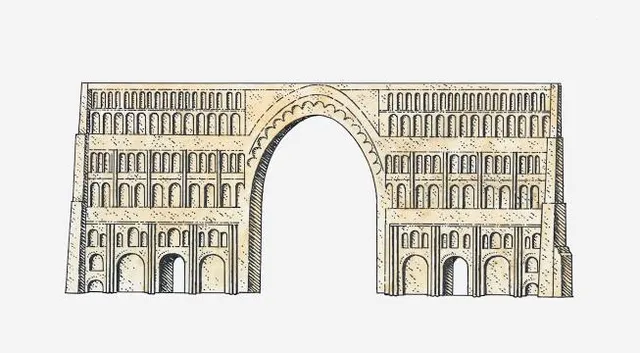
This effect represents the largest hall for a fractured roofed iwan in the form of a contract without the use of props or armament, and it is called locally and in the public as (fracture or tak). The ruins of the covered iwan are still preserved with its splendor, as well as the cracked wall. The Department of Antiquities in Iraq maintains the construction and care for it. He began to build Iwan Kisra in the reign of Kesra I, known as Anushirwan (the Eternal Soul), after the military campaign against the Byzantines in the year 540 AD. The iwan consists of two main parts: the building itself and the arch next to it. The arch is 37 meters high, 26 meters wide and 50 meters high, and is considered one of the greatest buildings of its kind in that era. The throne room - which is expected to be under or behind the arch - was over 30 meters high, 24 meters wide and 84 meters long. Iwan Kesra was acquired by Muslims in 637 AD and at that time it was converted into a mosque In 1888 AD, the torrent destroyed a third of the building, and rebuilding took place during the era of Saddam Hussein in the eighties of the twentieth century, but it was not completed and construction work stopped in 1991 during the Gulf War, and the University of Chicago is now cooperating with the current Iraqi government to rebuild it in what is called Diyala Project. It was in the area of Al-Madaen Iwanan, one of them was built by Sabor I, Ibn Ardashir, who ruled from the year 240 AD to 271 AD. Ibn al-Jawzi mentioned that Iwan Kusra built by Sabor II Bin Hormuz with the shoulders who died in the year 370 AD. In the introduction to Ibn Khaldun, he mentioned what happened in the demolition of Iwan Kisra, when Al-Mansour intended to build Baghdad, he wanted to demolish it, and he sent to Khalid bin Yahya, while he was in his council to consult him about that. They robbed the king of the people of that temple, so he accused him of the advice, and he said: I took him to the horseback. I swear by God. He began to demolish and gather hands on him, and took axes for him and protected him with fire, and poured vinegar on him, even if he realized the deficit after all this and feared the scandal. Lest it should be said: The Commander of the Faithful and the King of the Arabs was unable to demolish a factory of Al-Ajam! Al-Mansour knew her and shorter than...
Read morehistorians believe it was constructed under Shapur I who ruled Sassanian Persia from 242 to 272 AD and some other believe that construction possibly began during the reign of Anushiruwan the Just (Khosrow I) after a campaign against the Byzantines in 540 AD. The arched iwan hall, open on the facade side, was about 37 meters high, 26 meters across and 50 meters long, the largest man-made, free standing vault constructed until modern times. The arch was part of the imperial palace complex. The throne room—presumably under or behind the arch—was more than 30 m (110 ft) high and covered an area 24 m (80 ft) wide by 48 m (160 ft) long. The top of the arch is about 1 meter thick while the walls at the base are up to 7 meters thick. The catenary arch was built without centring. In order to make this possible a number of techniques were used. The bricks were laid about 18 degrees from the vertical which allowed them to be partially supported by the rear wall during construction. The quick drying cement used as mortar allowed the fresh bricks to be quickly supported by those that were previously laid. The Taq Kasra is now all that remains above ground of a city that was, for nine centuries—from the 2nd century BC to the 7th century AD—the main capital of the successor dynasties of the Persian empire: Parthians and Sassanids. The structure left today was the main portico of the audience hall of the Sassanids who maintained the same site chosen by the Parthians and for the same reason, namely proximity to the Roman Empire, whose expansionist aims could be better contained at the point of contact.[citation needed] The structure was captured by the Arabs during the conquest of Persia in 637. They then used it as a mosque for a while until the area was gradually abandoned. In the early 10th century, the Abbasid caliph al-Muktafi dug up the ruins of the palace to reuse its bricks in the construction of the Taj Palace in Baghdad. The Arabic poet Al-Buhturi wrote a famous poem about the ruins in the 9th century. The monument is also the subject of a poem by the Persian poet Khaqani, who visited the ruins in the...
Read more