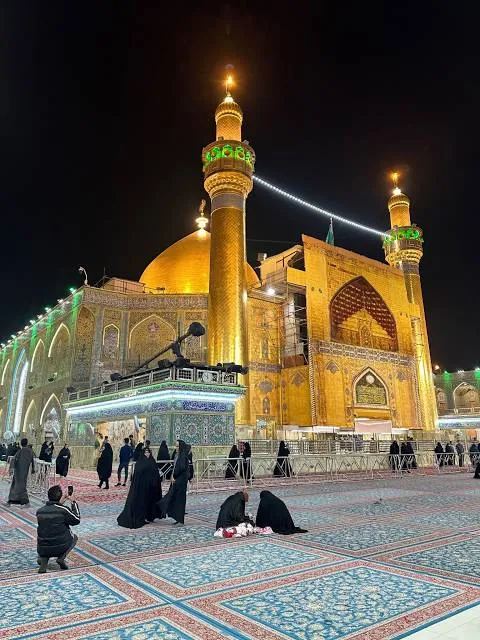
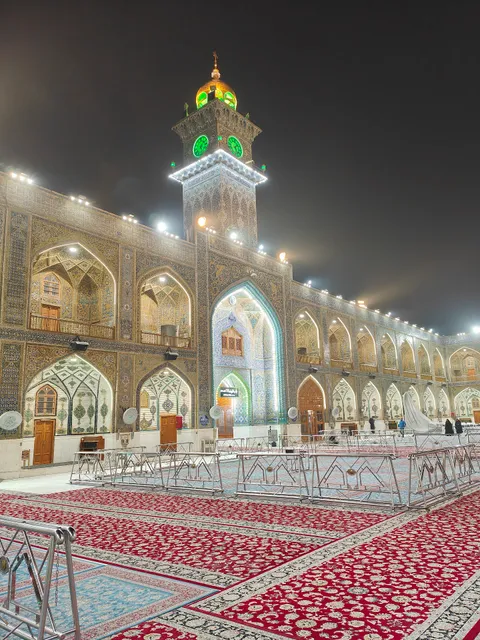
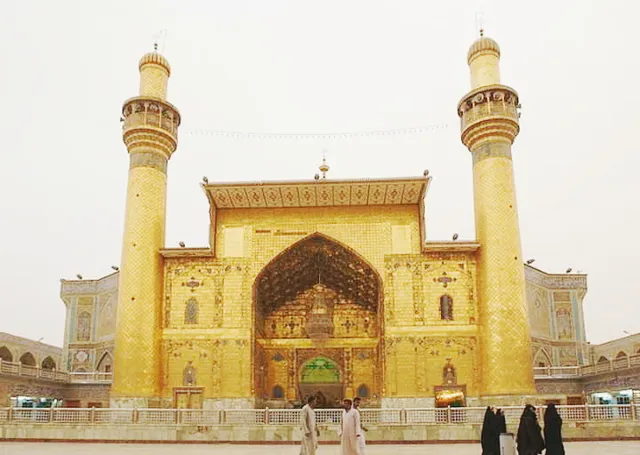
The Imam 'Ali Holy Shrine (Arabic: حَـرَم الْإِمَـام عَـلِي, translit. Ḥaram al-Imām ‘Alī), also known as the Mosque of 'Ali (Arabic: مَـسْـجِـد عَـلِي, translit. Masjid ‘Alī), located in Najaf, Iraq, is the Holy site for Shia Muslims. 'Alī ibn Abī Tālib, the cousin of Muhammad, the first Imam (according to Shia belief) and fourth caliph (according to Sunni belief) is buried here. According to Shi'ite belief,[1] buried next to Ali within this mosque are the remains of Adam and Noah. Each year millions of pilgrims visit the Shrine and pay tribute to Imam Ali.
Shrine of Imam AliḤaram al-Imām ‘Alī (Arabic: حَـرَم الْإِمَـام عَـلِي)
Imam Ali Mosque in Najaf, where the first ShiaImam Ali ibn Abu Talib is buried.
Basic informationLocationNajaf, IraqGeographic coordinates31.996111°N 44.314167°EAffiliationIslamCompleted977
HistoryEdit
The Abassid Caliph Harun al-Rashid built the first structure over the tomb of Imam 'Ali in 786, which included a green dome. The Caliph Al-Mutawakkil flooded the site in 850, but Abu'l-Hayja, the Hamdanid ruler of Mosul and Aleppo, rebuilt the shrine in 923, which included a large dome. In 979-980, the Buyid dynasty Shi'i sovereign 'Adud al-Dawla, expanded the shrine, which included a cenotaph over the burial site and a new dome. This included hanging textiles and carpets. He also protected Najaf with a wall and citadel, while providing water from the Euphrates via a qanat. Seljuq Sultan Malik-Shah I contributed large gifts to the shrine in 1086, as did Caliph Al-Nasir. The vizier Shams al-Din Juvayniadded facilities to serve the pilgrims in 1267, and Sultan Ghazan Khan added the Dar al-Siyada wing for the sayyids in 1303. A fire destroyed the shrine in 1354 but was rebuilt around 1358 by Jalairid Sultan Shaikh Awais Jalayir. He also interred his father's remains, Hasan Buzurg in the courtyard. Timur ordered the restoration of the shrine after a visit to Najaf. Suleiman the Magnificent also offered gifts, which probably helped restore the shrine, after a visit in 1534. The Safavid ShahIsmail I visited in 1508, but it was Abbas I who visited Najaf twice and commissioned 500 men to rebuild the shrine in 1623. The restoration was completed by his grandson Shah Safi al-Din in 1632. This restoration included a new dome, expanded courtyard, a hospital, kitchen, and hospice, so as to accommodate the numerous pilgrims. The cenotaph was restored in 1713 and the dome stabilized in 1716. Nader Shah gilded the dome and minaret from 1742-1743, while his wife paid for the walls and courtyard to be rebuilt and the retiling of the iwan faience. In 1745, the iwan was rebuilt as a gilt muqarnasof nine tiers. In 1791, a raised stone floor covered the tombs in the courtyard, creating a cellar space for them. The Ottoman Sultan Abdülaziz rebuilt the Clock Portal (Bab al-Sa'a) and the Portal of Muslim Ibn 'Aqil in 1863 and the former gilded in 1888 by Qajar Sultan Naser al-Din Shah Qajar.[2]
Ibn Battuta visited the shrine in 1326, noting that it was "carpeted with various sorts of carpets of silk and other materials, and contains candelabra of gold and silver, large and small." Between the three tombs, "are dishes of gold and silver, containing rose-water, musk and various kinds of perfumes. The visitor dips his hand in this and anoints his face with it for a blessing."[3] The first European visitors included Carsten Niebuhr in 1765, William Loftus in 1853, and Johann Ludwig Burckhardt in 1864.[2]:79
During the uprising of March 1991, following the Persian Gulf War, Saddam Hussein's Republican Guards damaged the shrine, where members of the Shia opposition were cornered, in storming the shrine and massacring virtually all its occupants. Afterwards, the shrine was closed for two years, officially for repairs. Saddam Hussein also deported to Iran a large number of the residents of the area who were of...
Read moreVisiting this shrine filled with devoted followers in deep prayer, tears streaming down their faces, creates a powerful and humbling experience. The air is thick with emotion—an intense mix of sorrow, hope, and unwavering faith. Every whispered plea and silent sob speaks of struggles carried to this sacred place, of burdens laid down at the feet of their beliefs.
The sight of so many people surrendering themselves to their faith, weeping as they seek solace, healing, or forgiveness, is deeply moving. It reinforces the strength of their devotion—their belief in something greater than themselves, something that gives them purpose and strength despite life's hardships. The rhythmic murmur of prayers create an atmosphere that feels almost otherworldly, as if the spiritual and physical realms are momentarily intertwined.
Observing such raw expressions of faith stirs reflection. It is a reminder of the deep human need for hope, for connection, and for something to hold on to in moments of despair. Whether as an outsider looking in or as someone sharing in the experience, the intensity of the moment lingers, leaving behind a sense of reverence and a newfound understanding of the power of belief.
Aside from the fact that I am standing before the magnificent Iranian-inspired shrine and mosque, one is immediately captivated by its breathtaking elegance and intricate craftsmanship. The towering golden minarets, adorned with delicate geometric patterns and calligraphic inscriptions, reach towards the sky as if in eternal devotion. The grand golden dome, shimmering under the sunlight, is a masterpiece of Persian artistry, its surface adorned with vibrant turquoise, deep blues, and golden accents that reflect centuries of architectural tradition.
As you step closer, the facade reveals an exquisite mosaic of floral motifs and arabesque designs, meticulously arranged in glistening tiles that seem to tell a silent story of faith and artistry. The entrance, framed by a monumental iwan, invites visitors into a sacred realm where light and shadow dance upon the finely carved muqarnas—intricate stalactite-like details that adorn the ceilings.
Inside, the air is filled with a serene reverence. The vast prayer hall is bathed in the ethereal glow of thousand of small pieces glass mirror, casting mesmerizing patterns across the polished marble floors. The mihrab, an ornate prayer niche, stands as the spiritual heart of the mosque, its elegant inscriptions from the Quran shimmering under the golden chandeliers.
And finally deep Inside, the shrine glows with the radiance of crystal yellow chandeliers casting a soft luminescence over polished marble floors. The walls are adorned with elaborate mosaic panels, their interwoven geometric patterns symbolizing the infinite nature of God. At the heart of the shrine lies the sacred tomb of Imam Ali ibn Abi Talib, enclosed in an ornate gold lattice, where pilgrims gather in reverence, whispering prayers and touching the intricate filigree. Surrounding the chamber, gilded muqarnas—honeycomb-like sculptural elements—create a celestial illusion, as if the heavens themselves are descending into the sacred space. Beyond its physical beauty, the shrine embodies a deep spiritual presence, a sanctuary where devotion meets artistic brilliance. Every tile, every arch, every dome speaks of an unbroken tradition of faith and craftsmanship, making it not just a place of worship, but a timeless architectural marvel. A...
Read moreThe Imam Ali Shrine (Arabic: حرم الإمام علي) in Najaf, Iraq, is one of the holiest sites in Islam, especially for Shia Muslims. It is the burial place of Imam Ali ibn Abi Talib (a.s) — the first Imam in Shia Islam and the fourth Caliph in Sunni tradition.
🕌 Quick Overview
📍 Location: Najaf, Iraq
🧭 Distance: ~160 km south of Baghdad
🕋 Importance: Second only to Karbala in Shia Islam
🕰️ Constructed: Original burial ~661 CE (secretly), structure rebuilt and expanded over centuries
🛐 Pilgrimage: Millions visit annually, especially during Ramadan, Eid al-Ghadeer, Arbaeen, and 13th Rajab
🟨 Religious Significance
Resting Place of Imam Ali (a.s)
Imam Ali (a.s), the cousin and son-in-law of Prophet Muhammad ﷺ, was martyred in Kufa in 661 CE.
His burial was kept secret due to political tension, and the shrine remained hidden for decades.
🕊️ Today, it is a major site of ziyarat (pilgrimage), where Shias weep, pray, and connect spiritually with the Imam.
Imam Ali in Hadith
Prophet Muhammad ﷺ said: "I am the city of knowledge, and Ali is its gate." — Sunan al-Tirmidhi, Mustadrak al-Hakim
Imam Ali represents wisdom, justice, and courage in Islamic history, and his shrine reflects those values.
🏛️ Architecture & Design
🌟 Golden Dome: Iconic feature; plated with real gold
🕌 Two Minarets: Also covered in gold
🕯️ Zarih (burial chamber): Beautifully ornate with silver and gold lattice
🧡 Calligraphy & Tiles: Quranic verses and names of Ahlul Bayt throughout
The shrine complex also contains:
Courtyards for thousands of worshippers
Libraries, seminaries, and offices for scholars
Tombs of notable Islamic scholars, including Allama Hilli, Sheikh Tusi, and many maraji’
🙏 Ziyarat Practices
When visiting the shrine, pilgrims usually:
Perform ghusl (ritual bath) before entering
Enter with respect and humility
Recite Ziyarat of Imam Ali (a.s) – often starts with:
"As-salamu ʿalayka yā Amīr al-Muʾminīn..."
Offer two rakats of prayer near the tomb
Make duas and ask for intercession (shafa'ah)
🔹 Interesting Facts
Some believe 70,000 angels visit the shrine every day.
Imam Ali himself reportedly foretold his burial site.
Many Shias request to be buried near Najaf due to hadith that the "land of Najaf is part of Heaven."
🚗 How to Visit
Closest airport: Najaf International Airport
Accessible from Karbala (1 hour drive), Baghdad, or Kufa
Pilgrims often combine it with Masjid al-Kufa, Masjid al-Sahla, and Karbala...
Read more