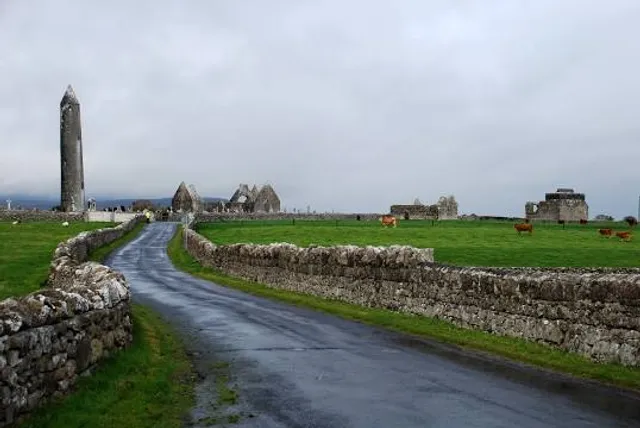
Kilmacduagh Abbey is absolutely stunning — a huge, impressive site with the tall round tower, the abbey church, and the remains of the monastic living quarters. You can easily spend an hour exploring here.
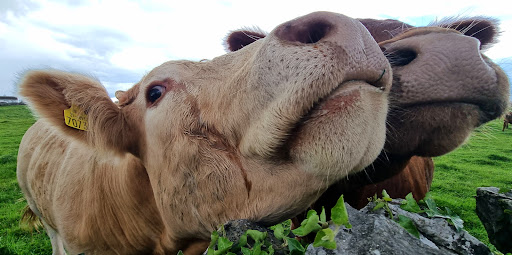
What made it unforgettable for us was the atmosphere: not just the ruins, but also the friendly cows grazing in the fields, calm enough to let us pet them. They made the place feel alive in a way you don’t expect from a 7th-century monastery.
There is plenty of parking available near the entrance, and you can open the gate to walk further into the grounds — just remember to close it behind you out of respect for the land and any farm animals.
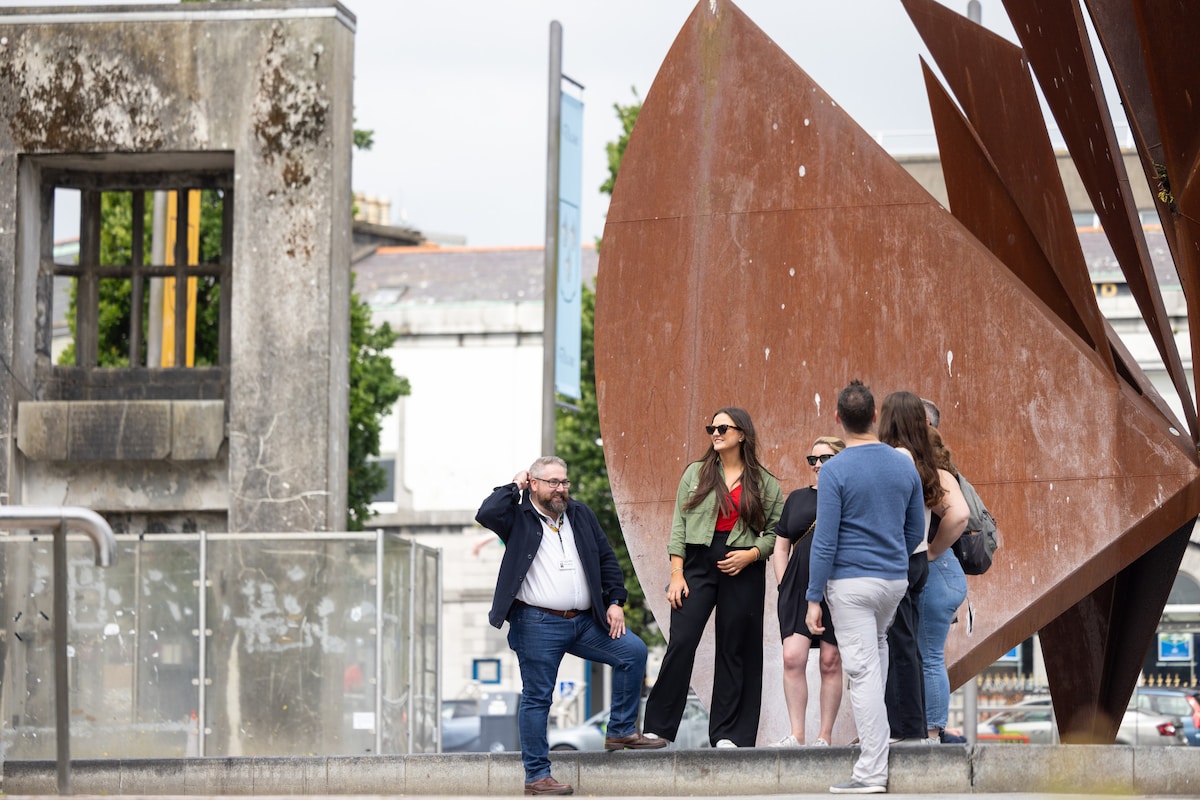
And then there are the modern “timegates.” We first stepped through the one on Corkscrew Hill earlier in the day, and on our way home we passed through this one at Kilmacduagh. It really felt like walking between worlds — out through one gate into the Burren, and then back into this world through the abbey gate. The symbolism of past and present overlapping was powerful, especially with the abbey towering in the background.
Founded in the 7th century by St. Colman MacDuagh, the abbey’s history is rich with legend — including the story that he was granted as much land as his belt would encircle, which miraculously stretched to cover this vast estate. The leaning round tower (sometimes compared to Pisa) is another striking detail, said to have given the monks both safety and a lookout over the Burren.
Altogether, Kilmacduagh is a place where history, folklore, nature, and even modern art come together in one...
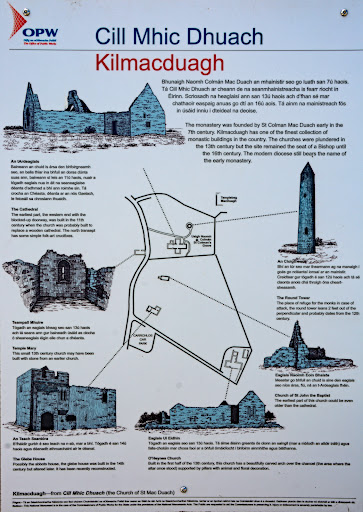
Read moreKilmacduagb Monastery in County Galway was founded by St. Colman Mac Duach early in the 7th century. Kilmacduagh has one of the finest collection of monastic buildings in the country. The churches were plundered in the 13th century but the site remained the seat of a Bishop until the 16th century. The modern diocese still bears the name of the early monastery.
The Cathedral: The earliest part, the western end with the blocked-up doorway, was built in the 11th century when the church was probably built to replace a wooden cathedral. The north transept has some simple folk-art crucifixes.
The Round Tower: The place of refuge for the monks in case of attack, the round tower leans 2 feet out of the perpendicular and probably dates from the 12th century.
Temple Mary: This small 13th century church may have been built with stone from an earlier church.
Church of St John the Baptist: The earliest part of this church could be even older than the cathedral.
The Glebe House: Possibly the abbots house, the glebe house was built in the 14th century but altered later. It has been recently reconstructed.
O'Heynes Church: Built in the first half of the 13th century, this church has a beautifully carved arch over the chancel (the area where the altar once stood) supported by pillars with animal and...
Read moreMy son and I were traveling around Ireland and frequently got a little lost. While trying to get back to the correct road, Jamie, my son, noticed the round tower in the distance and so we went to see what it was all about. Hope you can imagine our surprise when it turned out to be an entire complex of building and a wonderful old graveyard with some really beautiful stone. The place was locked up and there was a gate across the road to what is "The Monastery Church", but there is also a little sign telling you to inquire about the key at the white house across the road. We did that and so were able to wander about the entire grounds for what turned out to be a couple of hours or more. The is fascinating to see the old "dry stone" building standing today after centuries of disuse. The "Abbey Church" is a wonderful building that is still safe to go up to the second floor and see the beautiful arched ceiling and be amazed at how thick the walls are. From the windows of the second floor, one can see the entire complex.
I am so glad we got "lost" because these buildings were one of the highlights of the entire trip. I hope that anyone sightseeing in Co. Galway will take the time to see this wonderful old group of buildings. They are more than worth the time...
Read more