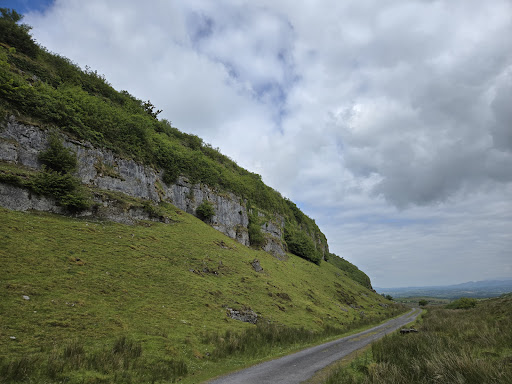
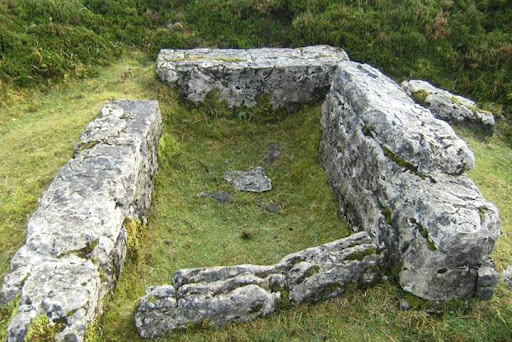
Well as more time passes, I'm more sure the faeries got to us on this hike. First, if you're going here, you can drive through the first gate, just please shut it behind you so the sheep don't get out. You'll drive up the road a little ways and park up there. There will be a sign that says no cars beyond that point, and a directional sign pointing the way to the tombs. I had read it was a 30 minute hike, so had planned on going to see the Keshcorran Caves afterwards. We started out, admired the beautiful scenery, and after probably 20 min, had walked past what looked like a smaller trail leading to a large passage tomb off to the left. After walking for awhile and not finding the route to the tombs in the pictures, we tried to go back to the small trail. We trecked back and forth for an hour and couldn't find it. We could see a tomb in the near distance, but the small trail was gone, or had never been there in the first place, who knows! So we went back the direction we had been heading on the main trail to the sign that says Pedestrians Only (or something similar) on the right hand side, and hiked up the hill to find the passage tombs that had been there all along. (I'm trying to leave detailed instructions in case anyone else has similar trouble.) I was also getting irritated because I was on a time schedule to get to our B&B, and we had been there for a couple hours. So after we saw a couple of the tombs, I realized we weren't going to make it to the Caves and called to my husband that we should get going. He was not far in front of me but the sound wouldn't reach him. I kept calling and calling, and I could see him, but he couldn't hear me. It wasn't even windy! I finally sent him a text that I was heading down, and he had to run the whole way down to catch up to me. It wasn't until afterwards that I realized how strange the experience was. It was quiet up there, and the sounds maybe got all muffled, like when it snows. So be wary of the faeries messing with you if you're on a time schedule when you go to see the tombs! Maybe they were trying to get me to slow down and enjoy it. Next time I'll have to see the Keshcorran Caves. Just...
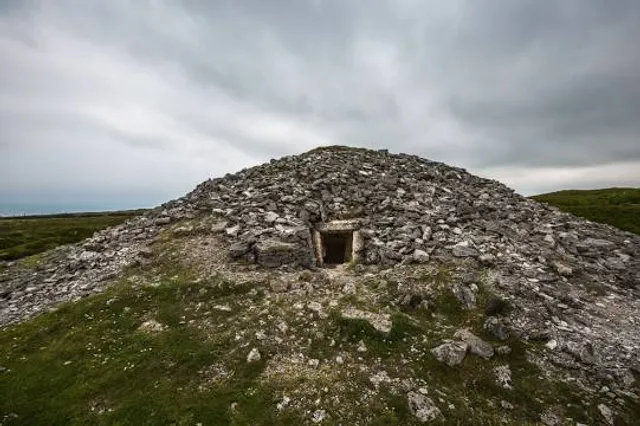
Read moreThe location is probably why much of the megalithic complex remains unspoilt. Access to the site is by a fairly robust climb, so be prepared! Once there, however, the whole site is breathtaking. The monuments themselves are awe-inspiring, some with intact 'light boxes' that are used to align with the solstice sun. The views too are genuinely phenomenal. The site is of especial importance to Irish archaeology and myth (see below):
Carrowkeel is a Neolithic passage tomb cemetery it’s name: An Cheathrú Chaol means 'the Narrow Quarter'. C14 dating places the tombs at between 5400 and 5100 years old (3400 to 3100 BC), so that they predate the Pyramids on Egypt's Giza plateau by 500-800 years. An Cheathrú Chaol is one of the big four passage tomb cemeteries in Ireland, set on high ground above Lough Arrow, and the tombs seem to be oriented towards the area of Cuil Irra, Knocknarea and Carrowmore.
There are fourteen passage tombs in Carrowkeel. Some can be entered by crawling through a narrow passage. Six more passage tombs are located close by in the Keshcorran complex. A particular type of crude pottery found in passage tombs has been titled Carrowkeel Ware, having first been recorded in the Carrowkeel Monuments. Close to Lough Arrow and just north of Carrowkeel is another, apparently related, giant passage tomb, Heapstown Cairn. This is part of the legendary Moytura, site of battles between the Tuatha Dé Danann, the ancient gods of Ireland, and the demonic Fomorians.
The mountain range containing Carrowkeel is called the Bricklieve Mountains (Breac Sliabh), meaning ‘the speckled mountains’ a possible reference to their appearance when more quartz rock survived on the outside of the cairns, causing them to sparkle in the sun. One can only imagine how these would have looked when first constructed....maybe white (like Newgrange) a beacon for...
Read moreA Hidden Gem with Timeless Views and Ancient Magic
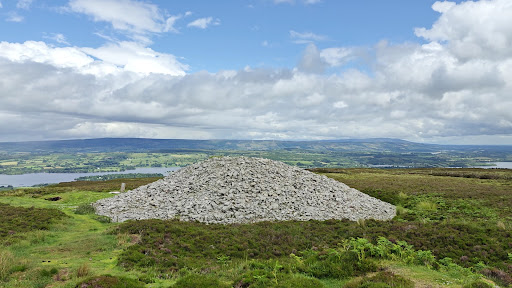
Carrowkeel Cairns are a seriously underrated slice of Irish history nestled in the Bricklieve Mountains of County Sligo. Just a 30-minute moderately steep walk from the small car park (which, to be fair, has limited space—but you likely won’t have to fight a crowd), and you’re transported back over 5,000 years. I went up on a classic Irish summer’s day—showery with the odd burst of sunshine—and when the clouds lifted, I could count nine counties from the top: Sligo, Donegal, Mayo, Leitrim, Galway, Roscommon, Longford, Westmeath, and Fermanagh. Breathtaking doesn’t quite cover it.
There are three main cairns (passage tombs) easily accessible from the trail, with many more scattered around the nearby hills. You also get stunning views of Lough Arrow to the east, shimmering like something out of a folklore tale.
These monuments were built by Neolithic farmers around 3200 BC—yes, before the Pyramids—and it’s believed they were used for burial and ceremonial purposes, aligning with the sun and stars. They likely came from the Boyne Valley culture (think Newgrange), and they managed all of this without tractors, JCBs, or breakfast rolls from the petrol station. Net zero before it was trendy, they hauled massive stone slabs uphill with ropes, logs, and grit—something that would take the Irish government 50 years to plan and another half-century to actually build (probably 50 times over budget too).
Carrowkeel is quiet, raw, and authentic—no gift shops, no signs pointing to the "selfie spot"—just pure Irish heritage and landscape. Highly recommended for walkers, history buffs, and anyone wanting to stand where ancient humans once stood and stare out over...
Read more