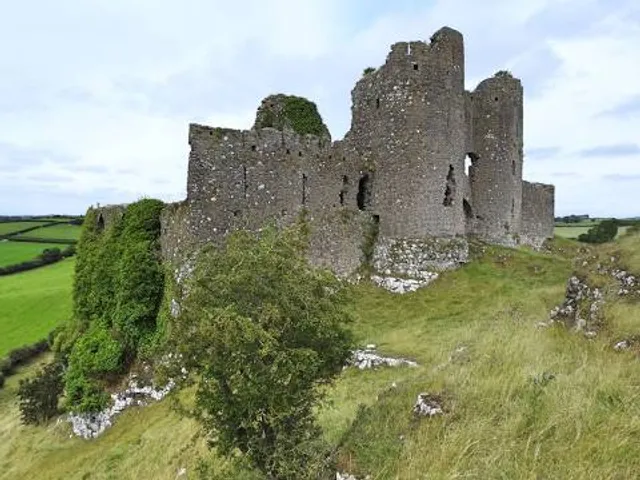
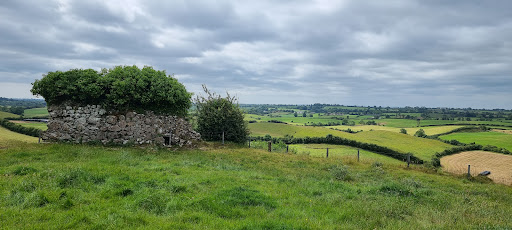
Castle Roche (Dún Gall) is a Norman castle located some 10 km nw of Dundalk, County Louth, Ireland. It was the seat of the De Verdun family (also spelt De Verdon), who built the castle in 1236 AD. It is built upon a large rocky outcrop and commands extensive views of the surrounding country. Together with a deep moat its strong walls rendered it virtually impregnable. A secret passage once connected the castle to a round tower outpost. Nearby is Faughert Hill and many a battle was fought there as this site and Faughert controlled the passage to/from the North. Bertram de Verdun by 1185 had erected a fortified position near where Castle is now situated. Bertram's granddaughter Rohesia de Verdun from Alton, England was married to Theobald Butler, 2nd Chief Butler of Ireland. Her husband’s sudden death whilst travelling in Poitou, France, forced her to move to her lands in Ireland. She immediately set about fortifying her land with a castle. A mythical legend tells a tall tale about how her quick tempered reputation deterred all potential architects; she offered her hand in marriage (and thereby a share in her wealth) to the man who would build the castle to her liking. The legend tells that after their wedding banquet in the newly completed castle, she invited her husband to the bridal suite and urged him to view their estate from the large bedroom window. Taking no chances with the castle’s secrets, she promptly pushed her new husband from the window, where he plummeted towards his death. The window was known thereafter as the Murder Window. Rohesia became a nun in Gracedieu Priory, Leicestershire, died there in 1247. Much of the great castle was added to by her son by Theobald. The name "Castle Roche" derives from its physical location - it was the castle on the 'Rock' ('roche' being old/Norman French for 'rock'). It was besieged and abandoned by the De Verduns at the time of the Bruce Invasion. Ultimately it was destroyed in the Irish wars of the 1640s. It is a fantastic spot a beautiful spot, easily accessible, a must see for Castle lovers and...
Read moreCastle Roche A dramatic ruin perched on a hilltop outside Dundalk, offering amazing views over the countryside. The atmosphere is wild and authentic — we even came across sheep, a goat, and a hare roaming the grounds.
Although the castle itself is closed off due to loose stones and falling masonry, you can still walk around the grounds and admire it up close. Just be aware that the road is very narrow, with no official parking — the best option is to carefully pull in by the fence.
Castle Roche was once the seat of the powerful de Verdun family, built by Lady Rohesia de Verdun in the 13th century. From here, the family could command the surrounding lands and guard the strategic pass into Ulster.
The castle is also wrapped in folklore: legend says that Lady Rohesia promised to marry whichever knight could build her a stronghold. After the wedding, she invited her new husband to admire the view from a window — and promptly pushed him out of it. That spot is still known as the Murder Window.
Even in ruins, Castle Roche’s commanding position, sweeping views, and tales of power and betrayal make it a fascinating stop for anyone...
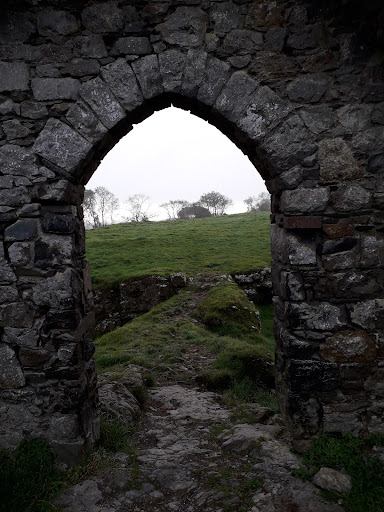
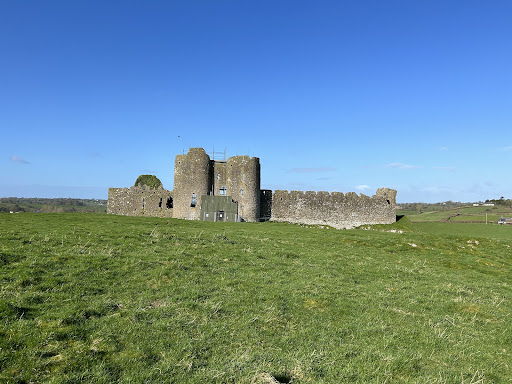
Read moreAn imposing ruin of a castle, sitting on a rocky outcrop in green fields. This castle was built in the 1200’s by the de Verdun family. It is currently in ruins, but practically all of the surrounding walls, and the imposing gate house still stand.
Entrance is free, but parking can be tricky, as one must park on a narrow lane adjoining the field containing the castle. Entrance is through the stile by the side of the gate, but there are no paths and the long grass can be wet, so be sure to wear appropriate footwear. The site is known, but not well-frequented by tourists, so it can often be viewed alone.
There is a legend that the owner of the castle, Rohesia de Verdun, promised to marry the architect and then pushed him to his death from a window. This is almost certainly untrue, but it typifies the rough and ready nature of the early Norman nobility of Ireland quite well.
Inside the castle are the remains of halls, storerooms, guardhouses and wells. The castle is not the largest or the best preserved in Ireland, but it is one of the most picturesque and it is very definitely...
Read more