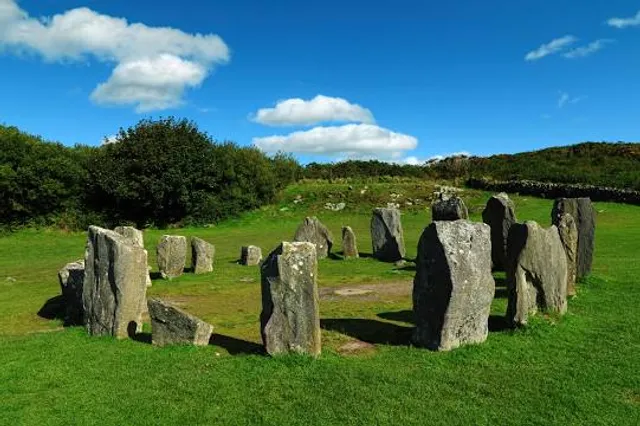
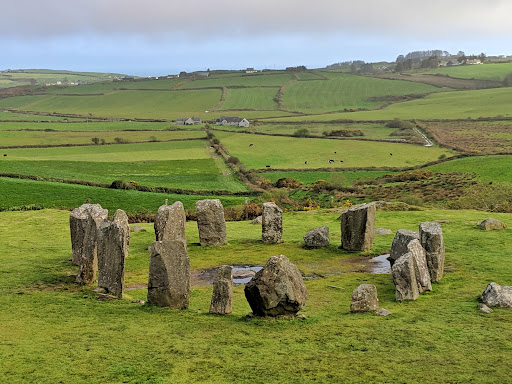
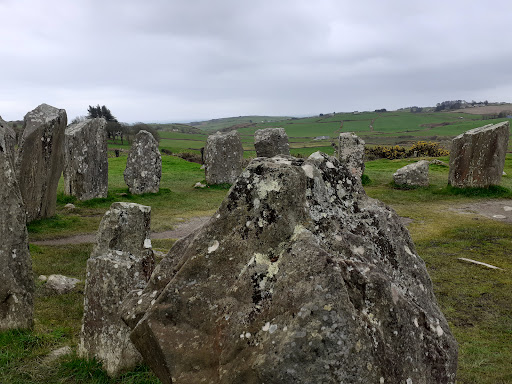
Drombeg is a 3000+ year old bronze age stone circle, with the tallest pair of stones directly opposite the altar stone, a lower flat table stone with carved cup-like depressions, the purpose of which are unknown. The line from portal to altar aligns with the sunset every winter solstice, at the turn of the year. Neolithic and Bronze Age cultures celebrated this solstice, with theories about the rebirth of the sun or the year as the days get longer. It would also have been the entry point to the hardest time of year, with no harvest. Some theorise that many cattle would have been slaughtered to avoid feeding then throughout the winter months, so there may have been a festive element to the rare surplus of meat.
Drombeg aligns with sunset (like Stonehenge) rather than sunrise (like Newgrange). While smaller than either, it's quite complete and gratifying set on a hillside overlooking the sea in two directions, and easily reached from Rosscarbery.
The stone circle was excavated slightly to reveal the remains of a young boy, whose disarticulated bones were radiocarbon dated to ~3k years ago. Also of note are the remains of two other structures nearby, a well preserved fulacht fiadh, and another structure where food may have been prepared (a bowl for milling cereals was also found).
The fulacht fiadh is a subject of debate. The stonewalled trough remains, along with a well dug to supply water, and the remains of a fire pit. Stones were heated at length and rolled in to boil water. Some believe they were steam huts (like first nation Americans used), baths, or breweries (and one was used to successfully brew ale!), but the prevailing theory is for cooking meat. This has also been tested successfully, with water boiling enough to cook in 18 minutes, and remaining hot for 3 hours, with an animal wrapped in straw successfully cooked and eaten.
Less relevant, the stream away from the fulacht fiadh can sometimes contain frogspawn, and many years ago I recall catching...
Read moreDrombeg Stone Circle is a prehistoric monument located in Glandore, County Cork, Ireland. It is a circular arrangement of seventeen stones, with one large stone lying flat in the centre. The stones are made of local sandstone and are thought to have been erected around 1500 BC.
The circle is thought to have been used for ceremonial purposes, such as sun worship or ancestor worship. It is one of the best-preserved stone circles in Ireland and is a popular tourist destination.
The circle is located on a hilltop with stunning views of the surrounding countryside. It is a peaceful and serene place to visit, and it is easy to imagine the people who once gathered here to celebrate the changing seasons or to mark important events in their lives.
The circle is open to the public and is free to visit. There is a small car park at the site, and there is a short walk to the circle itself. The circle is well-maintained and there are information panels on site that provide more information about its history and significance.
If you are visiting County Cork, I would definitely recommend taking a trip to Drombeg Stone Circle. It is a fascinating and atmospheric place to visit, and it is a great way to learn more about Ireland's...
Read moreThis is a fabulous, peaceful little site. But .... and bearing in mind its on the Wild Atlantic Way (particularly popular with campervans) - there's a height barrier to the stone circle carpark !!! Not sure why, so sadly you have to park on the little pull-in before the barrier, or on the road, which 2 other campers had to do. Not very welcoming .... it was really quiet at the circle. Absolutely amazing that this is 2500 yrs old, Absolutely incredible. Just a few yards from the circle are more rocks believed to be a heating/cooking pool. If you enjoy the mysticism of paganism and the ability of man all those years ago to determine where the winter solstice would like the circle ... it's definitely worth a visit. It's free to visit...
Read more