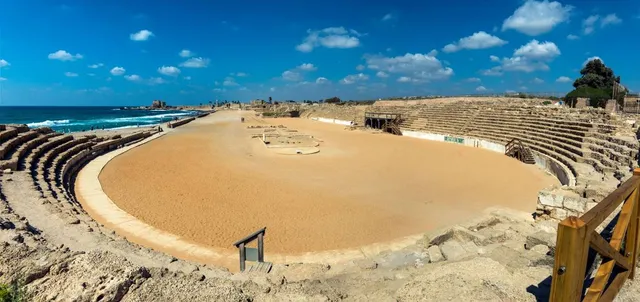
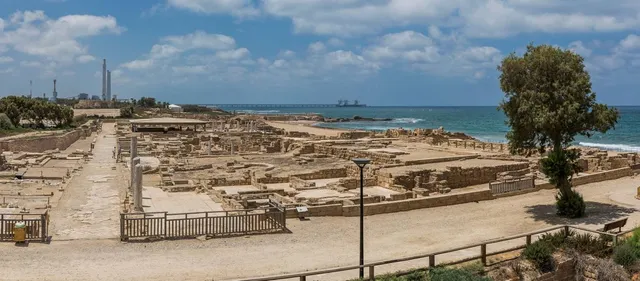
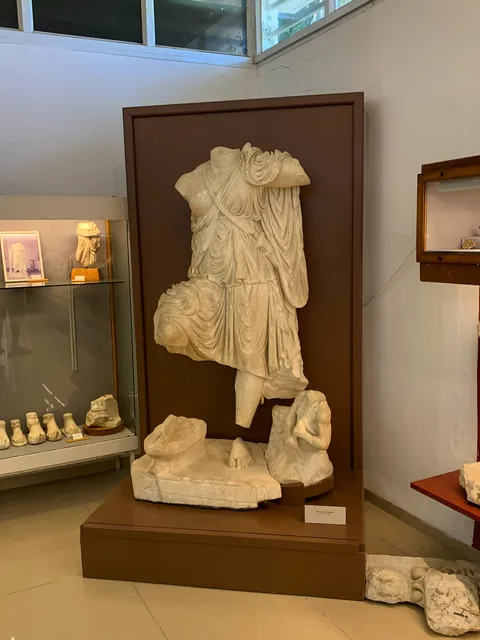
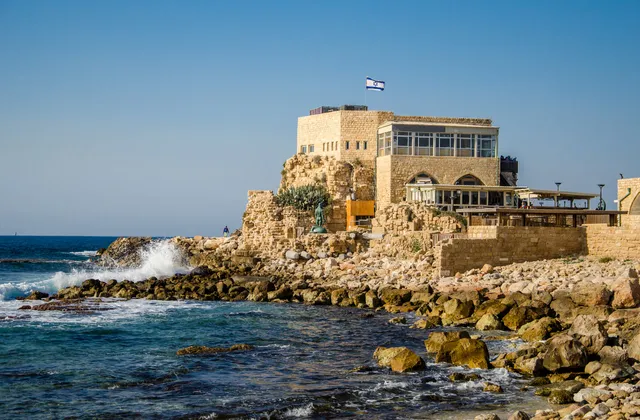
Caesarea National Park. In its chequered history the place was a important roman port city of Caesarea, named after Caesar. It was later occupied by Muslims and Crusaders. Due to Extensive ruins from roman and crusader period found in excavation work was undertaken to renovate and reconstruct major points of attraction. And the site was developed as Caesarea National Park. Today it has become a famous tourist attraction. We were dropped near the roman theatre On the way to the entrance came across display of roman period statues. All damaged and one impressive and beautifully crafted foot of what must have been a huge statue. Then came the Roman theatre. Looked very impressive. Typical roman theatre semicircular design of ascending seating arrangement facing the stage. It has been restored very nicely. Our guide told us that as an added attraction of the park, regular entertainment programs and concerts are held in the theatre. Walking north next was Promontory or coral Palace. Today the place is marked by lot of typical roman pillars, part of the palace and huge courtyard. The large area and existing remain indicate that it must have been an impressive building. Further north is what is found in almost every roman city of any importance a hippodrome. One end of the seating if fairly intact but other side seats are missing. Crusader Citadel with its ramparts with sea water mote running all around is a major and important part of Caesarea National Park. A Grand renovation work is going on in Crusader citadel. The facade of the Augusts and Roma temple is being renovated to its past glory to look is it did to impress the seafarers on their arrival in 1st century CE. Finally we exited Caesarea National Park through the Crusader gate which is in fairly good condition. Its arched ceiling leaving a...
Read moreCaesarea also known as Caesarea Maritima or Caesarea Palestinae, and in modern Israel as Keisaria, was an ancient and medieval city in the Sharon plain on the coast of the Eastern Mediterranean. For centuries it was a major intellectual hub of the Mediterranean and cultural capital of Palestine. Today the site is included in an Israeli national park. During the early Roman period, Caesarea became the seat of the Roman procurators in the region. It later became the provincial capital of the Roman province of Judaea, Roman Syria Palaestina and Byzantine Palaestina Prima provinces. The city was populated throughout the 1st to 6th centuries CE and became an important early centre of Christianity during the Byzantine period. Its importance may have waned starting during the Muslim conquest of 640 in the early Middle Ages. After being re-fortified by Muslim rulers in the 11th century, it was conquered by the Crusaders, who strengthened and made it into an important port, and was finally slighted by the Mamluks in 1265. Remains from many periods have been uncovered, in particular from the large city of the Roman and Byzantine periods, and from the fortified town of the Crusaders. Major Classical-era findings are the Roman theatre; a temple dedicated to the goddess Roma and Emperor Augustus; a hippodrome rebuilt in the 2nd century. Tiberieum, where archaeologists found a reused limestone block with a dedicatory inscription mentioning Pilate- the only archaeological find bearing his name and title; a double aqueduct that brought water from springs at the foot of Mount Carmel; a boundary wall; and a 200 ft (60 m) wide moat protecting the harbour to the...
Read moreIncredible history. Caesarea Maritima, City and the harbour, was first built by King Herod in 22 to 9 BCE. The city was thriving and populated from the 1st to the 6th centuries AD and actually became an important hub for Christianity through the Byzantine period and replaced Jerusalem as the capital in the 6th century.
Then in 640 the city was destroyed during the Muslim Conquest, after which the city and harbour lost there importance in the region.
In the 11th century the Muslims refortified the city only to have the Crusaders take it over, so the Crusaders strengthened the city and port and made it an important hub again, finally it was slighted by the Mamluks in 1265......what a history Caesarea Maritima has had!!
The name Caesarea was given by King Herod in honour of the Roman emperor, Caesar Augustus The entire city was built to Roman specifications including the Roman Theatre, chariot racing track or hippodrome and a temple dedicated to the goddess Roma and Emperor Augustus.
Visitors should take the time to watch to short movie that explains the history of the site. You can easily spend an entire day here soaking in the atmosphere and...
Read more