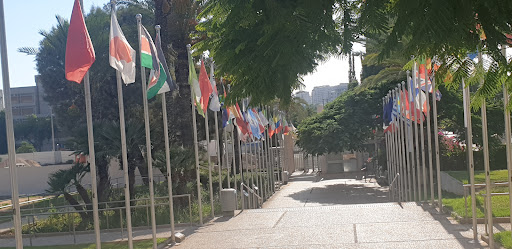
The Museum of the Jewish People at Beit Hatfutsot, and the Grand Reef Museum are located on the campus of Tel Aviv University. The two museums are in one building. 45 shecks can always be lingering in it. It is very cost-effective. After the visit, compare the experience of visiting the museum in China and feel that It’s not only cost-effective, it’s super cost-effective, it’s worthwhile.
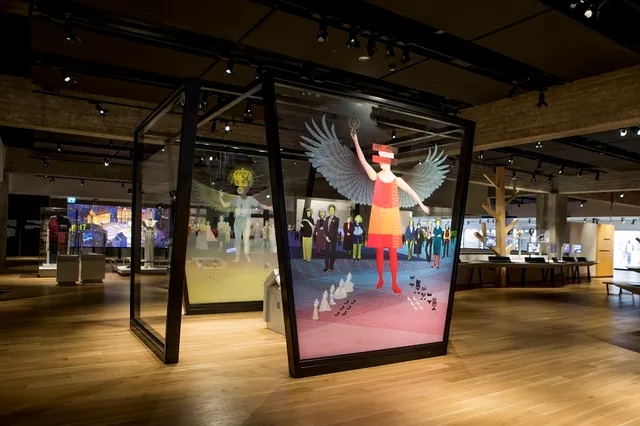
I think the Jewish education can be mapped out from the design and arrangement of the museum: compared to the simple display of the domestic museum, the two museums have achieved audio-visual integration. In addition to photos and text explanations, various documentaries and editing videos also account for a lot. Large proportion and moderate length. By watching video materials and enjoying pictures and texts, you can understand and feel the Jewish history and culture more intuitively and vividly.
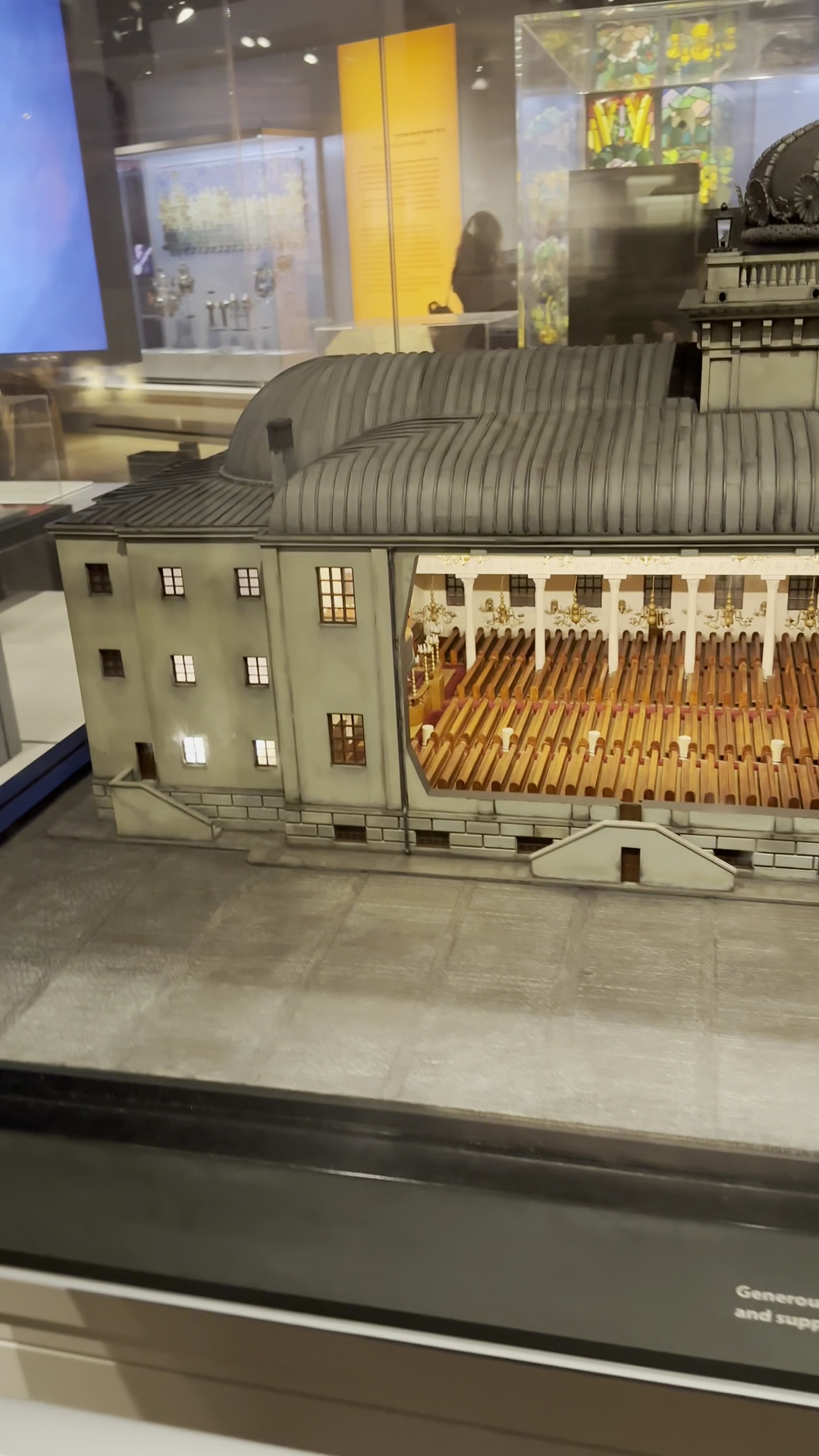
In addition to maps, texts, and images, most of the exhibits in the museum were restored by models. Because of the long history of the Jewish nation, many activities have been unable to find the corresponding cultural relics display, and if it is just a simple text explanation, it is too monotonous and boring, and it is difficult for the viewer to vividly understand these history. The Jewish synagogues in the museums around the world, the migration activities during the Great Sanctuary, and the ancient bazaars were all exhibited through models or sculptures. This way is more vivid and gives visitors a more intuitive understanding of history.
The two museums are on the left and right sides. I accepted the advice of the conductor and went to the Jewish Museum with the theme "New Wing". After going upstairs, there are three themes: Bob Dylan, the past and present life of the synagogue and the life of “immigrants”.
I was surprised at first. Why did you introduce Bob Dylan specifically, and also showed his photos, works and quotations. Does he have any connection with Jews and Israel? As the winner of the Nobel Prize in Literature, Bob Dylan appeared in everyone's sight, but in fact he has always had a long-lasting connection with the Jewish nation. He traveled to Israel three times and worked with everyone in Kibbutz. Entering this room, every step of your movement is accompanied by Bob Dylan's music. You can see him on a head-up projection. You can read his quotations, his experiences and his and Jews on the wall. The connection of the Jewish state, and this is something I did not know before. The second room, entitled "The Past and Present of the Synagogue", shows the synagogues that were built around the world in the early years. Each hall model is equipped with a restoration map and explanation, vivid and specific. The synagogue, as an important part of Jewish culture, is not presented in a single form. The structure of the synagogues in different parts of the world is different, and they are integrated into their respective urban cultures, but they retain the basic cultural heritage. The last room, which is my favorite one, mainly describes all aspects of life that people who have immigrated from all over the world after the founding of the People's Republic of China. The room layout is very simple, five small compartments, each of which tells a theme, namely "employment and unemployment", "racial discrimination and cross-community marriage", "settlement and separation", "responsibility and fatalism", "dreams and desire". There is a big screen in each cell that will continuously play a small short film, telling the different living conditions of two people in the face of similar situations, and comprehensively and truly reproduce the mental state and life form of people at that time. After visiting these, you will also have a deeper understanding of the Jewish community. Two hours after the "New Wing" linger, I went to the Great...
Read moreNamed 'Us' in Hebrew, this recently renovated museum (March 2021), whose name seems to self-describe its audience as the Jewish people themselves, attempts to address the challenging task of describing who the Jewish people are and their history. It does so with moderate success, but fails at times.
The main museum space is airy and attractive, and features a staircase in the middle of 3 floors, with wrap-around exhibits on each floor. From the large elevator, the first exhibit features modern-day Jewish families and interviews Jewish people from around the world who talk about how they are connected to their religion. It is a candid, thoughtful overview about the diversity within Judaism itself and what being Jewish today means. There are also some AV exhibits with some statistics.
The Jewish luminaries exhibit is the weakest exhibit in the museum. It seems to be a parade of famous names, but very little is said about how being Jewish informed and inspired their lives. Indeed, Spinoza himself is there, but no one bothered to write that he ended up renouncing his faith, becoming atheist and being effectively expelled from his Jewish community. Other luminaries may indeed have been Jewish, but did being Jewish actually matter to them? This exhibit lacks a nuanced and deeper approach, and so it felt very 'off'. There is also a short poorly made animated music video which is quite frankly, embarrassing.
There is a movie on the second floor that attempts to explain the history of the Jewish people, and it only does an ok job. While I understand that doing a 2-minute movie about this topic is a tall order to begin with, one should never really do it unless it's absolutely excellent, and it's not. First of all, it lacks lots of incredibly important details. It doesn't mention the first temple, how a central priesthood religion worked, and how the religion changed after the second temple was destroyed. It also doesn't mention ancient Israel's important kings, distinguish between the various early diasporas - after the first and then after the second temple - and doesn't mention Mizrahi people, who are not the same as Sephardi or Ashkenazi, and did not take the same migration paths. It also portrays the Middle Ages as hopeful times for the Jews (they were, in fact, terrible) and ends with a strange conclusion that Jews now live all over the world and one day might go to space. What? I feel like there could have a myriad of ways to create a better conclusion.
The animated movie discussing the link between the biblical exodus and the modern concept of freedom and equality (mainly addressed to US audiences) is much, much better. It is an inspiring, light-hearted movie I would recommend.
One of the most moving short animated films is that of Queen Salome - a little known Jewish queen who nevertheless was a truly inspiring figure, and whose story I did not previously know.
Another (hidden and neglected) gem is the exhibit featuring a few rare (some illuminated) Jewish books from the middle ages. Knowing just how few of these remain and just how many were destroyed maliciously and violently, I fully appreciated being able to see them, but I'm afraid most people will pass through these never having had any idea just how few and precious these are.
The exhibit featuring the various synagogues around the world is excellent, and it also features a few movies about how various Jewish streams traditionally pray.
The gift shop is a bit of a disappointment - with some investment, it could offer more and be much more of a resource for people looking for more information or inspiration from various origins. It seems to be lackluster and uninspired.
Some things hit the mark, some did not - With the guiding and nuanced hand of a curator who is more self-aware, this can be so much better than what...
Read moreNo Signage and Lack of Communication
We took the bus to the entry point (gate #2, as indicated on the museum's website), which is on the Tel Aviv University campus. Once you arrive at the campus, there is no signage whatsoever to indicate the way to get to the museum.
Guards at gate #2 were not letting in students or visitors, but were just yelling in Hebrew. We finally got a chance to ask if we could get in to the museum, one of the guards brusquely told us that the museum was closed. We called the museum and were told that it was open and that admission was free today.
So, we followed our GPS map to another entrance gate, which was also closed. This time, guards would let cars and trucks pass freely through the driveway, but students and visitors were held at the gate. Again, the guards were yelling at students and visitors alike. We politely asked if we would be able to go to the museum, and the head guard told us that the museum was closed. When we explained that we had called the museum and that it was, in fact, open, the guard didn't answer us and just turned around, not facing us. Finally, a student asked a few questions in Hebrew, and she explained that they would assess the situation about let some people in perhaps a half hour later. The guards did not explain why the campus was closed, even to the students.
I realize that the guards may have been dealing with a security situation on campus, but their handling and miscommunication was nothing short of insolent and rude.
Not knowing whether or not we would be “selected” to enter campus, even if we waited the supposedly 30 minutes, we just got back onto a city bus and returned to our hotel.
I understand that the handling of security is not the responsibility of the Museum of the Jewish People, but if we are not able to see the exhibits due to its reliance on campus security. The museum needs to find a way for a separate entry for visitors.
Given other recent reviews of the Museum of the Jewish People at Beit Hatfutsot by travelers, much of the exhibits are closed. So, maybe, we should just consider our attempted visit as a 24-shekel $6.65 USD) bus ride through Tel Aviv neighborhoods.
My advice is to call ahead to the museum to see how many of its exhibits are open, to get information on exactly where the campus entry point is, and to inquire as to what to do if the security...
Read more