Segesta (Greek: Ἔγεστα, Egesta, or Σέγεστα, Ségesta, or Αἴγεστα, Aígesta; Sicilian: Siggésta) was one of the major cities of the Elymians, one of the three indigenous peoples of Sicily. The other major cities of the Elymians were Eryx and Entella. It is located in the northwestern part of Sicily in Italy, near the modern commune of Calatafimi-Segesta in the province of Trapani. The hellenization of Segesta happened very early and had a profound effect on its people.
The origin and foundation of Segesta is extremely obscure. The tradition current among the Greeks and adopted by Thucydides, ascribed its foundation to a band of Trojan settlers, fugitives from the destruction of their city; and this tradition was readily welcomed by the Romans, who in consequence claimed a kindred origin with the Segestans. Thucydides seems to have considered the Elymians (Latin: Elymi), a barbarian tribe in the neighborhood of Eryx and Segesta, as descended from the Trojans in question; but another account represents the Elymi as a distinct people, already existing in this part of Sicily when the Trojans arrived there and founded the two cities. A different story seems also to have been current, according to which Segesta owed its origin to a band of Phocians, who had been among the followers of Philoctetes; and, as usual, later writers sought to reconcile the two accounts.
Another version of the Trojan story related in Virgil's Aeneid, which would seem to have been adopted by the inhabitants themselves, ascribed the foundation of the city jointly by the territorial king Egestus or Aegestus (the Acestes of Virgil), who was said to be the offspring of a Dardanian damsel named Segesta by the river god Crinisus, and by those of Aeneas' folk who wished to remain behind with Acestes to found the city of Acesta. We are told also that the names of Simois and Scamander were given by the Trojan colonists to two small streams which flowed beneath the town, and the latter name is mentioned by Diodorus Siculus as one still in use at a much later period.
The belief that the name of the city was originally Acesta or Egesta and changed to Segesta by the Romans to avoid its ill-omened meaning in Latin (Ægesta in Latin means "excements") is disproved by coins which prove that considerably before the time of Thucydides it was called by the inhabitants themselves Segesta, though this form seems to have been softened by the Greeks into Egesta.
The city was occupied by a people distinct from the Sicanians, the native race of this part of Sicily, and on the other that it was not a Greek colony. Thucydides, in enumerating the allies of the Athenians at the time of the Peloponnesian War, distinctly calls the Segestans barbarians. At the same time they appear to have been, from a very early period, in close connection with the Greek cities of Sicily, and entering into relations both of hostility and alliance with the Hellenic states, wholly different from the other barbarians in the island. The early influence of Greek civilisation is shown also by their coins, which are inscribed with Greek characters, and bear the unquestionable impress of Greek art.
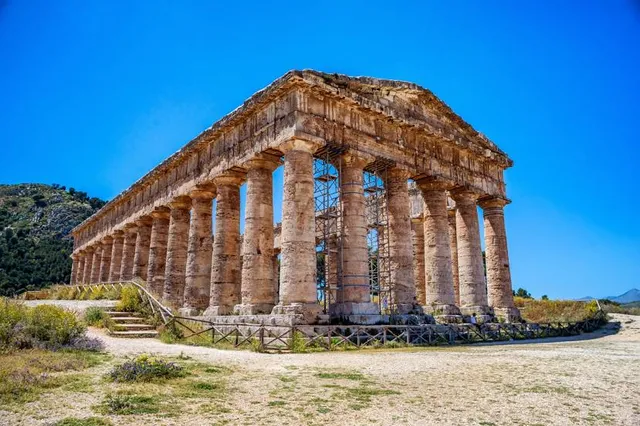
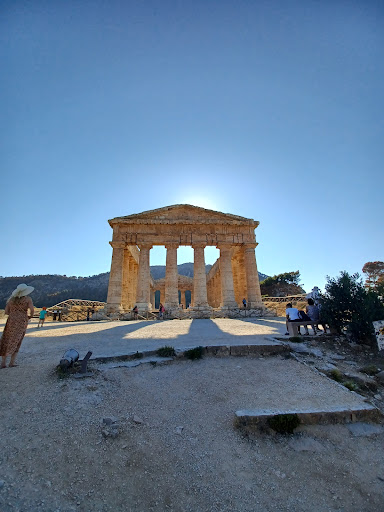
On a hill just outside the site of the ancient city of Segesta lies an unusually well preserved Doric temple. It is thought to have been built in the 420s BC by an Athenian architect, despite the city not having a large Greek population. The temple has six by fourteen columns on a base measuring 21 by 56 meters, on a platform three steps high. Several elements suggest that the temple was never finished. The columns have not been fluted as they normally would have been in a Doric temple and there are still bosses present in the blocks of the base (used for lifting the blocks into place but then normally removed). The temple also lacks a cella, any ornamentation, altar or deity dedication, and was never roofed over. The temple escaped destruction by the Carthaginians in the late...
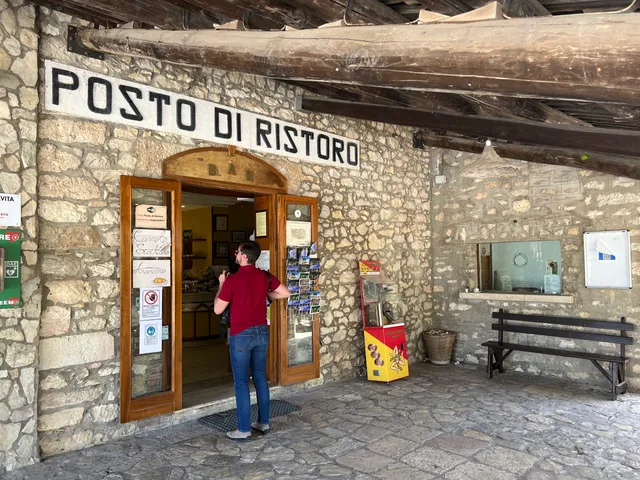
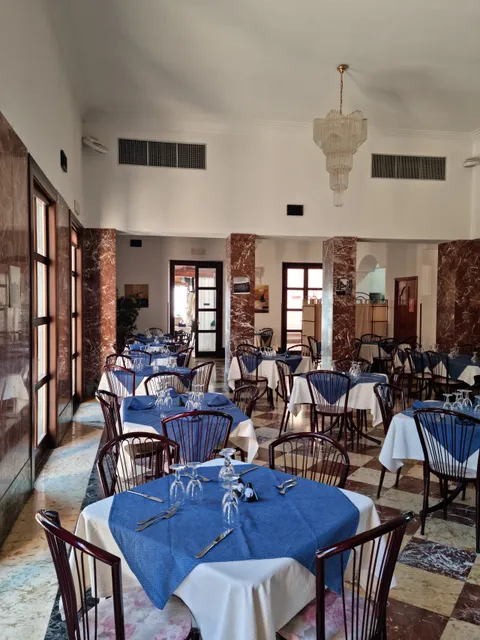
Read moreVisit it now to experience something from another age and another world. The wildfires swept through this area in late July and left the whole area burnt or scorched. The plants are blackened and brittle, the soil is dry and crusted, the air is heavy with the acrid smell of destruction. Yet despite this devastation (it appears even the restaurant did not survive) the temple continues to stand proudly on its plinth, as it has for millenia, a true survivor. The ticket office seemed untouched by the fire, and the staff are friendly and professional and spoke good English. There is a short flight of stairs to reach the temple, but these could be managed by most. It appears there is an access road that could be taken by those with mobility needs. The stairs give you an excellent approach to the temple, bringing you face to face with the main entrance, framed by the mountains beyond. Walk all the way around the temple if you can as the views are spectacular. You can walk within the.temple for even more immersion. The car park is gravelly and unshaded, but is safe and ample. There are a row of vending machines for snacks (although I expect they will reopen the restaurant before long as it did not appear to be badly damaged). I was only charged €5 as there was an event in the theatre. The scale of the temple is truly vast and it is well...
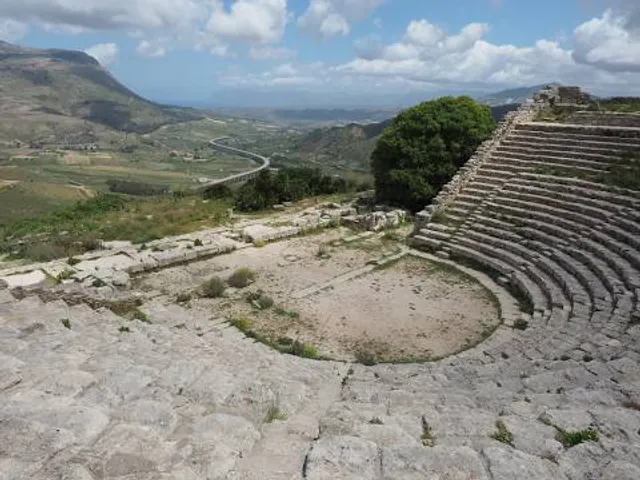
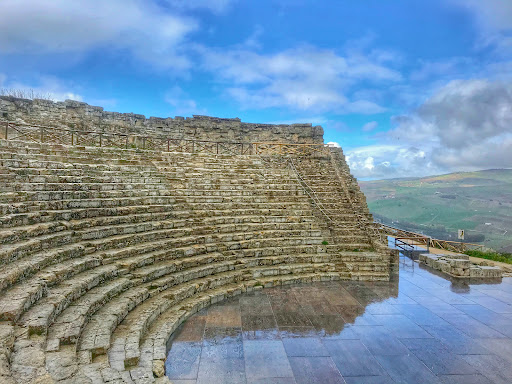
Read moreThe superbly intact temple was built in 418 b. C. This alone is reason for amazement. Parking is just off the main road. Purchase (cards accepted) a park & drive ticket per car for 5 euros, add 1 euro for maps if wanted, and then board the bus that takes you to the entrance to the Parco Archaeologico. Show your park and drive tickets to the driver. Busses run every 15 minutes and are air conditioned. Once off the bus, you can purchase the park 's entrance ticket, free for under 18, 50% 18 to 25 and full price (12 euros). You now have a choice to climb the short route to the temple or board a second bus. You'll show your entrance ticket at a booth just before boarding. This bus takes you to the amphitheatre at the top of the hill, again the bus is air conditioned. Some people climb up, which is fine but it was really hot when we visited and could not have hacked it in the heat!!! The views are spectacular. When ready to leave, repeat the steps the opposite way or walk downhill to visit the other archeological wonders. We opted to just visit the amphitheatre and the temple because too warm. Well worth it! Refreshments and toilets available at each bus stop basis. Considering water is at a premium, the cost of 1 euro per half litre bottle seemed more than reasonable. We paid up to £1.7 pound sterling at the airport...
Read more