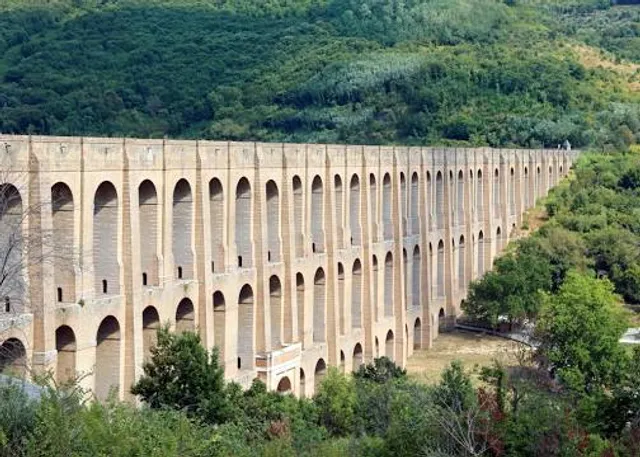
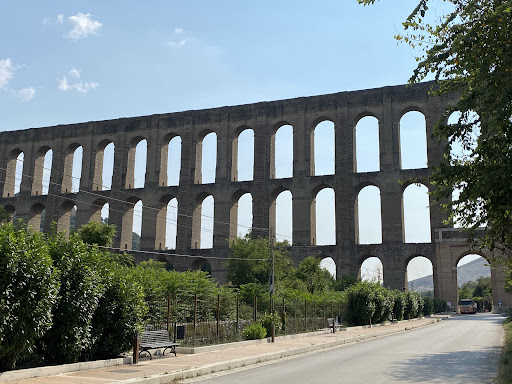
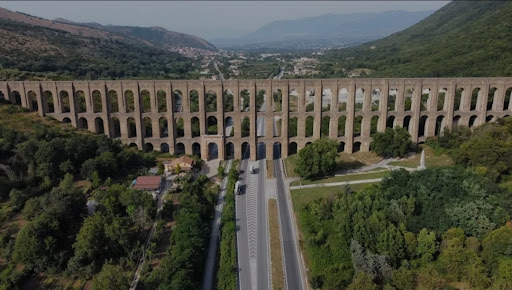
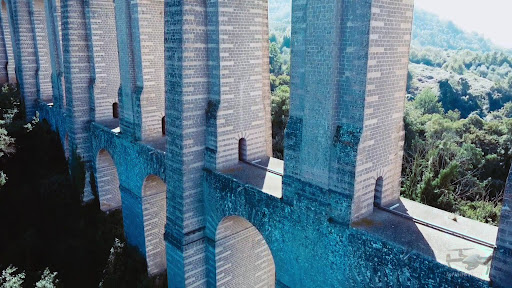
When you visit the Royal Palace of Caserta you don’t wanna miss this wonderful aqueduct just 10 km away from the palace. Mostly underground, the aqueduct is well known for its well-preserved and absolutely amazing, three-tier, 529-metre-long tufa-arched section bridging the Valle di Maddaloni between Monte Longano and Monte Garzano. This section was modelled after Roman arched aqueducts, is 55.8 metres high at its highest point, crosses what is now highway SP335 — and was designated a World Heritage Site in 1997.
The Aqueduct of Vanvitelli or Caroline Aqueduct is a 38 km aqueduct that supplied water to the Reggia di Caserta and the San Leucio complex from the foot of the Taburno massif and springs of the Fizzo Contrada, in the territory of Bucciano.
Commissioned by Charles of Bourbon, the aqueduct was designed by and named after Luigi Vanvitelli. Construction began in March 1753 and it opened on 7 May 1762. It is located in SS265, 81020 Valle di...
Read moreThis engineering beauty of simplicity is now an artistic welcome gesture that mesmerizes with the majestic presence to that of the Roman Colosseum. (construction started March 1753/completed May 1762, Province of Caserta, Italy).
With its three tiers of arches, 19, 29 and 43 across respectively, I strongly consider this masterpiece one of todays modern work of triptych art, hence, intended to be appreciated together. In mythology, arches represents the door between time and space through which one passes to enter another world. The arch signifies the opening to new perspectives, the fact of seeing on the other side.
The aqueduct was commissioned by Charles of Bourbon, and designed/named after Luigi Vanvitelli (12 May 1700 – 1 March 1773) who trained in Rome by architect Nicola Salvi, whom worked on the construction of the Trevi...
Read morePer il recupero della nostra storia é fondamentale salvare questa opera ingegneristica monumentale dal degrado e dalla dimenticanza; la nostra corta memoria, infatti, non ci consente di valorizzare i beni culturali presenti e innervati sul territorio casertano che é, incredibile dictu, uno dei più interessanti e ricchi della Campania. Ma anche uno dei più sconosciuti. Tale lacuna deriva dalle caratteristiche di una regione, la Campania Felix, che con l'aggressione militare é stata assoggettata a un'Italia di facciata ed é stata distrutta nella sua organicità. Difatti i capoluoghi di provincia campani si sono, da quel triste 1861, comportati come i Comuni e le Signorie del passato che non facevano altro che combattersi fra loro. Pertanto é stato generato una sorta di razzismo strisciante che ha portato al relativo isolamento di ampie contrade e ad una guerra sorda fra diverse amministrazioni. Invece occorre cooperazione per uscire dall'impasse e i Borbone l'avevano ben compresa la logica unitaria che tanto ha giovato a tutto il Regno delle Due Sicilie. Cosicchè attraverso l'Acquedotto Carolino le due province, beneventana e casertana, furono collegate dalla cosa più preziosa che esiste: l'acqua e i problemi incommensurabili che misero a dura prova Luigi Vanvitelli e le sue maestranze furono brillantemente superati dalla creatività, dall'ingegno e dall'intelligenza. Per noi che guardiamo con ammirazione a un passato, che tutto sommato, non é poi tanto lontano non resta che accettare l'eredità unitaria e simbolica che fece grande un Regno e che che purtroppo tende a mettere in risalto la mediocrità del presente. Complimenti a tutti coloro che amano la propria terra e si battono per...
Read more