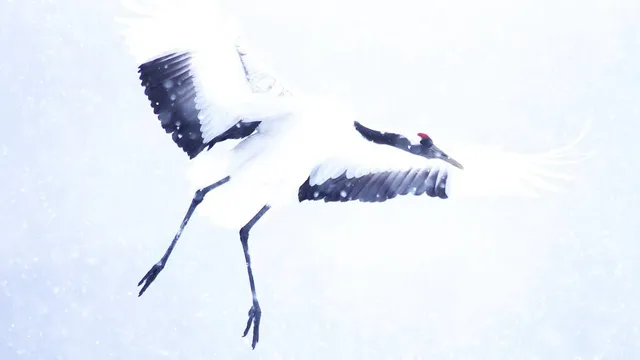
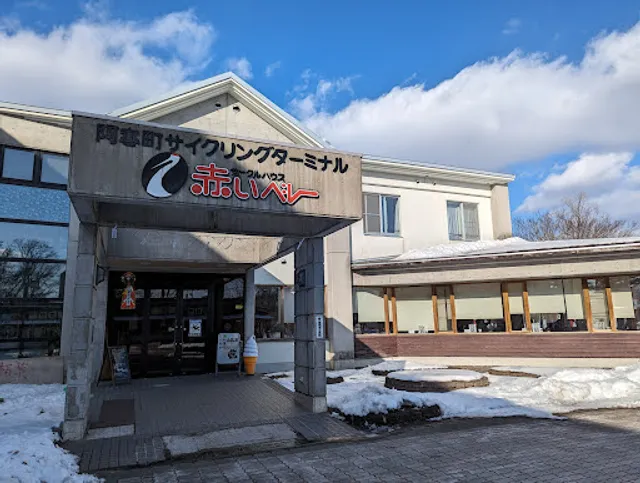
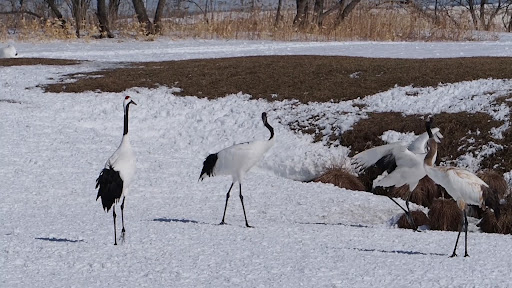
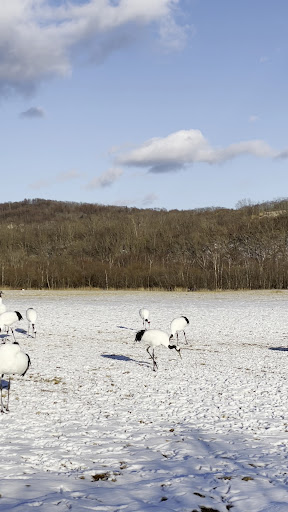
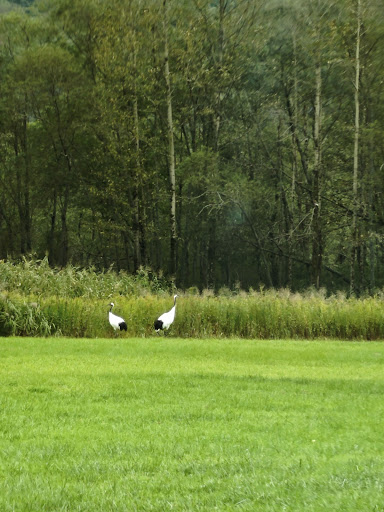
The visit to Akan International Crane Center (GRUS) was the highlight of my 6 week trip around Hokkaido! I stayed in Kushiro and visited the Tsurui-Itō Tanchō crane Sanctuary before I came here. That was good but (GRUS) was even better. I visited at the beginning of March 2024. It's just off a main road almost half-way between Kushiro and Lake Akan. I took a public bus from Lake Akan which took just over an hour to get here. There is a large area that curves around the main observatory building. This area is a very large open field where the cranes are free to fly in and out as they like. Unlike the other crane sanctuary there is an observatory building where you can go inside if you want to escape the cold. There are windows and seats on the ground and upper floor where you can still observe the cranes in the warm. There's also a good display of information about the Tancho, a nice childrens play area, toilets and a small souvenir shop in the building. I arrived around 11am and there were many Tancho on the field and flying in and out. There were quite a few people watching and taking photos, but because the outside viewing area is big and curved it didn't seem crowded. I got some really good photos and video without having to fight for space. I even managed to get some video of the Tancho doing their courtship ballet! During the winter when it's difficult for the Tancho to find food, the crane sanctuaries feed the birds. When I was there the feeding was at 2pm. After the feeding the cranes started to fly off to their roosting areas outside of (GRUS), so it's better to arrive before then. Once winter ends and it's easier for the Tancho to find food the feeding ends. The Tancho also move out to the wetlands to build nests and breed. So I think Winter is the best time to visit the crane sanctuaries. I found out about the Tancho from a program on NHK World called "Japan From Above." It showed a lady called Miyuki Kawase who was photographing the birds and talked lovingly about the Tancho. I showed the (GRUS) staff the clip on my phone, they told me that Miyuki Kawase was the Director of the center and she came out to talk to me! I realised that she was the one that had given me my ticket when I arrived and was also the person feeding the cranes! Certainly not a Director that sits in her office! That really was the icing on the cake of a...
Read moreSo full disclosure: we came when there were no longer any wild cranes visiting the land next to the centre. We had paid for tickets by the point they had explained this, so we thought we would check out the outdoor aviaries.
What I saw broke my heart, a red crowned crane and white-naped crane kept in individual enclosures, in solitary confinement but adjacent to each other. They called to each other and kept trying to peck at the divider between their enclosures so they could see the other.
Then we went to the aviaries where one solitary crane plus a nesting pair were again in separate enclosures. You cannot go up close to the enclosures so you look through a net or cage for the most part at these cranes.
It doesn’t seem humane and I had to leave quickly because I teared up seeing these birds, known for mating in pairs and doing a dance together.
I asked if there were nearby marshlands where one could see cranes in the wild, and they said no. I thankfully saw a wild crane 2 minutes down the road and felt better, but what I saw here will haunt me and I feel awful that I paid to go in here and am complicit in the sorrowful conditions that these birds are kept in.
If they were captive for rehabilitation or wouldn’t survive in the wild, I would have liked that to have been made clear. Also, were these birds isolated because they attack each other? If so, why are they so listless and sad? Their conditions could be...
Read moreOur second stop on our road trip from Kushiro. Very easy to get to by car.
We visited in late December. We thought the place was closed initially as there were no cars at a in the car park.
The place was very quiet with no other visitors in the main building when we arrived. We explored the outdoor area closest to the centre which houses a few caged birds with injuries before walking around to the fields at the back.
We were very lucky to see a large number of cranes very close up feeding in the fields adjacent to the centre. There was no need to enter the observatory. Some birds were flying off into the woodland behind and others arriving. It was an amazing experience and there was almost nobody...
Read more