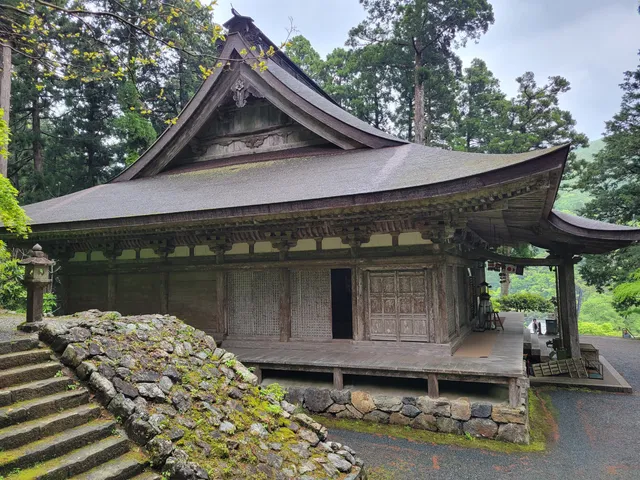
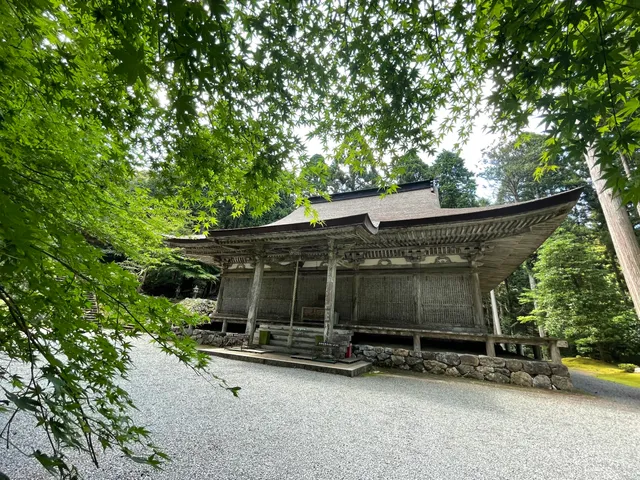
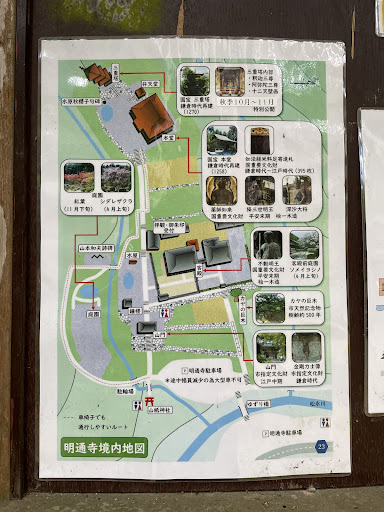
Myotsuji Temple : Myotsuji Temple is located in eastern part of Obama City. The temple belongs to Shingon sect of Buddhism. It was established in 806 when Sakanoue Tamuramaro curved three bodies of statuesout of one single trunk of an oak tree. The purpose of placing those statues in this place was to appease the spirits of aristocracies of his time as well as his wish for the peace. Tamuramaro was a general served for Imperial court who was on the mission to subjugate barbarians. Those three statues ( very important cultural assets ) are kept in the main hall of the temple. The one on the center is the main object of worship called Yakushi Nyorai Statue believed to have healing power with his left hand holding a cup filled with elixer ( heals all kind of illness). The rooftop of the main hall and three-story pagoda are elaborately constructed with bark of Japanese cypress called Hinoki. A wooden tatue of Fudomyo-o of this temple is another very important cultural asset, but this one was moved to Haga Temple also located in Obama City in an event of fire occured in 20th century.Those impressive structures of the temple are built in 13th century. The three-story pagoda is a symbolic structure of this temple. After passing through a point where you pay 500 yen to make your entrance to the main part of the temple there is a long fllight of stone steps leading your way to the main hall. Once you arrived at the main hall you will be welcomed by a priest of Myotsuji offering a guide inside. There are 3 ponds in its precincts where you can see many impressively colorful brocade Koi ( carps ) swiming. You are allowed to feed food sold at the temple for 100 yen. ( Trans-word+ : TGM...
Read moreObama has long prospered as a gateway for trade and cultural exchange with mainland Asia. Due to the many ancient temples and historical sites that still exist from that time, it is often referred to as "Nara by the Sea." Among these, eight temples designated as National Treasures or Important Cultural Properties of the nation or city are collectively called the "Eight Temples." This time, I visited some of them and the one that left the deepest impression on me was Myotsuji. It is said to have been founded in 806. Guarded by awe-inspiring Kongōrikishi statues at the mountain gate, visitors ascend gradually toward the main hall via gentle slopes and stone steps. With each step, a sense of calm fills the heart. The main hall and the three-story pagoda are the only National Treasures in Fukui Prefecture. The current main hall was rebuilt in 1258, while the pagoda was constructed in 1270. Both feature a serene appearance with their hinoki bark roofs. Inside the main hall, the chief priest explained the history of the temple and the Yakushi Nyorai seated statue enshrined at the front. As with the other temples, photography is not allowed, so I cannot show you any images. However, I truly believe it is worth visiting the place just to pay homage to the principal image, who's intense gaze felt as if it could draw you in. Renting a car is convenient for visiting temples, but you can also rent a bicycle to...
Read moreWe went late May, and although we miss the Sakura season and the beautiful garden flowers-it was still very majestic and serene. The temple is on the outskirts of Fukui; out in the countryside.
It’s so quiet here, we visited on a Saturday morning and were the only visitors. The monks scurried to meet us after we passed the temple gates at the top of the stairs. Further admission is 500 yen/per person. It’s worth it-there’s a beautiful pagoda at the top and the monk gave us a very nice tour.
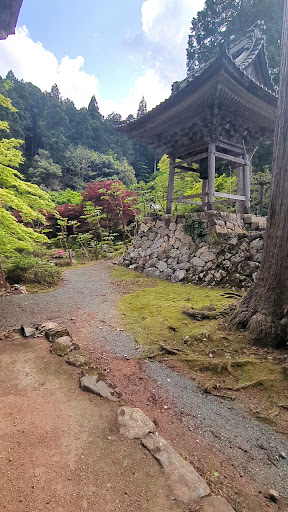
My only regret is not knowing enough Japanese to understand what could be some rich history here. There’s a pond to the left after you enter the temple gates, and the trees were red as if it had skipped over summer and into...
Read more