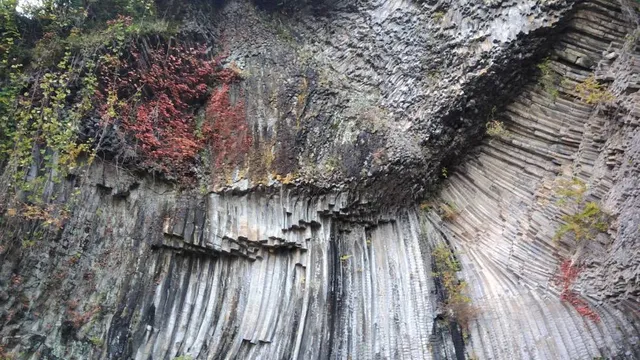
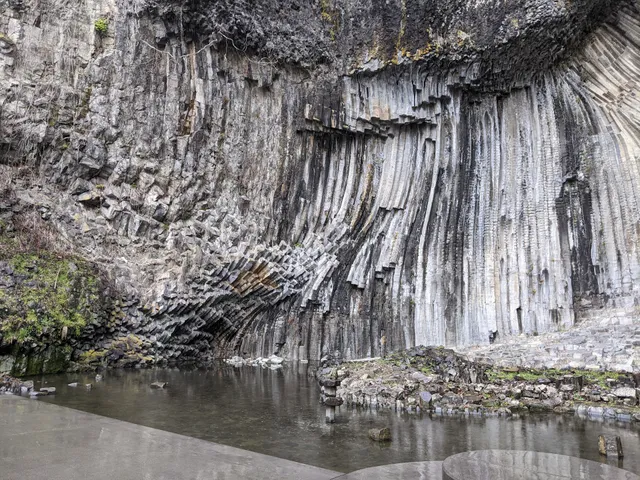
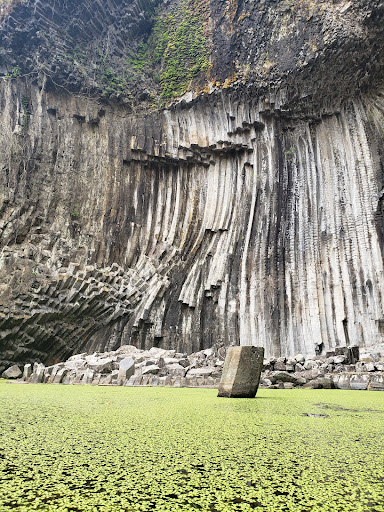
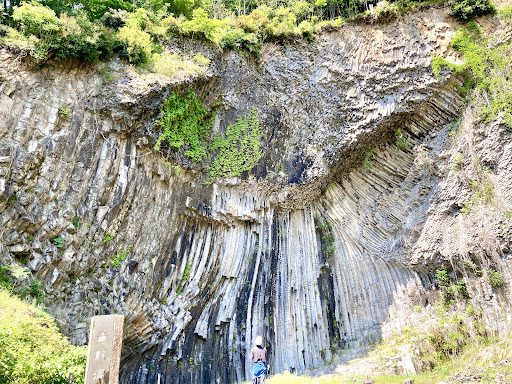
Genbudo Park ( Basalt Rock Cave Park ) is located in the southern part of Toyooka City of Hyogo Prefecture. As well as being a part of Sanin Coastal Geo Park has long been designated as a natural monument of Japan. The columnar joint rock of Genbudo was formed by an eruption of volcanic activity occurred approximately 1.6 million years ago as a result of reversal action of magnetic field of earth. It was discovered in 1931 that the direction of its magnetic flow was once running toward opposite direction from the current direction of magnetic flow. Those fine patterns of crevices on the rock are the result of terrestrial phenomenon formed when lave cooled down after volcanic eruption. Genbudo is the origin of naming association in Japanese term of Gembugan which is basalt. Genbu is a mythological monster creature in Japan which is a gigantic tortoise entwisted with a gigantic serpent considered to be a guardian of north. You can see those patterns on the rock suggesting scales of reptiles which has given such name to this rock. The entrance to the site is free. There are some onsite guide offering a tour providing two different courses for 300 yen and 500 yen per person. There are some information panels explaining about rock formation of each spot of highlight in English. There is a large parking space provided for visitors. If you wish to learn the details of its rock formation and history visit Genbudo Museum right next to the site. It is very easy to access here with JR Sanin West Line since it is very close to Genbudo Station.
Trans-word+ :...
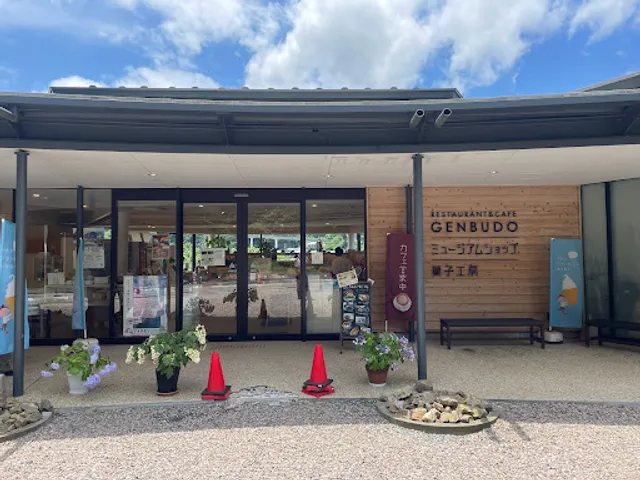
Read moreGembudo Park is a series of columnar volcanic formations dating back 1.6 million years. The path stops at several walls and caves that have been formed out of these unique geological phenomenon. The path is even made from hexagonal stone taken from where some of the volcanic rock has collapsed. For people going to Kinosaki Onsen, this is a great place to stop and spend 30-60 minutes. There are English signs as well so you can read about the history. There is also a gem/fossil store with other gifts, as well as a cafe/restaurant and a museum across the street. It is only about 10 minutes from Kinosaki and visitors coming by car will pass right by it....
Read more玄武洞は、玄武岩の名前の由来ともなった場所ですが、何よりも玄武洞は、地震発生のメカニズムを解明するきっかけとなった記念碑的場所で、世界的にも非常に重要な場所。
山口大学初代学長の松本基範(1884−1958)が、1926年に世界で初めて地磁気の逆転現象をここ玄武洞の地質によって発見(京都大学の紀要で1929年発表)。これはノーベル賞を取ってもおかしくないような大発見だったのですが、発表時点ではほとんど注目されていなかったようです。極東の地方の大学の紀要に掲載しても当時の日本の状況では世界的には、まったくノーマークだったのでしょう。
2年後にニールがパリ大学の紀要に検証した結果を発表。英国オックスフォード・ケンブリッジ(インド:デカン高原)でも、アメリカ(ロッキー山脈)でも検証されたことで松本の仮説が証明され、やっと世界的に認められたそうです。
地球を南北に走る地磁気は、方位磁石がその方向を示すように一定ですが、古い古い時代にはその方向が逆転していた時代があり、その時の地磁気の痕跡が、ここ玄武洞の地層に残っていたのです(現在は100万年に1回逆転することがわかっている)。
なぜその痕跡が残るのかというとキュリー温度よりも溶岩が冷えると地磁気がそのままその溶岩に残るから。したがって後で地球全体の地磁気が変わったとしてもこの痕跡は、そのまま残留磁気として残存。
それではなぜ地磁気の逆転が、地震解明の要因となったのでしょう。
それは地磁気の逆転現象を調査することで、特定の地層の磁力がどの方向に向いているのか、その地球の南北の角度からどのぐらいずれているのか、残留磁気の「伏角」の測定によって、その時代時代の地層の緯度が測定できるからです。なぜ時代ごとの緯度が測定できると地震の要因が解明できるのでしょう。
時代ごとのその場所の緯度がわかれば、おおよそのそれぞれの時代のその地層のあった緯度(日本は北緯40℃)が特定され、これによって地球の表面が動いていることが判明した結果、ウェゲナー(1880−1930)が唱えた大陸移動説が証明されたから。
例えば、東アジア大陸は、2億5千年前の地層の残留磁気を調査した結果、パンゲア時代(2億5千年前)のテージス海(古い地中海)の複数の島の集合体だということが判明。
地球の表面をこうやって、地質に残っている残留磁気を測定すれば、わずかずつ地球の表面が移動していることがわかったわけです。
これがプレートテクトニクス理論。
プレートテクトニクス理論の誕生によって、軽い大陸プレートの下に重い海洋プレートが沈み込むことがわかり、その沈み込む場所で地震が多く発生することがわかったわけです(他に火山要因もあり)。
例えば、東北地方では太平洋プレート(海洋プレート)が北米プレート(大陸プレート)に沈み込むことによって、関東以南や九州・四国では、フィリピンプレート(海洋プレート)が、ユーラシアプレート(大陸プレート)に沈み込むことによって発生。
具体的には、大陸プレートの跳ね上がり(リフトアップ)によって起きる場合(東北地方太平洋沖地震2011年)と、海洋プレートが沈み込むときに大陸プレートにある断層がずれて起きる場合(能登半島地震2024年。兵庫県南部地震1995年)とがあります。
このように、もちろん玄武洞での松本の地磁気逆転の発見がなくても、その後に西洋の科学者たちが地磁気逆転を発見したので、地震解明の要因となったプレートテクトニクス理論は生まれたでしょうが、世界で一番最初に松田が発見したきっかけは、ここ玄武洞であ...
Read more