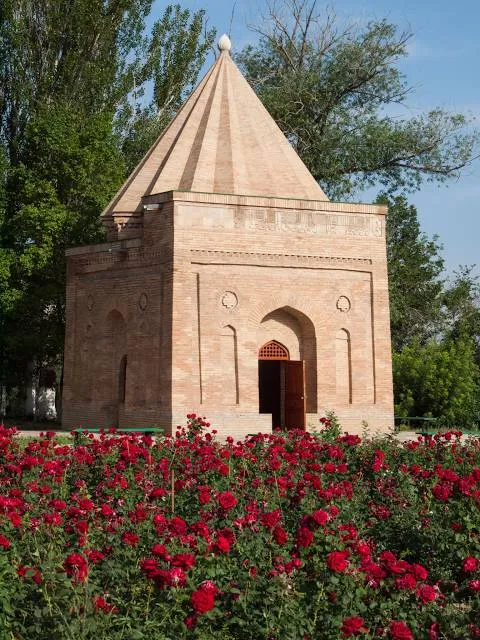
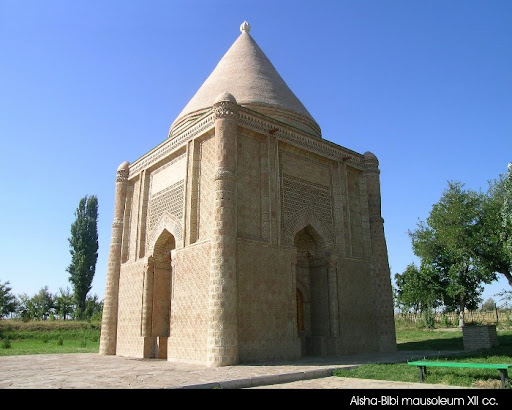
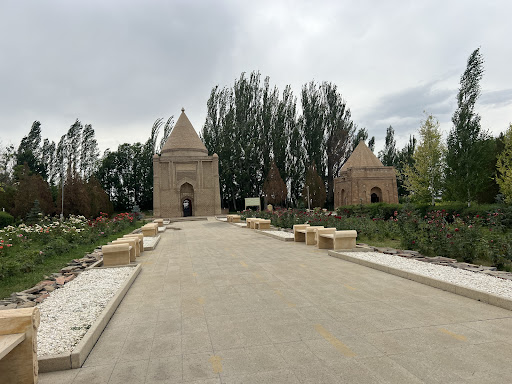
Architectural monument built between the eleventh and twelfth centuries, situated in the village by the same name, eighteen kilometers east of Taraz. Together with the mausoleum of Babadzha Khatun, it bears witness to a high standard of architecture. The original nature of the construction methods, the architectural forms and the decorative solutions found here, in the mausoleum of Babadzha Khatun and in other poorly preserved monuments dating from the tenth-twelfth centuries has led scholars to theorize the existence of a school of architecture in northern Turkestan, characterized by close bonds with the traditions of the steppes.
Studied at various times by eminent researchers of various nationalities, among the others the Russian archaeologist V.V. Barthold in 1893, the mausoleum was built on the orders of Karakhan (ca. 1042 - ca. 1052), the governor of the city of Taraz, in memory of Aysha Bibi, who was to have been his bride.
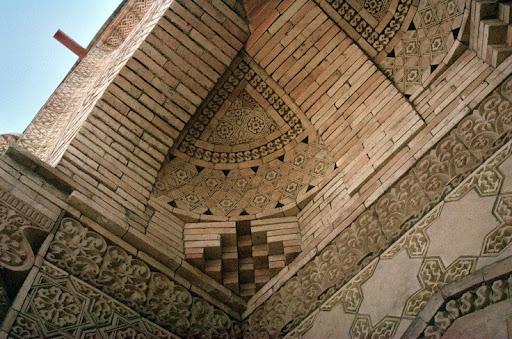
The building has a square floor plan of seven and a half meters, in the centre stands the tombstone (3 x 1.4 m). The interior walls are in raw brick, while on the outside they are clad in tiles with engraved geometric and floral motifs. It is possible to see more than sixty different types of decoration on the tiles used to embellish the exterior walls. These façades are identical: the terracotta panels help to create the illusion of masslessness typical of the Islamic architecture. At the same time, the terracotta decoration uses light and shadow rather than color to create movement on the facades according to the pre-Mongol style. Functionally, this type of decoration scatters the light so the viewer is not blinded as he might be from a smooth light colored wall in full sun. There are four entrances through niches, one on each side, equal in size and shape. On the corners there are four columns and at the point of constriction in each column there is band of calligraphy. In general they descrive the beauty of Aysha Bibi and of love in general: one of the old distichs reads: “Autumn … Clouds … The Earth is beautiful”. The conical roof that now soars above the mausoleum, is a modern addition, since the mausoleum never had either a dome or a conical roof. The mausoleum of Aysha Bibi was completely restored in 2004.
According to the most common and best-known legend, Aysha Bibi was the daughter of an important scholar and famous poet of the eleventh century, Khakim Suleyman Bykyrgan. After the death of her father, she was educated at the court of the sheik Aykozh. One day the governor of the city of Taraz, Karakhan Mukhammed (in honor of whom the Mausoleum of Taraz was erected) asked for her hand, which was refused by the sheikh in person, so the girl, with a subterfuge, tried to go to Taraz alone. However, her future husband never met her, because Aysha Bibi died on the banks of the river, bitten by a snake that had hidden in her headdress. Desolated by this sudden misfortune, Karakhan had a mausoleum built at the scene of the tragic event. Babadzha Katun, friend and handmaiden (she may have been the wet nurse, perhaps the servant) of Aysha Bibi, remained as the custodian of the mausoleum and on her death was buried in a tomb nearby.
According to another version, Aysha Bibi lived near the city of Tashkent around the eleventh or twelfth century. One day Karakhan, one of the governors of the state of Karakhanid, came to visit Aygozh, the father of the beautiful girl. The two young people immediately fell in love, but Karakhan had to return to Taraz to face attacks by his enemies and the two could not meet for some time. Aysha Bibi asked her father for permission to leave and go to Karakhan, but when her father refused she disobeyed him and left for Taraz in the company of forty handmaidens and servants. However, during the journey Aysha Bibi died of a snakebite. As the first version of the story tells us, Karakhan, as a sign of his love for the girl, had a commemorative...
Read more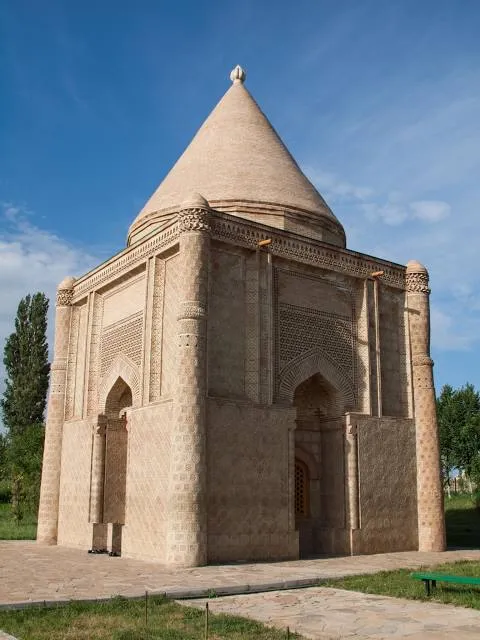
 Learn more insights from Wanderboat AI.