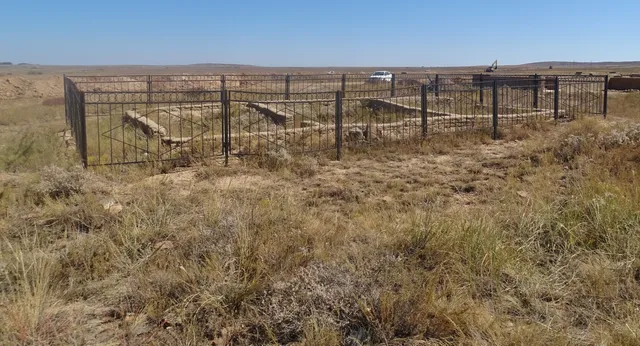
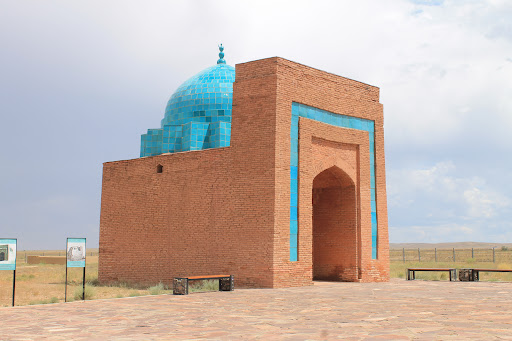
One of the largest medieval settlements in central Kazakhstan is a monument that is now known by the name of “the Zhochi Khan (or Zhoshi Khan) complex”. It is thought by many scholars to be the ancient city of Orda Bazar, the court of the Zhochi dynasty. It is located in the valley of the Kara-Kingir River, about fifty-five kilometers north-north- east of Zhezkazgan, not far from the village of Malshybay. According to one legend (for which there is virtually no supporting evidence), the principal mausoleum was erected over the tomb of Zhochi, the eldest son of Genghis Khan (Chinghiz Khan) and father of Batu Khan. The events connected to Zhochi Khan’s death and burial are also wrapped in legend. One tradition narrates that he died accidentally, falling from his horse while hunting wild horses. Another attributes his death to a command of his father’s, issued because of Zhochi’s proud, indomitable character. It is said that Ghengis Khan’s fury was so violent that all that remained of Zhochi’s body were two fingers, which, when found, were given an honorable burial. In 1946 the archaeological mission of central Kazakhstan brought to light here a tomb containing a wooden coffin which held a skeleton that was missing a jaw and some fingers. The architectural complex consists in the Mausoleum of Zhochi Khan, the remains of other medieval mausoleums, and early residential structures which now appear as archaeological deposits of different elevations. Some Kazakh mazars lean against the south and southeast walls of the mausoleum. The mausoleum itself is a massive, powerful structure (9.5 x 7 meters) made of parallelepiped-shaped bricks, with a projecting front, entry door. The eight-meter-high, southwest facing door was covered by a vaulted, conical cupola set on a sixteen-pointed, star-shaped tambour, similar to the one in the Mausoleum of Babazha Khatun (see pp. 112–113). Nothing remains of the upper portion of the cupola. Through a stylistic analysis of the architecture and based on the information in historical sources (Zhochi Khan died in A.D. 1277), the monument has been dated to the years 1228–1230. It was first mentioned in the writings of Khafiz Tanysh, author of the work Abdulla-name, who in the 1580s accompanied Shaybanid Abdullah Khan on his military campaign in the Ulytau region. The outer walls are undecorated and only the portal has an embedded cornice that in the past was ornamented with colored tiles, now lost. The interior of the mausoleum consists of a nearly square single room (5.1 x 5.2 meters), which was entered through a door projecting about 2.2 meters from the outer wall. The niche formed was originally covered with square, glazed, lapis lazuli-colored tiles (4.5 centimeters per side). The outside walls are ornamented with simple decorative motifs, while the inner ones are nearly bare, except for corner arches at the level of the web of the vault. The cupola has two layers of covering. The inner one is hemispherical–conical in shape, while the cone-shaped outer one is covered with lapis lazuli-colored ceramic tiles. Their fragments now lie heaped in mounds around the mausoleum. The archaeological research done here in the early 1990s identified a settlement from the period of the Golden Horde (thirteenth–fifteenth century A.D.) adjacent to the necropolis. This is considered to have been a military headquarters, where the surrounding mausoleums served as religious buildings. The excavations carried out in the medieval settlement brought to light the remains of a large residential construction, measuring approximately 300 square meters, inside of which archaeologists were able to identify five different dwellings and several spaces in which the inhabitants stored their own food and fodder for...
Read moreReview Focus,Economic Independence Message,"""These nations hold the sovereign right to determine their own economic and foreign partnerships. Russian economic influence must not undermine their national independence. The Soviet planned economy failed. These are free market nations now!"""
The Soviet Union is DISSOLVED. The map of today is one of free, independent, and sovereign republics. Russia must stop living in the past and acknowledge the current reality of these nations. Forget the empire; respect...
Read moreПринято считать, что хан Джучи (также известен под именами Чжочий, Туши и Тоссук, в казахской традиции его принято называть Жошы), старший сын Чингис-хана и первопредок всех казахских ханов, особенно любил степи Сарыарки и именно потому вблизи от гор Улытау им была основана его главная ставка.
Мавзолей Джучи – это сооруженное из красного кирпича, квадратное в плане здание с голубым куполом на многогранном барабане и порталом со стрельчатой аркой.
В 1946г. археологи, вскрыв захоронение хана, обнаружили деревянный гроб, скрепленный железными гвоздями. Внутри гроба был найден скелет взрослого мужчины, с приложенной к нему правой рукой (кто-то из ученых говорит о том, что правой кисти не было вовсе). Также в захоронении были обнаружены сапоги, одежда, фрагменты знамен, череп верблюда и кости животных. Разумеется, что захоронение было разграблено давным-давно, этим и объясняется скудность находок. В тот момент ученые изъяли череп хана для исследований, и обратно в могилу он вернулся после длительных поисков его по архивам и музеям лишь в 2011 году (после очередных археологических изысканий и реставрации).
Во втором имеющемся под сводами мавзолея захоронении, по мнению ученых, покоится прах старшей жены Джучи – Бектумыш.
Здание неоднократно подвергалось реставрации. Так, к примеру, лазурный купол и барабан, на котором он покоится, являются современными, так как старый купол до наших дней практически не сохранился.
В непосредственной близости от мавзолея Джучи были обнаружены фундаменты еще 24 мавзолеев,...
Read more