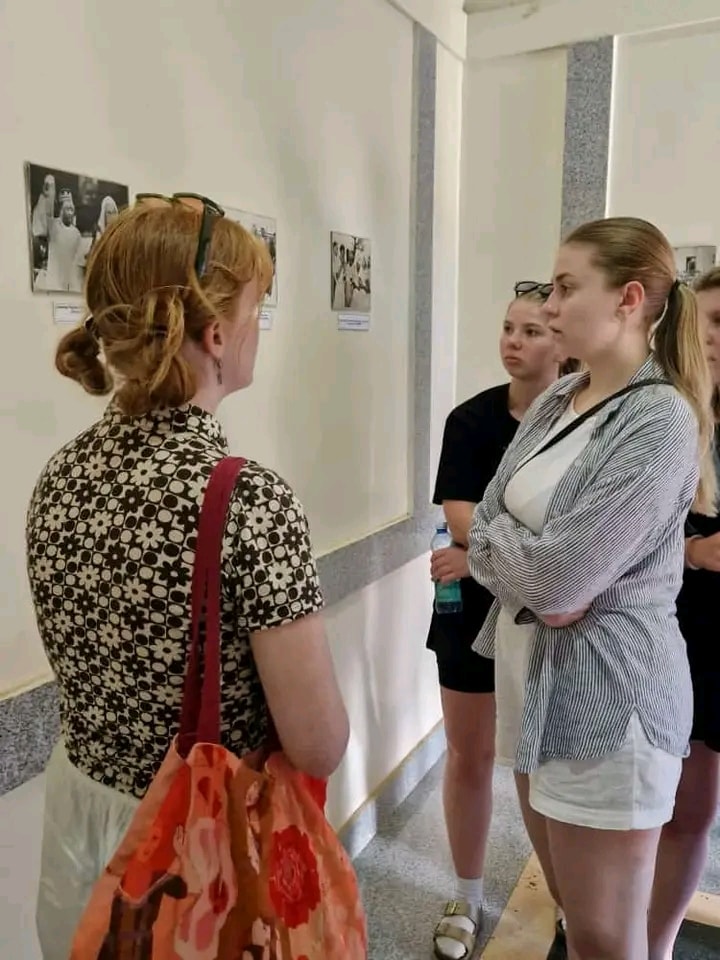
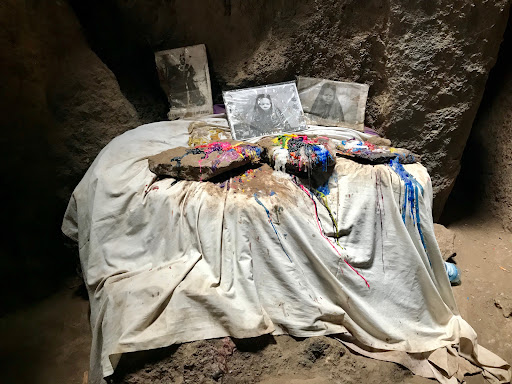
A great tourists attraction within Kombewa, Kisumu County, along Kisumu-Bondo Road. When you alight within the site, you'll find the local residents to be welcoming and friendly beyond your imagination. Before visiting the site, you'll be required to visit the guides always available within the site's guide office (Information Office) next to the entrance in which you'll have to pay at least Ksh.500 or more. This fee is paid for the support of the site and the residential people guiding, welcoming visitors and protecting the site. The site is considered to be sacred and also the pilgrimage of the Legion Maria. Within the site, you'll see the pictures and the symbolism of Simeo Ondeto, the founder of Legion Maria. Prayers and dances are being conducted within the place. I think they do this to appease the the spirits of the founders (dead). KIT MIKAYI literally means - The Stone Of The First Lady (In which KIT(Kidi) means Stone and Mikayi means The First Lady married to a man. Luo people depended on polygamous family planning during the times of our forefathers in which the first wife to be married they called Mikayi, the second Nyachira, the third Rero. You're all welcomed within the site to see all the adventures by yourselves and explore it all to the world. According to me I found the site to be extremely interesting to me...but what about you because am not sure whether if that pleases me will please you but I urge you to move from where you're and add paces to explore what is being hidden beyond your knowledge.
NB: Kidi - Luo word meaning Stone. Kit - Luo word meaning the stone of. Mikayi - Luo word meaning The First Lady The standing stone and progress of a home.
Nyachira - Luo word meaning The Second Lady The one responsible to fulfill when Mikayi is not responsible.
Rero - Luo word meaning The Third and The Rest Ladies. The one belonging where she is not supposed to be.
Kombewa - Luo word meaning Sitting...
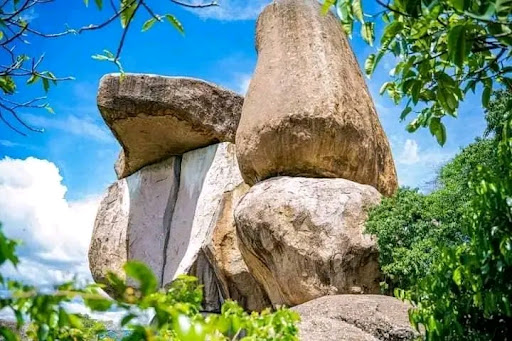
Read moreExistence of Kit Mikayi 'Kit Mikayi' as it is called is an unusual stone formation in Kisumu County. The name is a Luo dialect meaning 'The Stone of the First Wife'. It is located along Kisumu- Bondo highway roughly 30km from Kisumu CBD.
Long ago, there was an old man called Ngeso who was in love with the stone. He could wake up early in the morning and walk into the cave that was made by the stone.
He stayed there for long and this forced his wife to bring him breakfast and lunch each and every single day he went there.
Ngeso could go to the cave every day and when his fellow elders come seeking for him at his home, the wife could tell them he has gone to visit his first wife 'Mikayi' hence the name 'Kit Mikayi'. This meant that the stone was Ngeso's first wife.
The structure in which the stone is arranged reflects the cultural polygamous nature of the Luo community. 'Mikayi' the first wife's house is in the middle and the largest, on its left-hand side lies the third wife's house 'Reru'. On the right-hand side of the homestead lies the second wife's 'Nyachira' house.
The stone also reflects a nuclear family evident in the Luo community whereby the father who is Ngeso being the middle stone followed by first wife (Mikayi), then the second wife (Nyachira) and then third wife (Reru). At the furthest end lies the first son, who represents 'Simba' the House of the firstborn boy in the homestead.
The locals of Seme village in Kisumu county where 'Kit Mikayi' is located consider the stone a sacred place to hold prayers whenever the village...
Read moreKit-Mikayi — also spelled Kit Mikayi, Kitmikayi, and Kitmikaye — is a rock formation, a tor, around 120 m high[1] situated about 29 km west of the town of Kisumu in western Kenya. It is about 1 km from the Kisumu-Bondo road This rock is also seen to have a nuclear family whereby the father (Ngeso) being the middle stone followed by the bulky Mikayi (first wife), then Nyachira (second wife) followed by Reru (third wife) and further in front they have the child which is representing Simba (which is the house for the first born boy in the homestead). From a long time, this stone has been a sacred place for the villagers to worship in times...
Read more