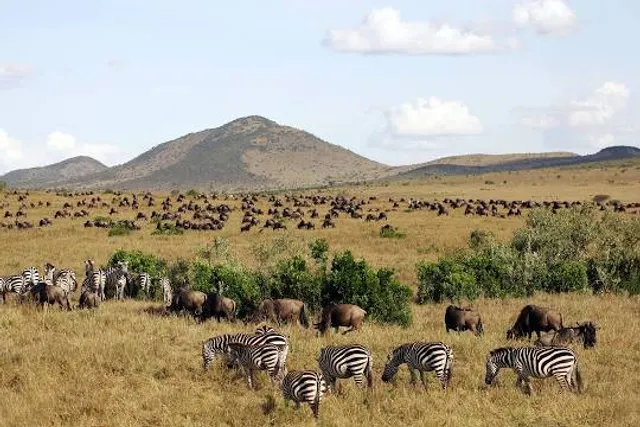
Our plan to visit the Mara was delayed by the COVID19 pandemic and we were so thrilled to finally be able to go. The Great Migration is the largest animal migration in the world and involves over two million animals, including wildebeest, zebras, and gazelles, migrating from the Serengeti in Tanzania to the Masai Mara in Kenya. The migration occurs throughout the year, but the best time to view it is between July and November. The migration attracts many other species because so many animals rely on wildebeest and zebra for food. This makes for unique sightings of diverse species.
Around January each year, the migration will be finishing a southward trek, moving along the eastern edge of the Serengeti and into the Ngorongoro Conservation Area. Here the plains are rich in nutritious grass, providing the herds with the best conditions for raising their newborn calves.
After bearing their young in February and March, around April the wildebeest herds begin to drift northwest toward the fresher grass of the central Serengeti, drawing with them thousands of zebra and smaller groups of antelope. By May, columns of wildebeest stretch for several kilometres as the animals start to congregate by the Moru Kopjes. Mating season begins toward the end of May and male wildebeest battle head-to-head. Throughout 'the rut,' the journey continues at leisure with the wildebeest, zebra and gazelle grazing as they go along.
During June, the dry season starts with large concentrations of wildebeest in the Western Serengeti and on the southern banks of the Grumeti River. Each migrating animal must face the challenge of crossing the crocodile-infested river — the first of many daunting and tense river encounters.
As June moves into July, the hundreds of thousands of wildebeest and zebra continue to head north along the western edge of the park toward an even riskier barrier: the Mara River in the north of the Serengeti. These river crossings are arguably one of the most exciting wildlife events on Earth. They usually begin at the onset of high season in July, but timing all depends on nature.
By August, the herds have faced the challenge of crossing the Mara River and are spread throughout the Masai Mara's northern region, with many remaining in the northern Serengeti. In years when the river is in full flow, the panic and confusion at the crossings — combined with waiting predators and surging currents — can cause massive loss of life. But, even in years of relatively gently flowing water, the crocs take their toll, not to mention the lions and other large predators that patrol the banks, ready to ambush any wildebeest that make it to the other side. There is no single crossing: at some spots, there are just a few individuals, while others see a mass of animals moving without break for hours.
By September to October, the main chaos has ended and the migrating columns have gradually moved eastward. However, they wildebeest will face the heavy waters of the Mara River once more as they prepare to cross once again for their return journey southward.
After the East African short rains in late October and early November, the wildebeest move down from Kenya and into the eastern limits of the Serengeti past Namiri Plains, an area known for outstanding cheetah sightings. By December, they are spread throughout the eastern and southern reaches.
In the early months of the new year, the grasses in the deep south of the Serengeti are lush with rain. This draws the herds of wildebeest and hundreds of thousands of zebra and other plains animals. The cycle continues as the calving season...
Read moreThis park is a natural wonder of the world. However, I have seen that the park management is not prepared to preserve its natural beauty. Corrupt rangers and overly enthusiastic drivers are not respecting the park's fragile state. This is certainly a big difference from the game reserves where animals were hunted for sport, but there is still clear room for improvement.
I recently visited for a safari in the park and was blown away by the natural beauty. Our guide took us close to the animals for several very cool natural events. During many times I wondered to myself if the cars were too close for the animals' comfort. I would eventually be proved correct.
My driver had gotten notice that there was a rhino spotted in a corner of the park, so we sped to that area. When we arrived to the area we saw a few cars stopped on the side of a bush area, where we were told the rhino was hiding. We waited outside of this area and saw the rhino through some bushes. After about an hour we rounded the bushes and looked from the other side. At this point the cars were off the road, right at the edge of some thicker vegetation. It could be seen that the rhino was about 10m from the car inside of that dense vegetation.
Suddenly one car decided to penetrate the dense vegetated area, trampling high bushes to get closer to the rhino. Other cars followed suit. This caused the rhino to get protective. It was protecting a child! The rhino lunged towards one of the intruding cars and rammed its front bumper a few times. The cars retreated and then followed the rhinos after they left the bush area.
Clearly the drivers had crossed a line. They had not only endangered the safety of their passengers but also had trampled tall bushy vegetation, threatening the long term presence of the bushed area. All this to be nature's paparazzi.
You may wonder to yourself if there is any system in place that would prevent this danger to wildlife and safety from happening. Actually, during my trip (before the rhino incident) our guide was actually pulled over for driving off road. This surprised me as almost all of the other guide cars were going off road. In addition, our guide ended up paying (1500ksh) much less than the actual fine of the park (20000 ksh) for driving off road. The actual paid amount could easily be covered by a tourist's tip at the end of the day. This shows that there is a huge disconnect between standards and enforcement!
At this point I cannot say that the drivers are at fault. The drivers I observed at the rhinos were from multiple different camps. The park must change its enforcement system, and its management, soon. Otherwise new roads will continue to damage the landscape, wildlife will be more distressed and the splendor of this natural area will diminish. I hope the management learns a lesson from...
Read moreThe Maasai Mara, often simply called "The Mara," is a world-renowned national game reserve located in Narok County, Kenya. It's an iconic destination for wildlife safaris and is considered one of Africa's greatest wildlife reserves. Here's a breakdown of what makes the Maasai Mara so special: Name Origin: It's named in honor of the Maasai people, the indigenous inhabitants of the area, who are known for their distinctive culture and traditional pastoralist lifestyle. The word "Mara" means "spotted" in the Maasai language (Maa), referring to the landscape dotted with short bushy trees and acacia trees. Location and Ecosystem: The Maasai Mara is situated in southwestern Kenya and forms the northernmost section of the larger Mara-Serengeti ecosystem, which extends into Tanzania with the Serengeti National Park. This shared ecosystem allows for the continuous movement of wildlife. Incredible Wildlife: The Maasai Mara is famous for its exceptional concentration of diverse wildlife. It's home to: The "Big Five": Lion, leopard, elephant, rhinoceros (both black and white, though black rhinos are critically endangered and rarer to spot), and Cape buffalo. Numerous other animals, including cheetahs, zebras, giraffes, wildebeest, hippos, crocodiles, hyenas, and various antelope species like topi, impala, and eland. Over 500 species of birds, including many raptors. The Great Migration: This is arguably the most spectacular natural phenomenon associated with the Maasai Mara. Every year, from approximately July to October, over a million wildebeest, accompanied by zebras and gazelles, migrate from the Serengeti to the Maasai Mara in search of greener pastures. This involves perilous river crossings (especially the Mara River, which is teeming with crocodiles) and dramatic predator-prey interactions, making it a truly awe-inspiring spectacle. Landscape: The reserve is characterized by vast, open rolling grasslands, acacia woodlands, riverine forests along its major rivers (the Mara, Talek, and Sand rivers), and some swamps and escarpments. This varied habitat supports the incredible diversity of wildlife. Conservation and Management: The Maasai Mara National Reserve is managed by the local county councils (Narok and Transmara). There are also privately owned conservancies bordering the main reserve. These conservancies are managed in partnership with the Maasai communities, allowing for more exclusive safari experiences and direct benefits to the local people, while also promoting conservation efforts. Safari Experience: The Maasai Mara offers a quintessential African safari experience. Visitors can enjoy: Game drives: Exploring the plains in 4x4 vehicles to spot wildlife. Hot air balloon safaris: Offering a breathtaking aerial perspective of the landscape...
Read more