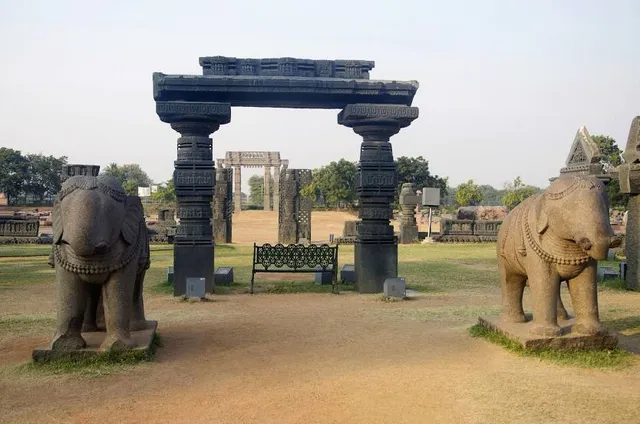
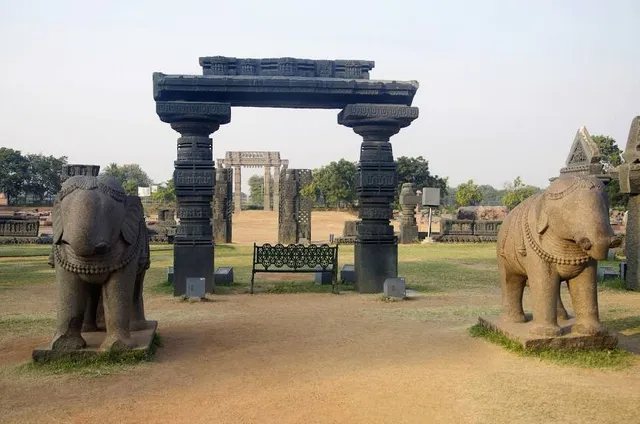
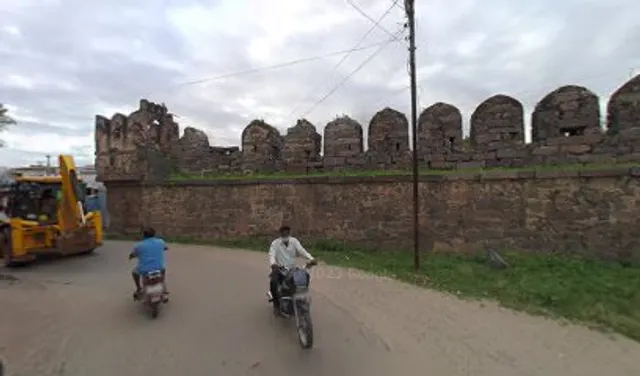
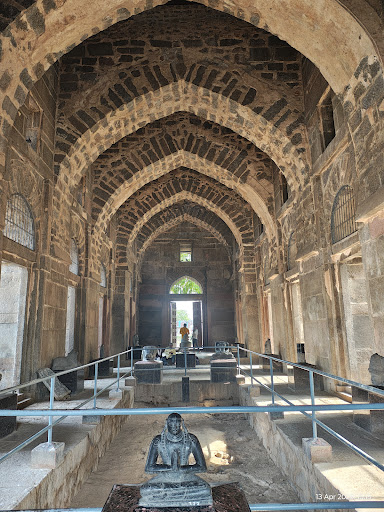
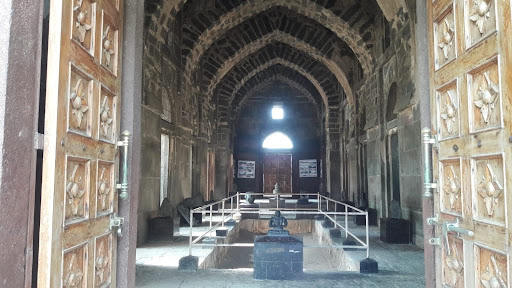
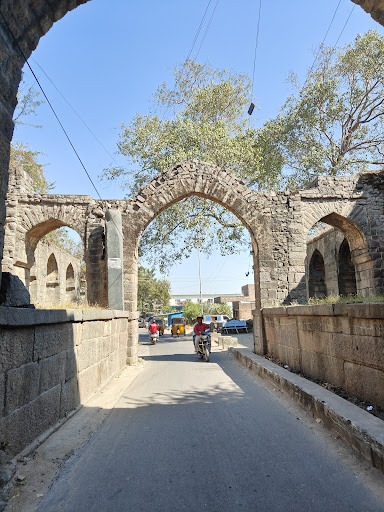
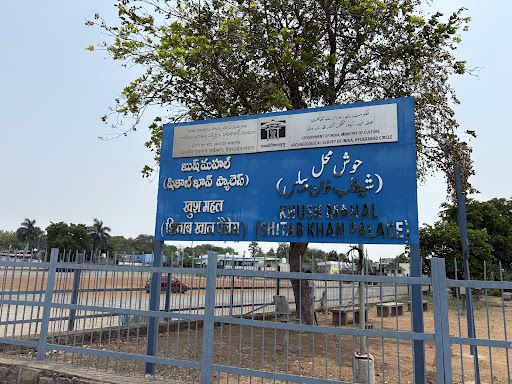
Khush Mahal, near Warangal Fort built in Islamic architectural style during Tughluq reign. Khush Mahal is an audience hall which was built around 14th century at the time of Tughlaq rule. It was later used by Shitab Khan who was Qutub Shahi Dynasty Governor of Warangal in 16th century. Khush Mahal is consisted of a huge chamber with arch opening on four sides with slanting walls. This sturdy looking structure has withstood the ravages of many decades, presenting an impressive architecture. The sculptures of Hindu, Jain religion and fort structural components with inscriptions un-earthed near the Fort and elsewhere in Telangana State are under display in this Kush Mahal. INSCRIPTIONS Ganapatideva’s reign year inscription (No: 338) is (Inscriptions of Warangal District (Reprint 2016), Page No: 219 to 220), on a conical stone inside the Kush Mahal. Registers certain gifts to the god Somanathadeva of Mathiyavada made by the nagara, trading in five metals (pancha-lohalu) the nagara of the perfumes, bachu-made nakhara (money exchange guild) pomkakude-nagarams (guild of arecanut dealers ?) and samta-nagara (guild of the fair merchants) during the reign of Ganapatideva Maharaja. Another Ganapatideva’s reign year inscription is ((No: 338), Annual Reports on Indian Epigraphy 1957-58, Page No: 24), in Kush Mahal. This fragmentary inscription is on the four sides of the broken pillar kept in front of Khush Mahal in the fort. Registers the gift of levies on certain articles as vritti to god Somanathadeva of Matiyavada by certain mercantile communities. Published in Hyd. Arch. Series, No. 13, p. 53, No. 11. Ganapatideva’s reign inscription (No. 339, Annual Reports on Indian Epigraphy 1957-58, Page No: 25) is in Kush Mahal. This inscription is on a pillar in two fragments kept in front of Khush Mahal in the fort. Records the gift of levies on various articles in cash or in kind for worship and offerings to god...
Read moreKush Mahal, located within the historic Warangal Fort, is a magnificent example of Indo-Islamic architecture. Believed to have been built during the Tughlaq or Qutb Shahi periods, this structure features distinctive slanting walls and high arches, reflecting the grandeur of its time. It stands as a testament to the architectural excellence of medieval India, once serving as an audience hall. Today, Kush Mahal has been repurposed into a fascinating museum. It houses a collection of valuable artifacts and ruins unearthed from the surrounding areas. The displays showcase various sculptures, some of which are from the earlier Kakatiya dynasty, and include Hindu and Jain deities, providing a glimpse into the region’s rich history and diverse heritage. The museum’s collection is thoughtfully displayed, allowing visitors to appreciate the intricate craftsmanship of the past. Walking through the hall, you can see fragmented sculptures and other archaeological remains, each telling a story of the fort's long and complex history. Entry to Kush Mahal is included with the nominal fee for Warangal Fort, making it an accessible and rewarding experience. This blend of historical architecture and a curated collection of artifacts makes Kush Mahal a must-visit for anyone interested in the layered history...
Read moreKush Mahal is a historic structure located in Warangal, Telangana, India. It is believed to have been built during the Bahmani or Qutb Shahi period after the fall of the Kakatiya dynasty. The structure is a blend of Indo-Islamic architecture, with arched doorways and a simple yet elegant design.
Kush Mahal is a lesser-known but significant historical structure located near the Warangal Fort in Telangana. It is believed to have been built during the Bahmani or Qutb Shahi rule, after the fall of the Kakatiya dynasty in the 14th century. The structure is thought to have served as a military or administrative building under the rule of later Islamic dynasties.
Warangal was originally the capital of the Kakatiya dynasty, which ruled between the 12th and 14th centuries. After the decline of the Kakatiyas, the region came under the control of the Delhi Sultanate, Bahmani Sultanate, and later the Qutb Shahi dynasty of Golconda. Kush Mahal was likely constructed during this transition, reflecting a mix of Persian and Indian...
Read more