Nicely preserved tower with lot of historic details, the museum , stone figurines and the awesome mountain views add the Cherry. The entry to the tower in the staircase was closed due to renovation.
World Heritage Site 10th-14th centuries
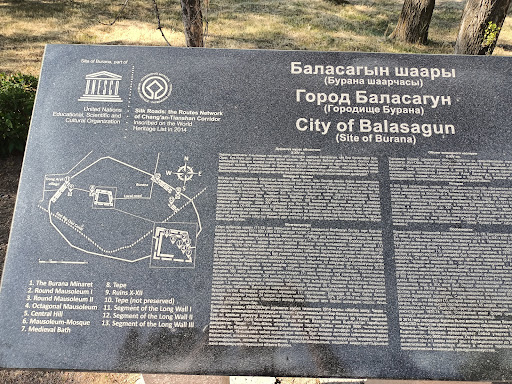
Burana has been identified as the medieval settlement of Balasagun (also known as Quz-Ordu or Quz-Ulush), founded in the early tenth century. The most noticeable structure at this site is the "Burana Tower (1), a medieval minaret made of fired brick. It dates from the late tenth century and is considered to be the earliest surviving minaret in Central Asia. Followers of Islam, Syro-Nestorianism, and Buddhism lived in Balasagun, which was an important stop on the Silk Roads and a place of intercultural exchange History
In 940, Balasagun was conquered by the Qarakhanids, the first Turkic dynasty that officially converted to Islam. It became their capital, along with Kashgar, and remained the main city of the eastern part of the empire after its split into the Eastern and Western Khaganates in 1041-1042. It became the capital of the Qara Khitai empire (also known as the Western Liaol in the 1130s, and from 1211 to 1218 was the capital of the Naimans (a Turkic tribe). The Mongols renamed the city Gobalyk after their conquest in the early 13th century, and it lasted as such until the 14th century. The history of Balasagun is a vivid example of how Muslim cities developed in the northeastern part of Central Asia during the Middle Ages. Balasaguri is mentioned in a range of written sources and was immortalized by Yusuf Balasaguni, who is known to have authored the first work in the Turkic language a poem entitled Qutadgu Bilig (Graceful Knowledge) Site Layout and Archaeological Findings
Burana is a site with long walls (11-13). The central part (5) of the settlement is a quadrangle, with sides measuring 570, 500, 600, and 570 meters. Some of its towered walls still rise as high as four meters. An outer suburb (9), rabad, was surrounded by two concentric rings of ramparts, with the outermost one reaching 17-20 kilometers. Aminaret (1) made of fired brick stands close to the east wall of the city center. Amedieval Muslim necropolis was found to the east and northeast of the minaret in the excavations of 1970-1974, along with the lower sections of three mausoleums (2-4) also built from fired brick. The fourth mausoleum (6) which has a different layout, is located in the northwest part of the fortified inner city (shakhristan) in it were found two gravestones (kairak) with epitaphs that have the nisba (Arab-Muslim name) of al-Balasagunt. The complex was in use in the 11th-12th centuries. In the late 1970s, the ruins of a hamam bathhouse (7) and the remains of a water supply system were uncovered 300 meters from the southeast corner of the shakhristan. A Christian necropolis dating from the 12th-14th centuries was found south of the shakhristan in the 19th century, The. remains of Buddhist sculptures were discovered at the turn of the current century on one of the surviving tepe (8) artificial earthen mounds one-and-a-half kilometers east of the minaret. The most famous preserved structure at Balasagun is the minaret (1), which was part of a grand mosque that no longer exists. Though it once reached a height of around 45 meters, it now stands at 24. meters high, About a third of the minaret visible today was reconstructed in 1970-1974. The minaret is shaped like a tapered cylinder with an interior spiral staircase.
In 2014, the Burana site was included in the UNESCO World Heritage List as a component of the "Silk Roads: the Routes Network of Chang'an-Tianshan Corridor which was nominated jointly by China, Kazakhstan, and Kyrgyzstan, The corridor is a 5,000-km section of the Silk Roads that took shape between the second century BC and first century AD, remaining in use until the 16th century. It linked multiple civilizations and facilitated far reaching exchanges of activities in trade, religious beliefs, scientific knowledge, technological innovation, cultural practices,...
Read more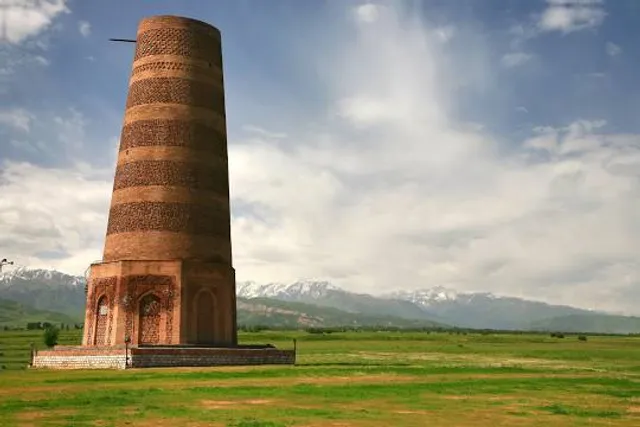
 Learn more insights from Wanderboat AI.