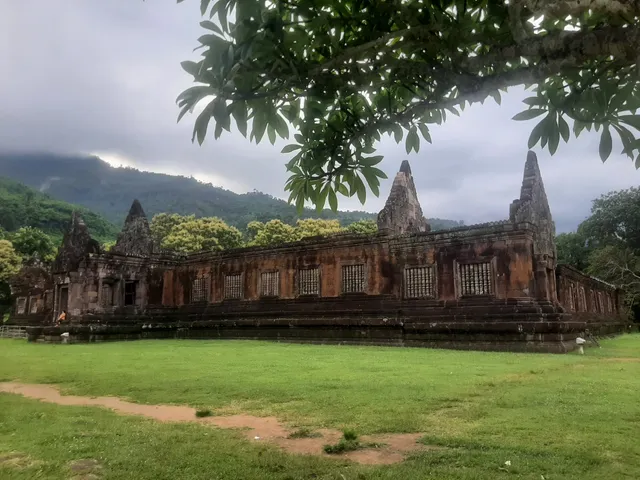
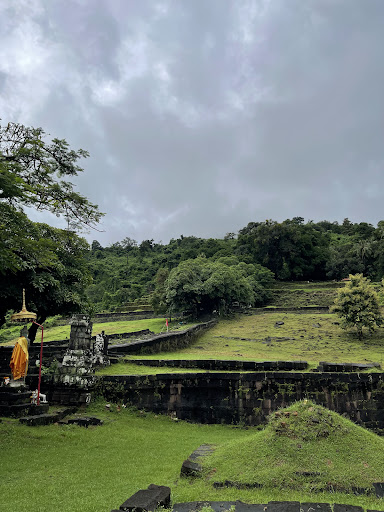
Vat Phou is a beautiful and significant Khmer temple in Champasak, Laos, renowned for its symbolic design, architectural evolution, and stunning natural setting. A UNESCO World Heritage Site since 2001, it is an outstanding example of the integration of a symbolic landscape with religious beliefs.
Unique Architectural and Symbolic Features 🗿 Vat Phou's beauty lies in its purposeful design, which reflects a Hindu vision of the relationship between nature and humanity. The complex is laid out along a central axis, with its structures stretching over 1.4 kilometers from the Mekong River to the base of Mount Phou Kao.
Sacred Mountain: The temple is situated at the foot of Mount Phou Kao, which the ancient Khmer believed was a sacred mountain due to a lingam-shaped rock formation on its summit. This natural feature was seen as a manifestation of Shiva, one of the principal deities in Hinduism. The temple's layout was designed to represent the spiritual universe, with the mountain as the home of the gods and the river representing the cosmic ocean.
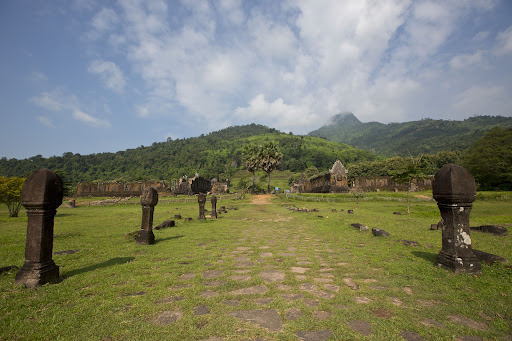
Processional Pathway: The complex features a long, processional walkway lined with ancient frangipani trees and ceremonial ponds (barays). This pathway leads visitors on a symbolic ascent, creating a feeling of pilgrimage and spiritual progression as they climb toward the main sanctuary.
Architectural Evolution: The site showcases the development of Khmer architecture over several centuries, with structures dating from the 7th to the 13th centuries. The main buildings, including the two quadrangular palaces on the lower level and the main sanctuary on the upper terrace, are built from laterite and intricately carved sandstone. The carvings and lintels depict various Hindu deities and mythological scenes, showcasing the exceptional artistry and craftsmanship of the time.
A Fusion of Cultures and Beliefs 🕉️ Originally built as a Hindu temple dedicated to the god Shiva, Vat Phou was later converted into a Buddhist monastery in the 13th century. This transition is evident in the blend of Hindu and Buddhist elements found throughout the complex. While many Hindu carvings and structures remain, the main sanctuary now houses Buddha images and is still an active place of worship for local Buddhists. This cultural fusion adds another layer to its historical and spiritual significance.
Breathtaking Setting and Serenity ✨ Beyond its architectural and historical value, Vat Phou is beautiful because of its tranquil and picturesque setting. The temple's tiered design allows for panoramic views of the surrounding plains and the Mekong River, making the climb to the top a rewarding experience. The ruins, overgrown in parts by ancient trees, evoke a sense of timelessness and connection with nature, which was a core part of its original design. The relative lack of crowds compared to more famous sites like Angkor Wat in Cambodia also contributes to a serene and reflective atmosphere, allowing visitors to fully appreciate its...
Read moreWat Phu is a Khmer Historical site, approximately 49 kilometres South West of Pakse. Travel time from Pakse is around one hour and is an easy run on a motorbike, across the bridge and down the western bank of the Mekong. There is plenty of signposting on the way but if you’re in doubt just use the Google maps tracker. The historical site is approx. six kilometres back from the river and tucked in against Phou Khao (mountain). Once you arrive at the carpark you’ll be pleasantly surprised by how well set up the site is. There is an entrance area with the obligatory entry fee to pay plus a nice restaurant and souvenir shop. The entry fee is about USD 5 which includes a tuk-tuk ride along a grassy track between the Barrays. The distance from the entrance to the drop off point is roughly two kilometres. However there is little shade on the way so if you decide to walk, be prepared to perspire. The approach to the historical site itself is by way of a cobblestoned path which is flanked by evenly spaced metre high columns. This wide pathway is the approach to the palace ruins. If you’ve visited other Khmer sites in Cambodia or Thailand the similarities in building construction and art work are easily identifiable as one gets closer. The two opposing stone buildings are the North and South palaces with both being in various states of disrepair. Beyond the palaces is another stone pathway leading up to the seven sandstone terraces. At the top of the terraces is a sanctuary with some Khmer/Hindu carved figurines, similar to those seen at Angkor, on the outer wall corners. Within the sanctuary are a number of Buddha statues adding some colour to the rustic grey and brown hues of the sandstone. Behind the sanctuary are some interesting features. Directly to the rear is a flat granite cliff face with a number of small freshwater springs trickling out from the overhang. Along the base of the cliff a small track leads off to the right and ascends to a little plateau where a large footprint has been carved into the smooth face of the cliff. Apparently it is a representation of the Buddha’s foot. Dropping back down to the grassy flat area just behind the sanctuary, another trail leads off to the left where more rock carvings can be seen. The first and most imposing is that of an elephant, carved into a boulder almost the same size as a full sized tusked behemoth. Another flat rock has a depiction of a crocodile carved into it. The crocodile stone has acquired some notoriety as being possibly the site of an annual human sacrifice described in a sixth century Chinese text; the identification is lent some plausibility by the similarity of the crocodiles dimensions and those of a human. After taking some time to view the sanctuary and the surrounding stone carvings some nice photos can be taken from the edge of the plateau, looking out over the ruins...
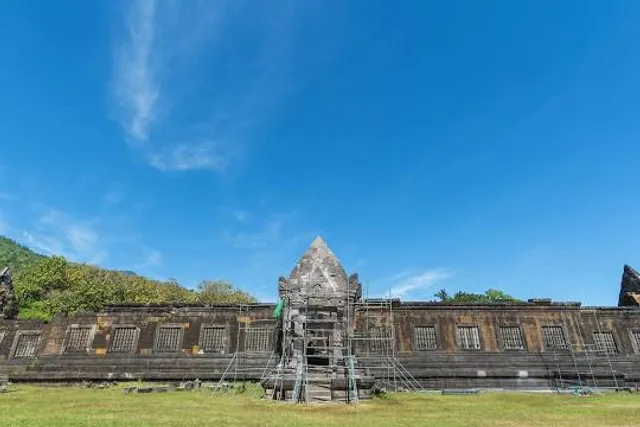
Read moreThis place is worth the walk! When you are at the visitors museum area, there is a car the comes to pick you up to take you to the drop off point where you start your walk upwards. The two temple ruins at eh base have so much detail put into it, it's worth walking inside the stone. Make sure you are wearing tennis shoes because there is a staircase that is extremely steep and also has tiny ledges so make sure to hold onto something on the way up and down. At the summit has a place where they sell water which is about 7000 Kip for the large bottles. The top has beautiful ruins of an old temple, but take the time to look around the temple as well. To the far left of the monk's house, there is a carving of an elephant, but if you follow the back walls of the mountain you'll come across a broken old staircase and some sort of sacrificial slab. A lot of people actually miss this when coming here so many people do not know about it. To the right of the temple ruins is a small well. The inside of the temple definitely shows it age, but please do take off your shoes before you enter just to show respect. If you turn around and stand at the ledge, you can actually see the two base temples and the road that car took. It's such a wonderful sight! If anyone takes the time to go through the visitor's center, I highly recommend that people donate so that they can maintain the ruins. I did read that France and India were helping with the reconstructions! The visitor's center has ancient artifacts incased on the left and information and the history to the right side. Right at the entrance is a book where people write on what the center can improve on or your take on the place. I thought that it was really interesting to see many languages written in there. I too wrote something in the book as well!...
Read more