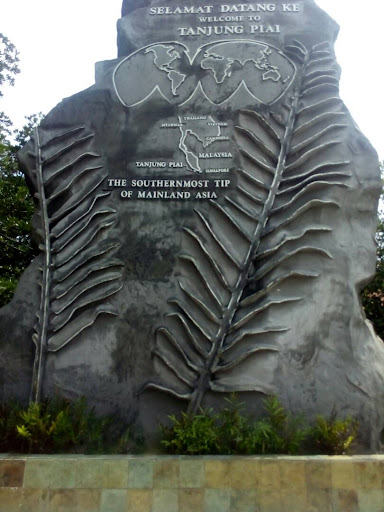
Tanjung Piai is named after a local fern, known as the “Paku Piai’ which is capable of living in brackish conditions. The park covers 526 hectares of mangroves and another 400 hectares of inter-tidal mudflats. It was declared a Ramsar Site on 31 January 2003.
Tanjung Piai is a cape of Pontian, Johor and is a must place to visit due to its many unique features. Geographically, it is known as the Southernmost Tip of Mainland Asia. The hinterland of Tanjung Piai offers the rural charms of remote villages, rich in their ethnic and cultural diversity. Tanjung Piai gives you a chance to experience rural life in proximity and also its natural wonders.
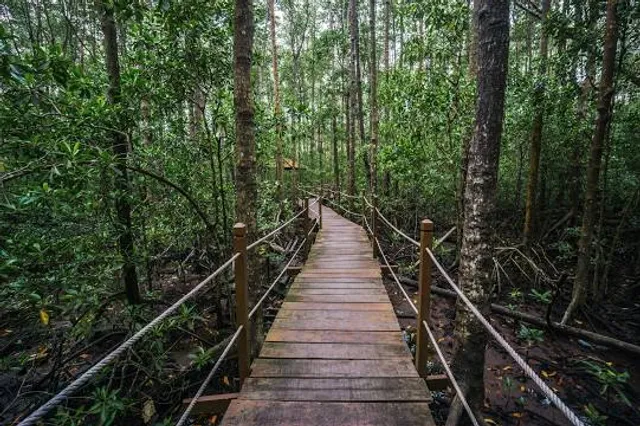
It is an excellent place for tourists and nature-lovers to experience the scenic coastal mangroves. Visitors can enjoy the long boardwalks that provide a good opportunity for bird watching and also observing the various species of animals living there. Rich in flora and fauna and is home to about 20 ‘true’ mangrove species and 9 related mangrove species, 3 types of primates, one endangered bird called the Lesser Adjuntant Stork (Leptoptilus Javanicus), mangrove crabs and mudskippers. Mangrove roots bind soils in place and prevent coastal erosion, filter salt water from intruding into the water table and provide food and shelter for fish, crabs, prawns and other animal species. With such high species diversity in a small area, the visit will be just as educational for everyone. Best time for birdwatchers to visit is between September and March, during the bird migratory season.
Directions: From Kuala Lumpur (KL) / Johor Bahru (JB)
The fastest route is via the North-South highway. Exit at Simpang Renggam (after Machap). Head to Pontian/Benut and follow the signboards to Tanjung Piai.
From Johor Bahru, take the Jalan Skudai and head for Pontian/Pontian Kechil. At Pekan Nenas, turn left at Sri Bunian, follow the rural road and take the right turn at Jalan Tenggayun. Thereafter, follow the signage to Pekan Pontian, reach a cross junction then turn left to Tanjung Piai.
Public Transportation
There is no direct bus service Tanjung Piai Johor National Park. A regular taxi service is available from Pontian bus station, in the town centre, to Sg. Belukang entry point. (You will have to book in advance with the cab driver for the...
Read moreTanjung Piai Johor National Park is known as the southernmost tip of mainland Asia, located in the Pontian District of Johor, Malaysia. It features a variety of ecosystems, including mangroves, wetlands, and coastal habitats.
Key Highlights:
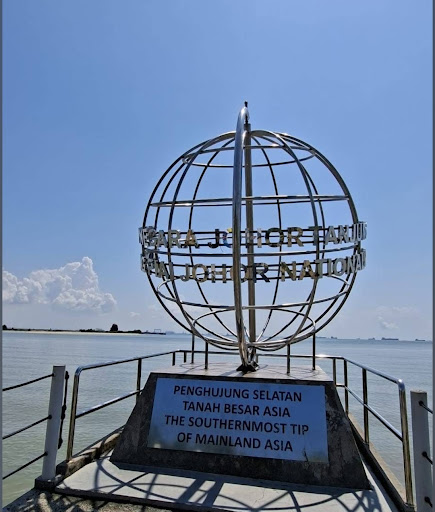
Southernmost Point: This is the main draw. The park marks the southernmost point of mainland Asia. A globe-shaped monument and plaque clearly denote this important location. Mangrove Forests: The park consists of 926 hectares, with 526 hectares of coastal mangroves and 400 hectares of inter tidal mudflats. Boardwalks allow you to easily explore the dense mangrove forests. Wildlife: Keep an eye out for mudskippers, crabs, lizards, and various bird species. The park is also home to long tailed macaques and dusky leaf monkeys. Activities: The park offers self-guided walks, guided tours, nature education packages, bird watching, fishing, and even an obstacle course. Camping is also available with advance booking.
Opening Hours: Open daily, but closed on Wednesdays. Hours are from 9:00 AM to 4:30 PM. Entrance Fee: RM20 for adults Singaporean.
As a leader, when I rode to Kukup, I recommended Tanjung Piai to the group of cyclists under my lead, as it's one of the iconic key points when near Kukup. I highly recommend this place to anyone visiting Kukup. Before reaching Kukup, I made sure we all stopped at Taman Negara Johor Tanjung Piai. For those who hadn't been before, this is an absolute MUST for a photo op. We all had to get our "I was here!" pictures to mark the occasion. A great stop to stretch our legs and appreciate a...
Read moreEducational for kids & adults because many wildlives are in the photos & in jars, also some in Jungle or Junk-le? To prohibit the bad habits from humans is the best for the animals & plants to inhabit in their habitat. A National Park with lots of disposables indicates a national/international problem of improper disposals. This tip is just a tip of the iceberg, though no iceberg near the Equator. Thanks for the irrational emotions & non-objective objections, which were correct in 1970s, some urgently needed modern & clean incinerators have no timeframe to be built, any cleanup action would just shift the rubbish from Point A to Point B. Johor coal-fired power stations can be seen in this Park, but a much better option: a world-class Tokyo style 'Waste to Energy' Power Station (20 in use in the most densely populated Japanese city) mentioned in a Malaysian press conference, was delayed a few times in Johor. Without high temperature Ash Melting Furace for pollutants decomposition, resources recovery & volume reduction; the contaminations & destructions caused by landfills, coal mining & washing, ash deposition & etc are yet to be resolved. Entrance fee is nothing when compared to fuel or car rental costs. 2 way taxi (important or else...stuck) is at least RM 200 plus (very likely) surcharges due to reluctant, rejective, unhelpful & unfriendly drivers. Opening hours make it impossible to see sunrise or sunset. Not many major attractions nearby, once not twice maybe still worth for 4 people who expect to spend 4 days or more in JB. Wheelchair accessible boardwalks make this National Park...
Read more