Great place to visit. Free entrance. Calm and quiet. Lovely for site scene. Amazing large natural cave.
Kek Lok Tong (sometimes spelt as Kek Look Tong) is translated as Cave of Ultimate Bliss (or Great Happiness) and indeed it does seem to bring a feeling of well-being to the many local visitors who regard it as their favourite among Ipoh's many splendid cave temples.
The cave has been used as a place of worship since the 1920's but during the 1960's the area was engaged in iron ore mining and parts of the cave were excavated for this activity.
When mining ceased it was dedicated again to religious purposes and opened to visitors in the 1970s. The floor of the cave has been levelled and paved and much of the lower walls are lined with marble tiles. The roof and upper walls however remain in their natural state with some impressive stalactite formations.
Benches have been installed together with railings and staircases. Being a spacious cavern with large openings at each end, it enjoys good natural lighting and a refreshing breeze blows through the cave.
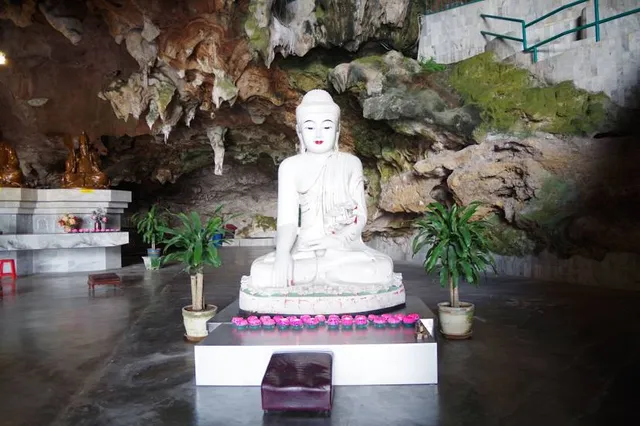
This airy atmosphere makes it a popular place for people to come and sit, relax and reflect in the company of a number of metal Buddhist and Taoist statues which were cast in Taiwan.
Next to the car park is a statue of Kuan Yin and a pond with turtles. The stairs from the car park are actually on the rear side of the cave. The stairs have been curved to resemble the shape of a carp's tail and the large opening at the other end of the cave where the laughing Buddha sits is supposed to be the carp's mouth. I can't quite see it myself!
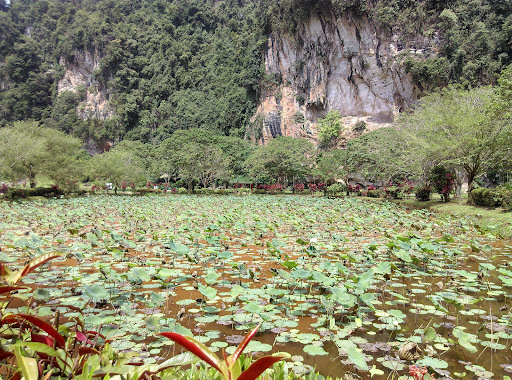
The Buddha enjoys a lovely view of the landscaped gardens which surround a couple of small lakes (remnants no doubt of earlier mining activity).
Steps lead down from the cave to the jogging/walking path circling the first lake where a sign directs you to walk round in a clockwise direction. I wonder what happens if you go anti-clockwise - does it upset the harmony and spiritual energy of the place?
The gardens include gazebos, a reflexology path and a massive electricity pylon (out of site from the Buddha statue's vantage point). A cement plant is also visible behind a screen of trees but it does not really spoil the beauty...
Read moreThe cave temple sits on a 12 acre site and was used as early as 1920 as a place of worship. In 1960, the cave became part of an iron mining site operated by the late Mr. Chooi Ah Kee. The mining operation used excavators to enlarge the cave entrance to allow lorry access through the cave to transport loads laden with iron ore. Mr. Chooi started clean up of a small prayer section of the cave, originally named 'Tien Hou Gong'. In 1982, 'Tien Hou Gong' was handed over by the son of Mr. Chooi to a non-profit charitable organization, Kek Look Seah and the cave temple was renamed 'Kek Look Tong'. The committee of Kek Look Seah took on development of the cave by enlarging the cave, as well as reclaiming the swampy area near the rear entrance using soil and earth from a nearby hillock. The floor of the cave has been filled and then paved into a flat surface while parts of the rough cave wall are lined with marble tiling. The impressive stalactites and stalagmite formations however were left alone. Recognizing that the shape of the cave resembles a carp, renovations to develop the cave have been done mindful of this theme. The front entrance of the cave is likened to the head of the dragon carp, its mouth open to the heavens. The stairs leading downwards to the rear cave entrance symbolizes the throat of the carp, the cavernous back entrance the belly of the fish. There are even gill-like limestone formations on both sides of the "head" and a curious evergreen hanging rock formation, covered with moss, at the hind cavern that resembles the gallbladder. And finally, the pronged flight of stairs that descent unto the car park and pond was specifically made to resemble the tail of a carp. Today, the reclaimed area around the rear cave entrance is host to a beautiful garden as well as a large car park for the convenience of visitors. The area is under continuous landscaping projects such as a pond filled with carp and an artificial waterfall. Kek Look Tong is a unique and fascinating place not...
Read moreGua Kek Look Tong, located in Ipoh, Malaysia, is a renowned cave temple known for its impressive limestone formations and beautiful gardens.
Established as a place of worship in the 1920s, it temporarily became part of an iron mining site in the 1960s before being restored and reopened for religious activities in the 1970s.
The name "Kek Look Tong" translates to "Cave of Ultimate Bliss," and it certainly lives up to its name by offering visitors a peaceful and scenic environment amidst the natural beauty of the limestone caves.
Inside the temple, you will find a variety of Buddhist and Taoist deities. Notable statues include Manjushri Bodhisattva, Maitreya Bodhisattva, Samantabhadra Bodhisattva, Wei Tuo Bodhisattva, Ksitigarbha Bodhisattva, and Vairocana Buddha.
There are also Taoist deities, reflecting the temple's diverse spiritual significance. The temple complex features stunning landscapes, including award-winning gardens and serene lakes, remnants of the cave's past as a mining site.
One of the unique activities at Gua Kek Look Tong is the availability of bicycle and paddle boat rentals.
Visitors can choose to cycle around the temple's picturesque surroundings on tandem bikes designed for two or four people. Paddle boats, which allow you to explore the tranquil lake, are also available, although they were under maintenance during your visit.
The temple is also home to a variety of wildlife, including geese, turtles, and occasionally monkeys, adding to the charm of the location.
Overall, Gua Kek Look Tong is a must-visit spot in Ipoh for its unique combination of natural beauty, cultural heritage, and recreational activities.
Whether you're exploring the cave's intricate formations, enjoying a peaceful walk in the gardens, or cycling around the lake, it offers a memorable experience...
Read more