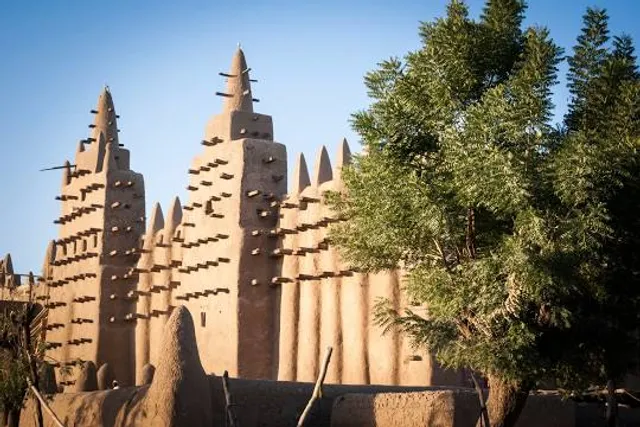
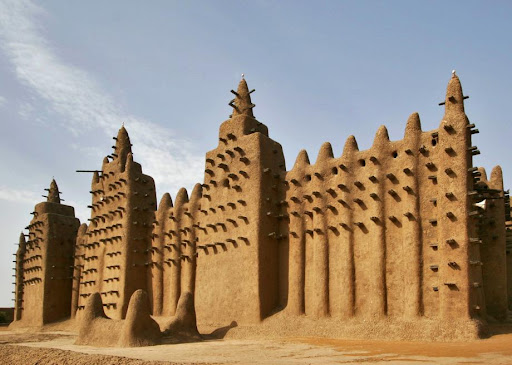
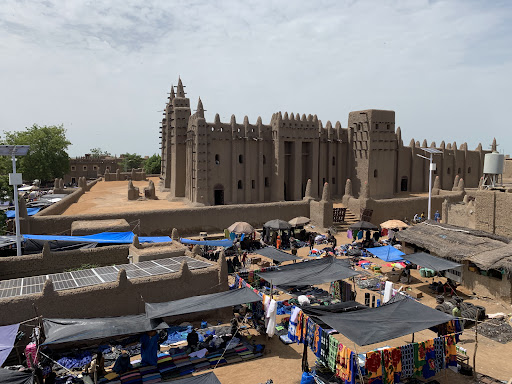
Great Mosque of Djenne, Mali is one of the wonders of Africa, and one of the most unique religious buildings in the world, the Great Mosque of Djenné, in present-day Mali, is also the greatest achievement of Sudano-Sahelian architecture (Sudano-Sahelian refers to the Sudanian and Sahel grassland of West Africa). It is also the largest mud-built structure in the world. We experience its monumentality from afar as it dwarfs the city of Djenné. Imagine arriving at the towering mosque from the neighborhoods of low-rise adobe houses that comprise the city.
Djenné was founded between 800 and 1250 C.E., and it flourished as a great center of commerce, learning, and Islam, which had been practiced from the beginning of the 13th century. Soon thereafter, the Great Mosque became one of the most important buildings in town primarily because it became a political symbol for local residents and for colonial powers like the French who took control of Mali in 1892. Over the centuries, the Great Mosque has become the epicenter of the religious and cultural life of Mali, and the community of Djenné. It is also the site of a unique annual festival called the Crepissage de la Grand Mosquée (Plastering of the Great Mosque).
The Great Mosque that we see today is its third reconstruction, completed in 1907. According to legend, the original Great Mosque was probably erected in the 13th century, when King Koi Konboro—Djenné’s twenty-sixth ruler and its first Muslim sultan (king)—decided to use local materials and traditional design techniques to build a place of Muslim worship in town. King Konboro’s successors and the town’s rulers added two towers to the mosque and surrounded the main building with a wall. The mosque compound continued to expand over the centuries, and by the 16th century, popular accounts claimed half of Djenné’s population could fit in the...
Read moreA sacred mud-brick building that towers over an ancient trading city in West Africa.
The first mud-brick Great Mosque at the Malian town of Djenné was built around 700 years ago. The current building was constructed in 1906–1907, when Mali was ruled by a French colonial administration. A local master-builder, Ismaila Traoré, was responsible for the work, employing long-established mud-building techniques.
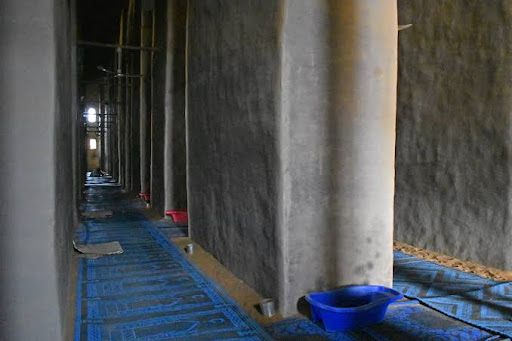
A changing structure. The bricks of the mosque were made by mixing mud and sand with husks and straw, then drying them in sunshine. The flat earthen roof is supported by pillars rising from the sand floor. The walls are protected against the elements by a layer of plaster, composed of river silt mixed with other materials that may include dry rice husks and cow manure. The plaster has to be reapplied almost every year, an activity that has become a ceremony in which the whole community joins. The constant repairs to the structure mean that the detail of its appearance is...
Read moreI have never visited The Great Mosque of Djenne in person, yet I have watched many television documentaries. It is by far the largest building in the entire world made of mud. What happens when it rains you may be asking- Seeing it is in the middle of our planets largest desert, this problem does not come up to often and when it does, the entire community comes together to gather, mix and apply fresh mud to shore up the damage the rain brings to the mosques massive walls. Don’t go buying a ticket and picking your seat by the emergency exit just yet, westerners are not allowed inside due to a film company violating the great building by filming an illegal type of...
Read more