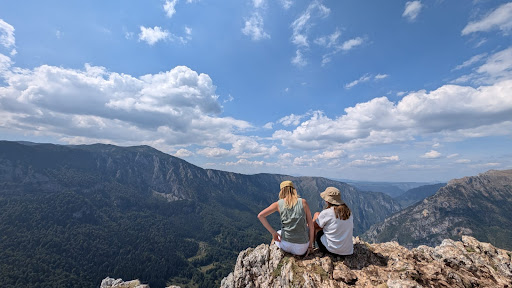
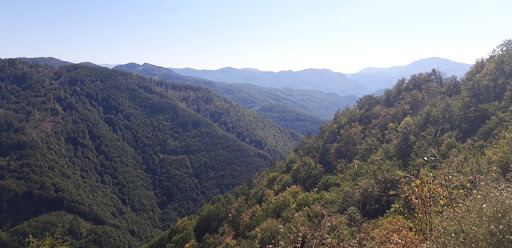
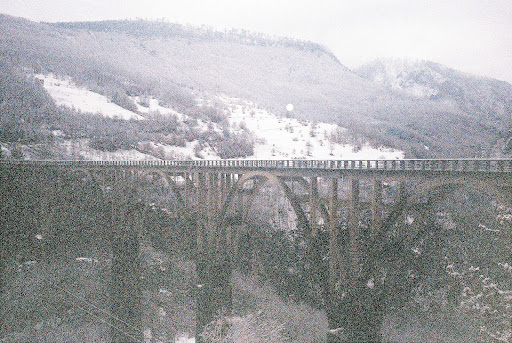
Tara River Canyon (Montenegrin / Bosnian: Кањон ријеке Таре / Kanjon rijeke Tare, pronounced [kǎɲɔːn târɛː]), also known as the Tara River Gorge, is a canyon in Montenegro and Bosnia and Herzegovina, through which runs the Tara River. Measuring from near Bistrica in Montenegro to Hum in Bosnia and Herzegovina it is 82 kilometers (51 miles) long, with the last 36 kilometers forming the border between Bosnia and Herzegovina and Montenegro. The canyon at its deepest is around 1,300 meters (4,300 feet) deep. These parameters make the Tara River Canyon one of the deepest river canyons in Europe.
The canyon stretch within Montenegro is protected as a part of Durmitor National Park and is a UNESCO World Heritage Site.
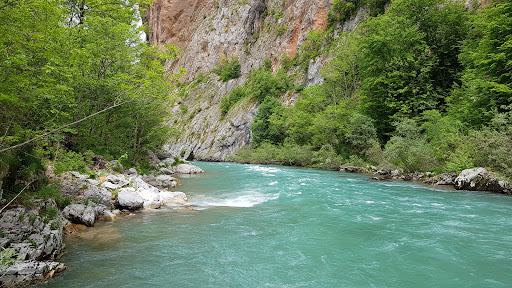
The Tara River becomes the Drina at the point of confluence with the Piva near Hum, and is some hundred and fifty kilometers long at that point. In its passage through the Durmitor National Park, the river has a mean fall of 3.6 meters/kilometer, with a host of cascades, making it whitewater between category 2 and 4.
All along its flow, the Tara gets large quantities of water from numerous abundant wellsprings and few very short tributaries. The most important tributaries on the left bank of the Tara are the Ljutica and the Sušica, and the most important tributaries on the right bank are the Vaskovaćka Rijeka and the Draga. The most important wellspring is the Bajlovića Sige, a source located on the left bank of the Tara river, giving to the Tara a few hundred liters per second, where the water pouring from the Bučevica Cave falls into the Tara more than thirty metres high, and more than a hundred and fifty meters wide. Very special are the Tara cascades. The roar from the cascades is heard on the very peaks of the canyon. There are more than forty cascades, the most famous being Đavolje Lazi, Sokolovina, Bijeli Kamen, Gornji Tepački Buk, Donji Tepački Buk, etc. Because of the quality of its water, and because of its unique ecological system, Tara in 1977 was put into the program “Čovjek i biosfera” (Human and Biosphere) and inscribed into the ecological biosphere reservations of the World, being thus protected under an internationally issued convention.
There are rocky and pebbly terraces, sandy beaches, high cliffs, and more than 80 large caves along the canyon. The river Tara itself, together with its parent extension river, the Drina river, is Europe's main habitat and spawning ground for huchen...
Read more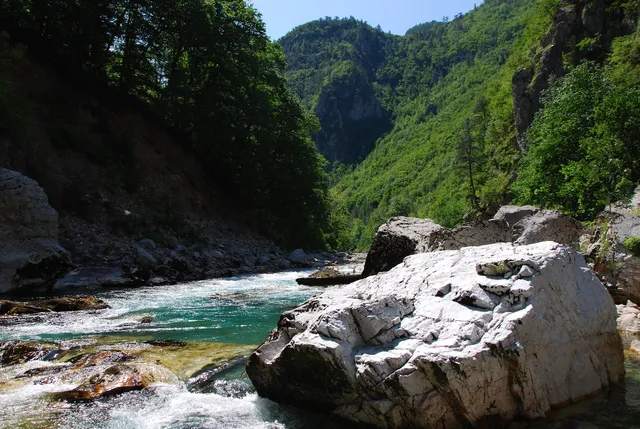
 Learn more insights from Wanderboat AI.