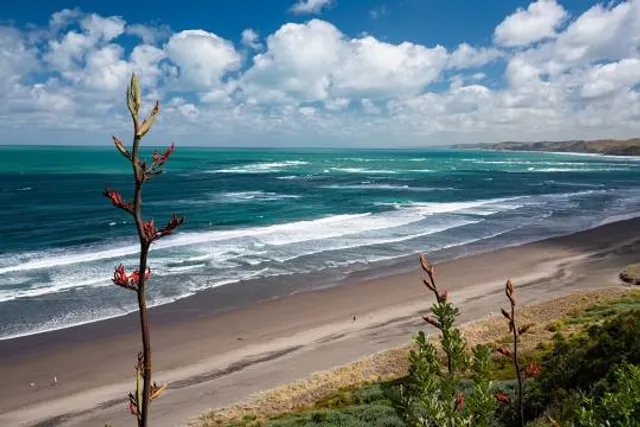
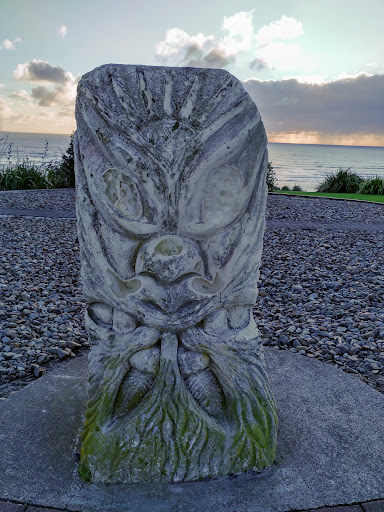
Ngarunui (sometimes called Ocean Beach, Main Beach or Wainui Beach) is the main sandy swimming beach in Raglan in New Zealand. A magnificent blacksand surfing beach, it’s ideal for swimming, is perfect for learning to surf or simply sunbathing on the sand. The beach has an area patrolled by surf lifesavers (October to April) immediately in front of the access trail to the beach. Quite a physical workout This breach is no good for physically weak ppl or small children. The pull of the undertow is very strong. Ngarunui Beach is located in Raglan, North Island of New Zealand. The best waves are given with SW swell. It is an open spot to the sea with a sandy bottom whose best waves are in spring and autumn. The spot offers good left and right-hander waves working with all the heights of the tide. Raglan town and Ngarunui beach rest in the shadow of an ancient volcano; Mt. Karioi that, translated from Maori means to loiter, or stand by idly. This is a nice expression of an extinct volcano about 2.4 million years old, that in its hay-day was a regular eruptive ragamuffin but now just sits and watches. Cliffs at the south end of the beach contain deposits of volcanic ash and lapilli that once rained down on the surrounding area, plus bouldery mudflows, or lahars, that were probably pretty destructive. A few fossil sea shells are caught up in some of the volcanic sediments indicating that the shoreline 2.4 million years ago may have lapped upon its outer flanks.The beach at Ngarunui has black sand, or iron-sand like many west coast North Island beaches. Sand here consists mostly of the iron-bearing mineral titanomagnetite (a titanium-bearing form of magnetite – magnetite itself is an iron oxide), plus a few other dark green or black minerals like hornblende and pyroxene, that likely originated from volcanoes on Taranaki Peninsula, about 120km to the south. The Taranaki volcanoes were eroded and the resulting iron-bearing sands distributed north and south along the shore and continental shelf. In summer, the dry sands become very hot, as anyone lacking appropriate footwear will attest to (even second-degree burns). The iron-sands have been used locally to produce steel. Karioi is one of four volcanoes (the others are Pirongia, Kakapuku, and Te Kawa) that all erupted over a period lasting from 3.7 to 1.8 million years (Te Kawa is the youngest). Erupted lavas were mostly basalts. Karioi’s original volcanic edifice of can still be recognised but it has been eroded into steep ridges and ravines, that now are clad in native forest. The south side of the volcano can also be accessed from...
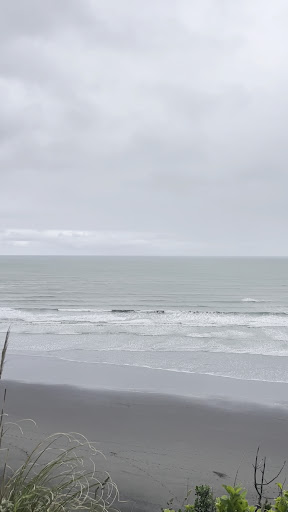
Read moreWe walked down to the beach from the Bryant Memorial Scenic Reserve track. The beach is quite big but it wasn't too busy. We were there when it was overcast which could have played a part. The main lifeguard tower was very visible from the beach. We strolled in that direction on the black sand. It was an enjoyable walk. There wasn't much shade along the beach so it would be good to bring something if you were planning on staying out there for a while. It looked like it was an uphill climb to get to the carpark from the beach. The waves were fairly big and there were quite a few people out on board which is not surprising. We didn't go for a swim this time around but it did look like a nice place to...
Read moreNice beach. Decent access, if you have bad knees better be careful and take it slow on the descent.
Multiple parking areas.
There are pit latrines for usage. Women's was the worst smelling ever, I don't know if these ever get maintained, well obviously because of the toilet paper and soap replenished.
But the I almost teared up and threw up walking in. It was horrendous.
Besides the bathroom, the beach was nice. Black sand, luckily it was not a really hot sunny day so the beach was cool.
Crazy breaks and the paddle would have been far. There were also bathrooms, changing rooms, and showers at the base of the hill before reaching the beach.
There was a leash rule for the dogs, but it was...
Read more