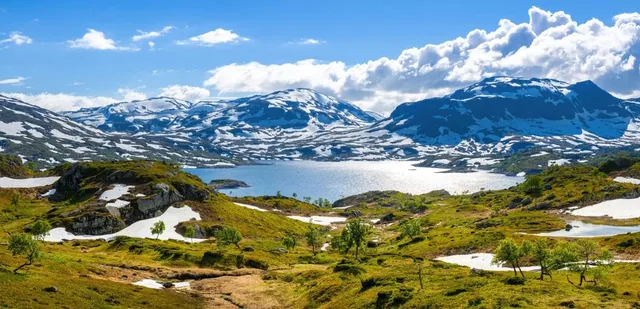
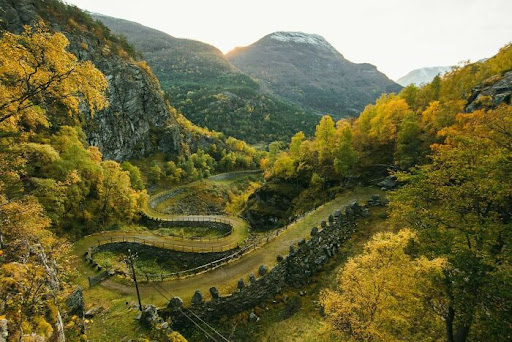
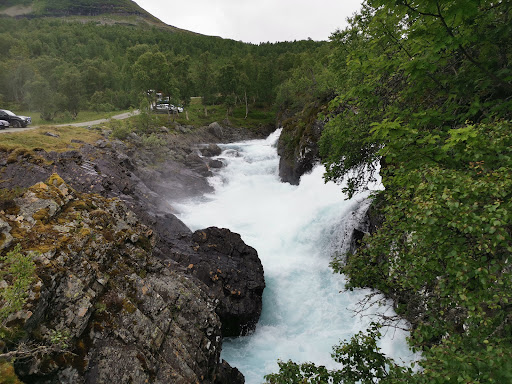
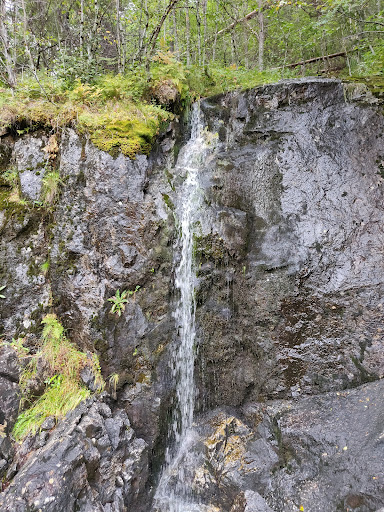
Hardangervidda National Park is the largest national park in Norway, covering 3,422 square kilometers across Hordaland, Viken, and Telemark counties. Established in 1981, it spans the vast Hardangervidda mountain plateau—often called Norway’s “rooftop”—featuring dramatic alpine scenery, moorlands, rivers, and glaciers.
Landscape & Nature
The park’s terrain includes wide plateaus, deep valleys, lakes, and glacier-fed rivers. The western section is rugged and wet, while the eastern side is flatter and drier. This variation supports a mix of alpine and Arctic ecosystems, including hardy tundra vegetation and high-altitude flora.
Wildlife
Hardangervidda hosts Europe’s largest population of wild reindeer, which roam freely across the plateau. Other notable wildlife includes moose, Arctic foxes, wolverines, and many bird species like the snowy owl and ptarmigan.
Outdoor Activities
Hiking & Trekking: A vast network of marked trails is ideal for both short walks and multi-day treks. The Norwegian Trekking Association (DNT) maintains cabins across the park.
Fishing: The numerous lakes and rivers offer excellent trout fishing opportunities.
Winter Sports: In winter, the park becomes a cross-country skiing paradise, with maintained routes and cozy lodges.
Cycling: Some areas are accessible by mountain bike, offering scenic and less-traveled routes.
Visitor Centers & Access
Hardangervidda Natursenter (Øvre Eidfjord) and
Hardangervidda Nasjonalparksenter (Skinnarbu) These centers provide interactive exhibits on the park’s geology, wildlife, climate, and Sami culture.
Access is easy via main roads like Route 7 and the Bergen Line railway, connecting the park with Oslo and Bergen.
Weather & Conditions (May 26, 2025)
Current weather is light rain with temperatures around 2°C. Wet snow is expected in the morning, clearing later in the day. Visitors should dress in layers, carry waterproof gear, and check safety updates before...
Read moreOi, 'ave you 'eard of 'ardangervidda National Park? It's a right proper gem hidden up in Norway, and let me tell you, it's worth the journey! The scenery up there is so breathtaking, it'll make you forget about all your problems down in the city. From mountains to lakes, to waterfalls, it's got everything a nature lover could ask for. And the best part is, it's not overrun with tourists like some of those other parks. You can still get that sense of peace and tranquility that's so hard to come by these days.
One of the things that really impressed me about 'ardangervidda National Park was the sheer size of it. I mean, it's huge! You could spend weeks hiking through all the different trails and still not see everything. And the diversity of the landscape is incredible. One minute you're walking through a lush forest, the next you're in the middle of a vast, barren wilderness. It's like you've been transported to another world. And the wildlife up there is something else. I saw reindeer, musk oxen, and even a few arctic foxes. It's like a little slice of heaven for nature enthusiasts.
Now, let's talk about the facilities up there. I was pleasantly surprised by how well-maintained everything was. The trails were clearly marked, the campsites were clean, and the staff were all very friendly and helpful. And if you're not the camping type, don't worry. There are plenty of cabins and lodges in the area that you can rent out. I stayed in one myself, and let me tell you, it was a cozy little retreat from the cold. All in all, I'd say 'ardangervidda National Park is definitely worth a visit if you're ever in Norway. Just make sure...
Read moreThe plateau is the largest peneplain (eroded plain) in Europe, covering an area of about 6,500 km2 (2,500 sq mi) at an average elevation of 1,100 m (3,500 ft). The highest point on the plateau is at the top of the Hardangerjøkulen glacier, which reaches a height of 1,863 m (6,112 ft).
The landscape of the Hardangervidda is characterised by barren, treeless moorland interrupted by numerous pools, lakes, rivers and streams. There are significant differences between the west side, which is dominated by rocky terrain and expanses of bare rock, and the east side, which is much flatter and more heavily vegetated. The climate also varies between the two sides: it is considerably wetter on the west side than on the east, with over 1,000 mm per year (39 inches) recorded in some parts. The prominent peak of Hårteigen 1,690 m (5,545 ft) is visible across much of the plateau.
Much of the Hardangervidda's geology is extremely ancient. The rolling fells of the Hardangervidda are the remnants of mountains that were worn down by the action of glaciers during the Ice Ages. The bedrock is mainly of Precambrian and...
Read more