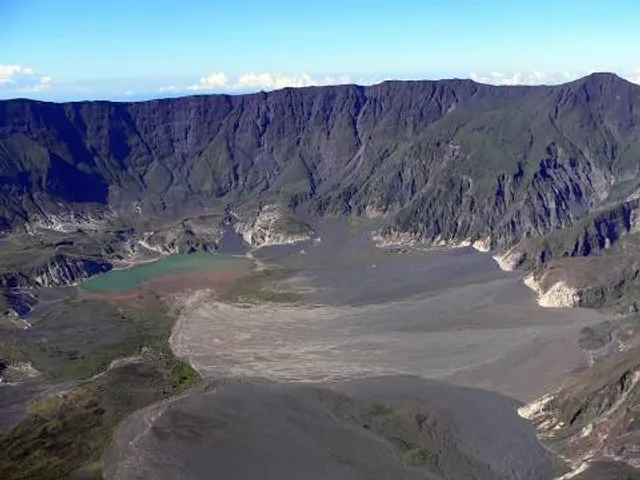
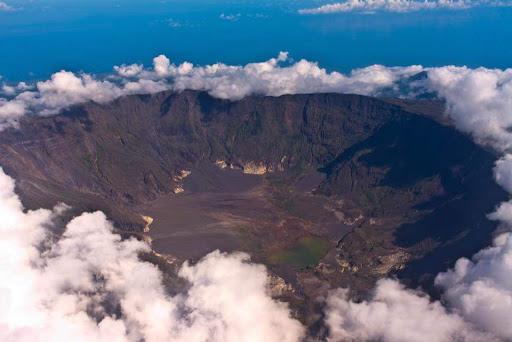
Everyone is not born to like something right away and take it as a hobby, nor is climbing a mountain. Some health experts say that sports and recreation such as hiking are as important to the body as the need for nutritious food. Of course there's nothing wrong with trying to climb a mountain, right? If you visit the eastern region of Sumbawa Island, precisely in Dompu Regency, there is a mountain with an altitude of 2,851 meters above sea level (masl), named Tambora. This mountain originally had a height of 4,200 meters above sea level then its altitude was cut to the current height due to a powerful eruption in 1815. Mount Tambora looms large in the northern region of Dompu, as if waiting for everyone who comes to climb and see its natural beauty. There is a gaping crater about 7 kilometers in diameter with a depth of about 1.2 kilometers. This makes Mount Tambora the mountain with the largest crater in Indonesia. In Tambora crater, there are landscapes such as savanna, lake and Toi Volcano which always emits sulfuric fumes. Climbing Mount Tambora can be done by two official routes which are the working areas of the Tambora National Park (TN), namely the Kawinda Toi route and the Pancasila route. Currently the most popular and very safe route for beginner hikers is the Pancasila route. The name of the Pancasila hiking trail comes from the name of the village located at the foot of Tambora, namely Pancasila Village in Pekat District. Getting to this village can be accessed by car or motorbike and takes about 3-4 hours from the center of Dompu City. The Pancasila route has five climbing posts, before post 1 there are 5 shelters or shadow posts to be used as a resting place before climbers continue their journey. Post 1 will usually be the longest post to travel, but is very sloping with the coolness of coffee plantations, ferns and various types of shrubs. ...
Read moreTambora violently erupted in a series of eruptions beginning 5 April 1815, culminating in the largest eruption in recorded human history and the largest of the Holocene (10,000 years ago to present). The magma chamber under Tambora had been drained by previous eruptions and underwent several centuries of dormancy as it refilled. Volcanic activity reached a peak that year, culminating in an explosive eruption. The explosion was heard on Sumatra island, more than 2,600 kilometres (1,600 miles) away and possibly over 3350 km (2060 miles) away in Thailand and Laos.[4] Heavy volcanic ash rains were observed as far away as Borneo, Sulawesi, Java, and Maluku islands, and the maximum elevation of Tambora was reduced from about 4,300 to 2,850 metres (14,110 to 9,350 feet). Although estimates vary, the death toll was at least 71,000 people.[5] The eruption contributed to global climate anomalies in the following years, while 1816 became known as the "year without a summer" because of the impact on North American and European weather. In the Northern Hemisphere, crops failed and livestock died, resulting in the worst famine of...
Read moreMount Tambora is on the island of Sumbawain present-day Indonesia (formerly part of the Netherlands East Indies). Although its eruption reached a violent climax on 10 April 1815,[2] increased steaming and small phreatic eruptions occurred during the next six months to three years. The ash from the eruption column dispersed around the world and lowered global temperatures, in an event sometimes known as the Year Without a Summer in 1816.[3] This brief period of significant climate change triggered extreme weather and harvest failures in many areas around the world. Several climate forcingscoincided and interacted in a systematic manner that has not been observed after any other large volcanic eruption since the early Stone Age. Although scientists have proven that the post-eruption climate changes and the Tambora eruption are linked, they have only an incomplete understanding of the processes...
Read more