Uch Sharif was founded in 325 BCE by Alexander the Great as the city of Alexandria on the Indus, according to British officer and archaeologist Alexander Cunningham. The city was reportedly settled by natives of the Greek region of Thrace and was located at the confluence of the Acesines river with the Indus. Uch was once located on the banks of the Indus River, though the river has since shifted its course and the confluence of the two rivers has shifted approximately 40 km (25 miles) southwest. In 712 CE, Muhammad bin Qasim conquered Uch. Few details exist of the city in the centuries prior to his invasion. Uch was probably the town recorded as Bhatia that was conquered in 1006 by Mahmud of Ghazni. Following the schism between the Nizari and Musta'li sects of Ismaili Shi'ism in 1094, Uch became a centre of Nizari missionary activity for several centuries and today the town and surrounding region are littered with numerous tombs of prominent pīrs, as well as pious daughters and wives of those Sufi pirs The region around Uch and Multan remained centre of Hindu Vaishnavite and Surya pilgrimage throughout the medieval era. Their interactions with Ismaili tradition resulted in the creation of the Satpanth tradition. Throughout this era, Uch was at the centre of a region that was steeped in both Vedic and Islamic traditions. The city would later become a centre of Suhrwadi Sufism, with the establishment of the order by Bahauddin Zakariya in nearby Multan in the early 1200s. Muhammad of Ghor conquered Uch and nearby Sultan in 1176 while it was still under the influence of the Ismaili Qarmatians. The town was likely captured from the Soomras based in Sindh. Sindh's various dynasties had for centuries attempted to keep Uch and Multan under their sway. 17 tiled funerary monuments and associated structures remain tightly knit into the urban fabric of Uch. The shrines, notably the tombs of Syed Jalaluddin Bukhari and his family, are built in a regional vernacular style particular to southern Punjab, with tile work imported from the nearby city of Multan. These structures were typically domed tombs on octagonal bases, with elements of Tughlaq military architecture, such as the addition of decorative bastions and crenellations. Three shrines built over the course of 200 years are particularly well known, and along with an accompanying 1400 graves form the Uch Monument Complex, a site tentatively inscribed on the list of UNESCO World Cultural Heritage sites. Of the shrines, the first is said to have been built for Sheikh Baha’al-Halim by his pupil, the Suharwardiya Sufi saint Jahaniyan Jahangasht (1307–1383), the second for the latter's great-granddaughter, Bibi Jawindi, in 1494, and the third for the latter's architect. Flooding in the early 19th century caused serious damage to many of the city's tombs, including structural problems and the deterioration of masonry and finishes. As the problems have persisted, the Uch Monument Complex was listed in the 1998 World Monuments Watch by the World Monuments Fund, and again in 2000 and 2002. The Fund subsequently offered financial assistance for conservation from American Express. In 2018, the World Bank provided a $500 million loan to the Punjab Government to restore several historical monuments, including the Tomb of...
Read moreThe Tomb of Bibi Jawindi is a significant historical and architectural landmark located in Uch Sharif, Punjab, Pakistan. It is part of a larger complex of mausoleums in the region, which is known for its rich heritage and Islamic architecture.
Historical Background Bibi Jawindi: The tomb was built in 1493 for Bibi Jawindi, a saint and a descendant of the Sufi saint Jahaniyan Jahangasht. Bibi Jawindi is revered for her piety and contributions to the spread of Islam in the region. Construction: The tomb was commissioned by an Iranian prince, Dilshad, and is considered one of the most beautiful examples of Central Asian architecture in the Indian subcontinent. Architectural Features Design: The tomb is octagonal in shape, built on an elevated platform, and features a blend of Central Asian and local architectural styles. The structure is made of brick, and its walls are decorated with intricate blue and white tile work, a hallmark of Islamic art. Dome: The tomb has a distinctive blue dome, which has partially collapsed over time but still retains much of its grandeur. Tile Work: The use of blue glazed tiles, combined with calligraphy and geometric patterns, creates a visually striking appearance. The tiles are arranged in floral and arabesque patterns, typical of the Timurid style. Decorative Elements: The exterior is adorned with calligraphic inscriptions from the Quran, floral motifs, and intricate carvings, reflecting the high level of craftsmanship of the period. Current Condition Preservation: The tomb, along with other historical structures in Uch Sharif, faces challenges due to environmental factors such as flooding and neglect. Efforts have been made to preserve these monuments, but many structures are in a state of disrepair. UNESCO Status: Uch Sharif is on the tentative list of UNESCO World Heritage Sites, recognizing its historical and cultural significance. Cultural Significance Pilgrimage Site: The tomb is a popular pilgrimage site for both locals and visitors, who come to pay their respects to Bibi Jawindi. Heritage: The site reflects the rich cultural and religious history of the region, showcasing the blend of different artistic and architectural traditions that flourished in medieval South Asia. The Tomb of Bibi Jawindi stands as a testament to the region's historical significance and architectural brilliance, attracting scholars, historians, and...
Read moreThe Tomb of Bibi Jawindi is one of the five monuments in Uch Sharif, Punjab, Pakistan, that are on the tentative list of the UNESCO World Heritage Sites. Dating back to the 15th century, the shrine was built in the spirit of the historical Sufi premier Bibi Jawindi of the Suhrawardiyyah order, a strictly hegemonistic Sunni school of theosophical thought which puts particular emphasis on the Shafi’i school of classical jurisprudence in the context of its interpretation of the Sharia. Jaw Indo was great-granddaughter to Jahaniyan Jahangasht, a famous Sufi saint in his own right.
The site is located in the south-west corner of Uch, a historical city founded by Alexander the Great, in the Bahawalpr state and Punjab province of Pakistan. Uch, locally known as Uch Sharif, is known as the home of the "shrine culture" because of its cultural significance and the presence of several monuments and shrines.
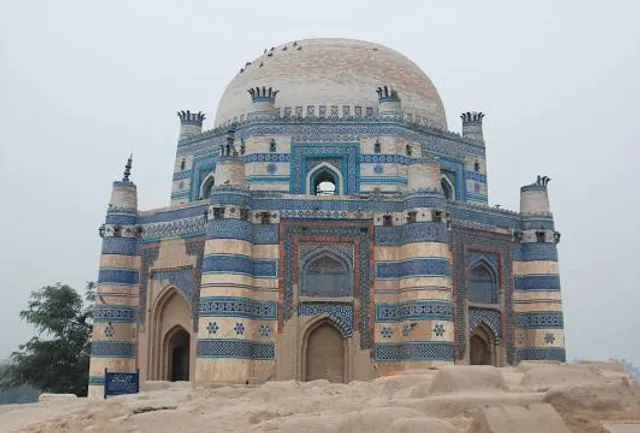
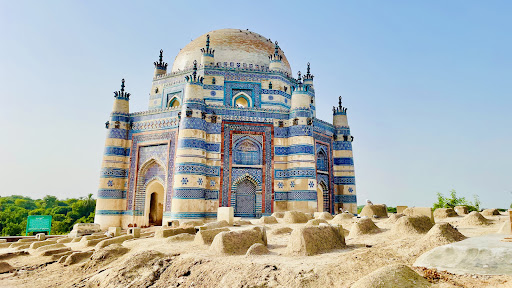
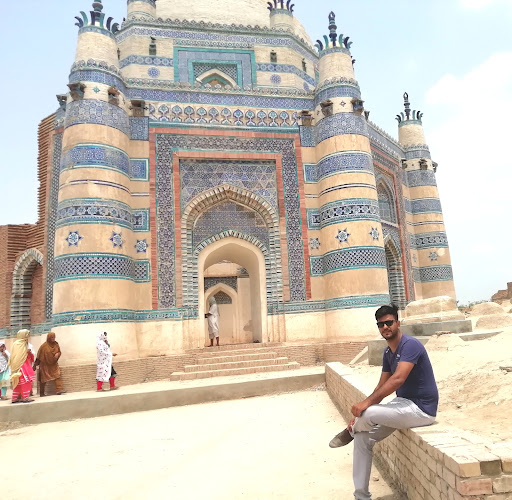
Built of glazed bricks on an octagonal base with turrets on each of its eight corners, the tomb of Bibi Jawindi is considered one of the most ornate monuments in Uch. The exterior of the building has three tiers with the top one supporting a dome, while the interior is circular due to thick angled walls rising up two stories. Both the interior and exterior of the building are richly decorated with Islamic scriptures, carved timber, and bright blue and glazed white mosaic tiles. The base tier is supported by the eight tapering turrets in each corner. The compound enclosing the shrine is preserved in its original desert-like conditions and is mostly covered with cemented graves. The surrounding area is covered with green vegetation due to a network of river tributaries and canals crossing the area.
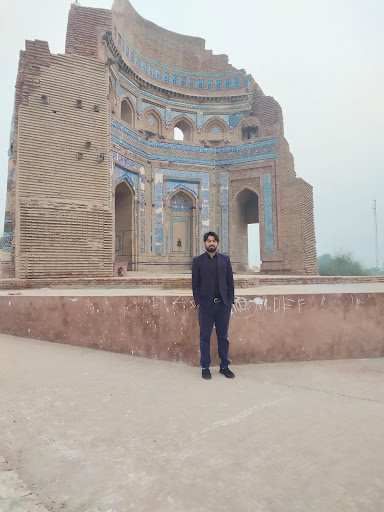
Over the centuries, the tomb has badly disintegrated as a result of environmental conditions, and during torrential floods in 1817 half of the structure was washed away. Only half of the structure remains today. In 1999, the Conservation and Rehabilitation Center of Pakistan invited international bodies and city officials to work on the conservation of the site. However, because of humidity, salt infiltration, and erosion the complex monuments are still crumbling. Inappropriate methods of repair have further damaged the complex. The World Monuments Fund placed the structure on their Watch in 1998, 2000, and 2002 to gather international attention and obtained grants to...
Read more