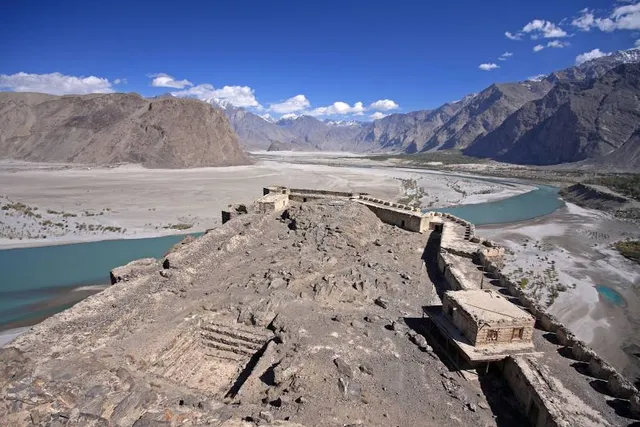
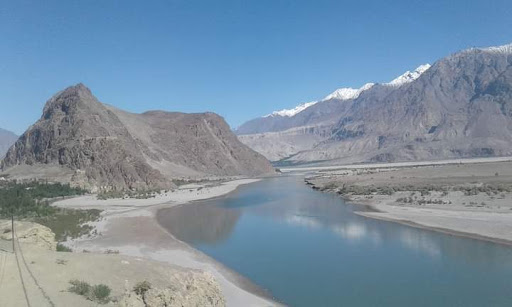
Skardu fort or kharpocho fort (meaning king fort) lies in Skardu, a City and headquarter of Baltistan division of Galgit Baltistan. It lies just near the junction of mighty Indus and the Shigar, sitting Right over a rock looking over the whole Skardu City and valley. The remains of the Fort are sufficient to depicte of its splendor and grandeur, it's historical and military significance being built on a stretegic location. It was built in late sixteen century and demolished in 1857. While visit to the Fort, I peeped into history through 16,17 ,18and nineteenth century. I assumed myself of an archerer, sitting as a guardian of the King and his kingdom, dominating the entire Skardu valley, passes leading from Shigar and Kargal side, simultaneously enjoying the captivating beauty of the valley. He must've enjoyed The romance while the Indus and the Shigar embrace each other witnessed by the width of worlds highest Cold desert' mighty sarfarnga' overlooked and cherished by Snow covered, weather beaten , sky high mountains of the karakaram. The Fort carries in his heart, the sorrows of bloodshed, each Stone of it is nurtured by blood of brave son of soil, the unsung heroes of the ages. Even my spirit could appreciate The mourning of hundreds of young widows of the heros, who Lost their lives for the cause of land. I witnessed the place where Commander in Chief used to sit. Honestly speaking it brought tears in my eyes. The Fort direly needs kind heart of administration/ archaeological department else it completely vanishes from the place Along with centuries old tradition. It's just 15-20 mints hiking if you are regular hiker otherwise it takes 40 mints from Bazar. Track is bit dangerous at places, children especially need to taken care of. Highly recommend place if you visit Town of Skardu. Please don't expect anything like history from so called guide there sitting...
Read moreSkardu Fort or Kharpocho, means The king of Forts is a fort in Skardu city in Gilgit-Baltistan region of Pakistan. Skardu, is a city in Gilgit-Baltistan region of Pakistan, and serves as the capital of Skardu District. Skardu is located in the 6 kilometres (4 miles) wide by 23 kilometres (14 miles) long Skardu Valley, at the confluence of the Indus and Shigar Rivers at an elevation of nearly 2,500 metres (8,202 feet). The city is an important gateway to the eight-thousanders of the nearby Karakoram Mountain range. The town is located on the Indus river , which separates the Karakoram Range from the Himalayas. Australian mountaineer and film maker Greg Child writes that the fort is "perched above the junction of the rivers" and overlooks the Rock of Skardu. The fort was built by the king Ali Sher Khan Anchan in the end of the sixteenth century.The Skardu region was part of the cultural sphere of Buddhist Tibet since the founding of the Tibetan Empire under Songsten Gampo in the mid 7th-century CE. Tibetan tantric scriptures were found all over Baltistan until about the 9th century. Given the region's close proximity to Central Asia, Skardu remained in contact with tribes near Kashgar, in what is now China's westernmost province of Xinjiang. General Zorawar Singh of the Dogra Rajput clan working under Maharaja Gulab Singh realized the importance of the fort's location in the town and so he occupied the fort. It was part of his many military campaigns to annex the areas Skardu became part of the Pakistan-controlled Kashmir, eventually renamed Gilgit-Baltistan.American mountaineers Robert Bates and Charles Houston write that they were "lavishly entertained" as they...
Read moreKharpocho Fort, located in Baltistan, Pakistan, is an ancient fort with a rich history. Here's a brief overview:
History:
Kharpocho Fort, also known as Kharphocho Fort, is believed to have been built in the 14th century by the rulers of the Balti Kingdom, specifically during the reign of Raja Daulat Ali Khan. The fort served as a strategic stronghold and a royal residence.
Architecture:
The fort is constructed from stone, wood, and mud, with impressive walls and towers that showcase the skilled craftsmanship of the Balti people. Its architecture reflects a blend of Tibetan and Persian influences.
Significance:
Kharpocho Fort played a crucial role in the region's defense and trade, controlling access to the Shigar Valley and the Skardu Valley. It also served as a center for Buddhist learning and culture.
Preservation Status:
The fort underwent restoration work in the 1990s and 2000s, funded by the Pakistani government and international organizations. However, concerns remain about the fort's preservation, as natural erosion and human activities threaten its structural integrity.
Interesting Facts:
The name "Kharpocho" translates to "King of Forts" in the Balti language. The fort offers breathtaking views of the surrounding valleys and the Indus River. Kharpocho Fort is one of the most impressive and well-preserved ancient forts in the Gilgit-Baltistan region.
Would you like to know more about visiting Kharpocho Fort or its...
Read more