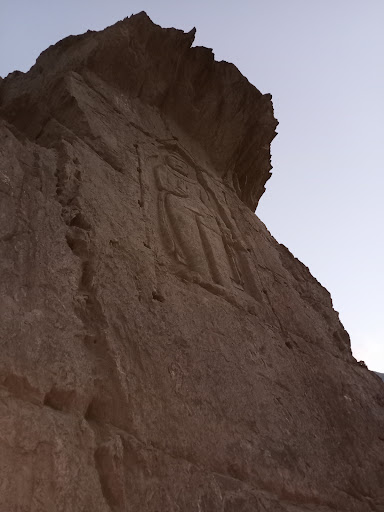
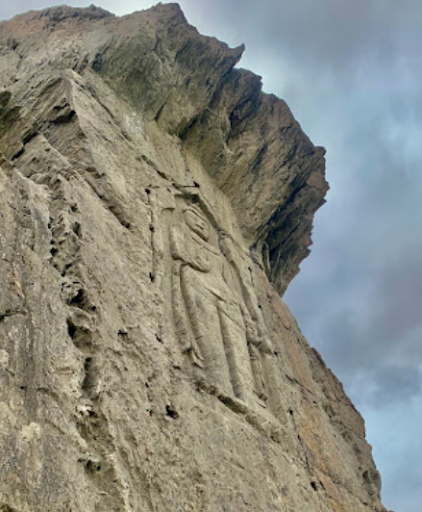
History of KargahBuddha The face of the image is broad and squash with stended ears Rainose, broad mouth, cont Hips hair arranged in skull tight, the right hand raised in AHATAMUDRA a fearless pose).
At a first lek it seems a naked female figure. However it looks draped thoug concentrated vision
According to a noted Japanese scholar DrHaruka Tsachips, this is a chamba style figure. The ly and anther figure of the same style is found in MulbeLadakh. This sort of figure is now a Buddha
MAITREYA which is nothing to do with Gandhara art.
As per local tradition it is called YATCHAN which means a female deman Dir evil spirt.
A British political agent BL.A. Lorimer, stationed at Gilgit From 1920 AD to 1524 AD had collected and published this Yachani tale in his Books Gilgit, Chitral and Yasin. For the interest of visitors and grear readers it is reproduced over here.
They say that in early times was a dev woman called the YACHANI. two men went off from Gilgit to fetch wood, they say, she used to eat one and left one go, and i four men went off, She would eat two and let two go. In this way she had eaten and finished off all the people of the countryside The people took counsel among themselves saying "How can we I how shall we bind her?".One among them said To Bagrot there is a Dalyalkhints, be will bied her. When they had the DAIYAL fetched from Bagrot he said to them. "Gin you folk this is noth worry about, I will bind her for you, and I give youthis advice: After she has been bound, wherever I may go and die bring my body thence and prepare a grave below the YACHANI and bury me there, then she won't come to life again". Thus he counseled the people and they accepted his advice.
Then DalyallChimit, driving iron pegs into the face of the clillclimbed u, and arrived at the door of the YATCHMY's dwelling.On this she came out of her house to the door, "O YATCHANI said Khimto" alas your brother has c Kashmir. When he said this the YATCHANI pressed her open hand on her breast andhimita Iron peg into it. Once again he said Alas your f has ded in Paltistan". The chanpressed her thigh with her other hand and Chimito drove a peg i her thigh and let it in. The Yachini now was fixed to the spot.She said to khamite what am I to "Eat gravel of the earth ciff above the Basin" said he. After binding the Yachini, Khimito came again. Then the people said. "now if he go s off and dees, or goes off somewhere and doesn't die, where are we to go and look for hom? saving this they slow the wretched Daylal humite there and buried below in this place which ar had pointed out. ..................................
Buddha de yesheni Gilgit is a phrase that refer to An ancient Buddha sculpture that is located about 6 miles (9.7 km) outside of Gilgit, in the Kargah Nala. The sculpture is carved into the face of a cliff and is about 50 ft (15 m) high. It is estimated to date back to the 7th century, when Gilgit was a prominent centre of early Buddhism. The sculpture is also known as Kargah Buddha or Yʂhani in the local Shina language.
Buddha de yeshe ni, is a Tibetan phrase that means "the wisdom of the Buddha". It is often used as a mantra or a prayer to invoke the blessings and guidance of the Buddha. The phrase can also be translated as "the enlightened wisdom of the Buddha" or "the wisdom of awakening". The phrase is related to the concept of yeshe, which is a Tibetan term for primordial wisdom or the innate awareness that transcends dualistic thinking. Yeshe is one of the five wisdoms that are associated with the five Buddha families in Tibetan Buddhism. The five wisdoms are: dharmadhatu wisdom, mirror-like wisdom, discriminating wisdom, all-accomplishing wisdom, and yeshe or wisdom of equality. The phrase Buddha de yeshe ni can also be written in Tibetan script as...
Read moreBefore I could Jump over to a brief Historical Background let me give you a few Tips if you are planning to visit this place!
TIP NO 1: Take with yourself something cooked from your Home (incase you are local) or some snacks from shops before coming here (incase you are a Tourist). You might save yourself a couple of bucks.
TIP NO 2: If you are visiting during the Summer its ideal to bring with youself some fruit (Mangoes, WaterMelon). Put them into the running stream fro 30 mins and enjoy later.
TIP NO 3: There is a beautiful stream running along the road with multiple places that suits sitting with family in a peaceful environment while cold breeze blowing right across you.
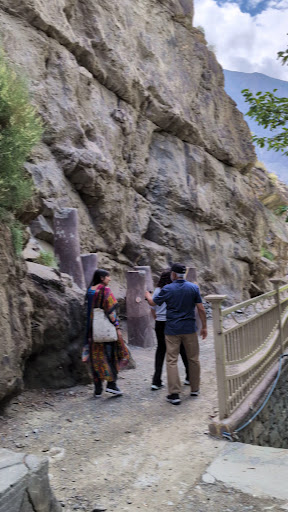
TIP NO 4: There is an entry ticket to the Buddha Visiting Site. I have added the latest picture that you can read as per your catagory. Prices may vary with time
TIP NO 5: Its the best place to visit incase you are with your family and you have a single day left in your trip. This place has it all. Additionally, multiple waterfalls on the way can be an attraaction for females especially kids.
TIP NO 6: Local Vendors offer frest Tout Fish from the stream or the Farm which you can Enjoy.
TIP NO 7: DONOT THROUGH GARBAGE AROUND YOURSELF. KEEP A PLASTIC BAG, PUT YOUR GARBAGE INSIDE AND LATER DISPOSE OFF IN DUSTBINS !!
Kargah Buddha, Gilgit - A Historical Gem
Kargah Buddha, also known as Kargah Buddhas, is an ancient rock carving site located in Gilgit, Pakistan. This remarkable site features a large Buddha image, along with several smaller carvings and inscriptions dating back to the 7th century, from the Gandhara period when Buddhism thrived in the region.
Located about 6 miles (9.7 km) west of Gilgit, at the junction of the Kargah and Shukogah streams, the site offers a unique glimpse into the rich cultural heritage of Gilgit-Baltistan. The carvings are well-preserved and provide valuable insights into the historical significance of the area as a prominent Buddhist center from the 3rd to the 11th century.
The Buddha figure, with distinct features such as extended earlobes and a raised right hand in a fearless pose (Abhayamudra), stands out for its artistic and historical value. Nearby, a Buddhist monastery and stupas containing ancient Sanskrit manuscripts were excavated, further emphasizing the region's historical importance.
According to local legend, the carving represents Yakhshini, a man-devouring ogress bound by the heroic figure Dayyal, ensuring she could no longer harm the locals. This tale, along with the site’s historical context, adds a mystical dimension to the visit.
Each year, thousands of tourists and Buddhist pilgrims from Korea, Japan, and other countries visit Kargah Buddha to marvel at its historical and spiritual significance. The site is ideal for those interested in exploring ancient archaeological wonders and the enduring legacy of Buddhism...
Read moreThis morning, our team of eight visited this historic archaeological site located approximately 6 to 7 miles from the Serena Hotel in Gilgit−Baltistan, Pakistan. The drive took about an hour due to the unpaved roads. One of the main attractions at the site was the impressive Buddha statue carved into a mountain, along with the rich history that accompanies it. The area is surrounded by beautiful, towering mountains, offering stunning views that make you feel as if you could almost reach out and touch them. We spent about an hour and a half exploring the site and learning about its history with our tour guide.
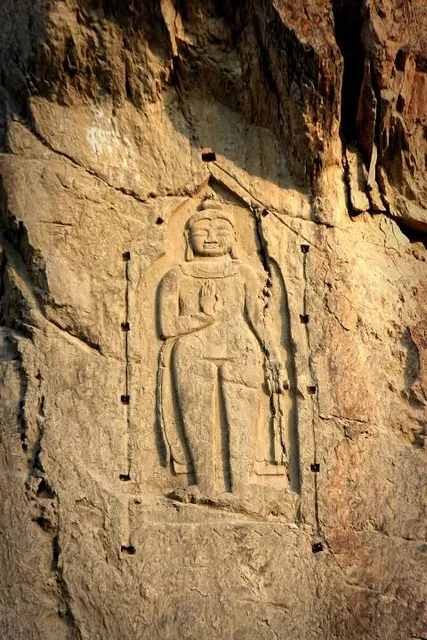
It's important to note that the drive was quite bumpy, as most of the route consists of unpaved roads, which can make for a difficult ride. However, the experience was well worth it to see this historic site. If authorities were to improve the roads, the site could accommodate many...
Read more