HTML SitemapExplore
logo
Find Things to DoFind The Best Restaurants

Hiran Minar Park — Attraction in Sheikhupura Tehsil

Name
Hiran Minar Park
Description
Hiran Minar is an early 16th-century Mughal era complex located in Sheikhupura, in the Pakistani province of Punjab. The complex was built at the site of a game reserve in honour of Mughal Emperor Jahangir's beloved antelope named Mansraj.
Nearby attractions
Nearby restaurants
Nearby hotels
Related posts
Keywords
Hiran Minar Park tourism.Hiran Minar Park hotels.Hiran Minar Park bed and breakfast. flights to Hiran Minar Park.Hiran Minar Park attractions.Hiran Minar Park restaurants.Hiran Minar Park travel.Hiran Minar Park travel guide.Hiran Minar Park travel blog.Hiran Minar Park pictures.Hiran Minar Park photos.Hiran Minar Park travel tips.Hiran Minar Park maps.Hiran Minar Park things to do.
Hiran Minar Park things to do, attractions, restaurants, events info and trip planning
Hiran Minar Park
PakistanPunjabSheikhupura TehsilHiran Minar Park

Basic Info

Hiran Minar Park

PXQ4+WMP, Hiran Minar Park Rd, Sheikhupura, Pakistan
4.4(3.1K)
Open 24 hours
Save
spot

Ratings & Description

Info

Hiran Minar is an early 16th-century Mughal era complex located in Sheikhupura, in the Pakistani province of Punjab. The complex was built at the site of a game reserve in honour of Mughal Emperor Jahangir's beloved antelope named Mansraj.

Outdoor
Cultural
Family friendly
Pet friendly
attractions: , restaurants:
logoLearn more insights from Wanderboat AI.
Website
hiranminar.com

Plan your stay

hotel
Pet-friendly Hotels in Sheikhupura Tehsil
Find a cozy hotel nearby and make it a full experience.
hotel
Affordable Hotels in Sheikhupura Tehsil
Find a cozy hotel nearby and make it a full experience.
hotel
The Coolest Hotels You Haven't Heard Of (Yet)
Find a cozy hotel nearby and make it a full experience.
hotel
Trending Stays Worth the Hype in Sheikhupura Tehsil
Find a cozy hotel nearby and make it a full experience.

Reviews

Get the Appoverlay
Get the AppOne tap to find yournext favorite spots!
Wanderboat LogoWanderboat

Your everyday Al companion for getaway ideas

CompanyAbout Us
InformationAI Trip PlannerSitemap
SocialXInstagramTiktokLinkedin
LegalTerms of ServicePrivacy Policy

Get the app

© 2025 Wanderboat. All rights reserved.
logo

Reviews of Hiran Minar Park

4.4
(3,066)
avatar
5.0
1y

A few days ago I visit a historical and beautiful place name Hiran Minar Park located in district Sheikhupura I shared with you some important information who collects from different ways History is a witness that the Mughal emperors left their mark on whatever route they took and wherever they stayed.if you look at the history on the Indian subcontinent, you will know that whether it is a matter of justice or war, whether it is love or politics, tourism or hunting,arts and crafts or architecture, the Mughal have conquered every field.I honed my skills, craftsmanship, good looks and individuality.In architecture, the Mughal adopted their style in some places and in some places they mixed the local color in it with such beauty that from this charming combination many rare things like Taj Mahal ,Shahi Fort,Badshahi Masjad,Tomb of Jahangir,Shala Mar Bagh,Red Fort and Hiran Minar were built.Masterpiece were born.Today , the rule of the Mughals has become a thing of the past, but with the historical and unique buildings built by them, they stood the test of time and still receiving praise from everyone,.Haran Minar in particular is a unique example of its kind in the whole world.During the British rule, British tourists and rulers praised Haran Minar generously and describe it as an eternal example of human -animal ship and love.Haran Minar is located in former Virk Ghar in Sheikhupura district of Punjab province.The historical city of Sheikhupura was founded by the great emperor Muhammad Jahangir.Jahangir's mother fondly called him Shekhobaba and accordingly the city was named Sheikhupura.During the reign of Emperor Muhammad Jahangir from 1605 to 1627, Sheikhupura had the status of a royal hunting ground because this area was very green and lush and in the vast and dense forest of Sheikhupura, various kinds of animals were found in abundance. At the invitation of Jahangir, Maharajas and Nawabs use to come to Sheikhupura to play hunting.This area of Haran Minar was once surrounded by wild grass and dense forests where herds of deer used to fill the chaukaris.It was the hunting ground of Mughal Emperor Muhammad Jahangir.It is said that Emperor Muhammad Jahangir had a deer named Hans Raj.Haran,who was loved by the king, died,so Jahangir built a tower over his grave, which was named Haran Minar.A reference to this is also found in Jahangir's autobiography Tuzk Jahangiri . Jahangiri writes that "on the Tuesday of Zul_Hajj I encamped at Jahangirpura (Sheikhupura) which was my favorite place for hunting." There is a Tomb and minar of a deer named Hans Raj at this place. In 1606,it to be added to the royal animals.This deer very innocent and beautiful.Emperor Muhammad Jahangir fondly called him Hans Raj.within a few weeks,Hans Raj had left his wild features and adopted the habits of a domestic animal and became the apple of Jahangir' eye.In 1607, Hans Raj died due to an illness.Secondly , it is also known that Emperor Muhammad Jahangir was playing Shikar. His pet deer (Hans Raj) accidentally gets hit by his own arrow and dies. Jahangir was deeply saddened by his death and he was saddened for many days.In 1608, Emperor Muhammad Jahangir ordered the construction of a towering minaret over the grave of Hans Raj.Lee and the tombstones were also made in the shape of a deer by his orders.an inscription on the deer' grave was engraved by Mullah Muhammad Meena Kashmiri,a famous calligrapher of the reign of Jahangiri.This building, which is located in a lush forest and is surrounded by a pond, was actually built by Emperor Muhammad Jahangir for hunting. This three storied building, located in the middle and with a path leading to it, was the royal resting place where King Jahangir and Queen Noor used to rest, especially on moonlight nights.The resting place is ninety feet high and one had to climb about a hundred steps to reach the top.The shape of the minarts is round and conical towards the height,it was 176 rosens at suitable places so that fresh air and light can enter well.The number of internal stairs is around one...

   Read more
avatar
5.0
24w

Hiran Minar, also known as the Deer Tower, is a beautifully preserved Mughal-era monument in Sheikhupura, built by Emperor Jahangir (1606–1620 CE) in memory of his beloved antelope Mansraj. The complex features a 30 m minaret, an octagonal baradari pavilion, and a large water tank—once a royal hunting retreat and today a serene lakeside heritage site .

⸻

📈 Tourism Development & Needed Works

Infrastructure & Access • Improved access roads from the M2 motorway and Sheikhupura city entrance: local feedback highlights muddy, unclear routes—upgrading these would ease visitor access . • Proper signage and wayfinding along major highways and at the site, including multilingual maps and information boards.

Facilities & Amenities • Enhanced parking with clear zones for motorcycles and cars—current high charges plus inconsistent enforcement deter visitors . • Public conveniences: clean restrooms, drinking water fountains, and shaded picnic pavilions. • Quality on-site food services: replace makeshift vendors with hygienic eateries or kiosks offering local cuisine.

Interpretation & Heritage Conservation • Improved conservation efforts: ongoing maintenance to preserve masonry, water hydraulics, and pavilion, following UNESCO and archaeology department guidelines . • Interpretive signage/tours: highlight historical, architectural, and ecological stories—Jahangir’s love for Mansraj, Persian tomb traditions, hydraulic engineering, and Mughal hunting culture. • Guided tours & audio guides, including evening illumination shows to bring the monument to life after dark .

Visitor Experience & Recreation • Boating facilities: expand pedal-boat access across the lake, ensure safety gear and fair pricing (current nominal PKR 50) . • Mini‑zoo or wildlife sanctuary: introduce deer (and possibly other native birds) to revive the site’s original identity, as planned by Punjab Archaeology & Wildlife Departments . • Landscaping & gardens: revive Mughal-style charbagh gardens, add native flowering plants to enhance biodiversity and aesthetics .

Safety & Security • Enhanced security presence and lighting along pathways, especially for evening visitors .

⸻

🎯 Planned & Started Initiatives • Mini‑zoo plan (2021): Punjab Archaeology and Wildlife departments approved a mini‑zoo with deer/birds . • 2018 renovation: added lighting show, boating, rose gardens, parking, and dining; this resulted in a 300% surge in annual visitors . • Punjab Tourism Budget 2020–21: allocated PKR 400 million to heritage and park development including Hiran Minar . • Signature heritage plan: Tourism Department includes infrastructure improvements and public–private partnerships .

⸻

✅ Benefits of Implementing These Works • Enhanced visitor satisfaction: better infrastructure and interpretative services improve stay and boost word‑of‑mouth. • Economic uplift: drives local employment—guide services, vendors, conservation labor. • Heritage preservation: builds pride in Mughal-era legacy and ensures structural integrity. • Ecotourism blend: combining heritage and wildlife attracts varied audiences—from history buffs to families and...

   Read more
avatar
2.0
2y

Hiran Minar (Urdu: ہرن مینار; or "The Deer Tower") is an early 16th-century Mughal era complex located in Sheikhupura, in the Pakistani province of Punjab.

The complex was built at the site of a game reserve in honour of Mughal Emperor Jahangir's beloved antelope named Mansraj. The emperor is remembered for his fondness of nature, and his complex embodies the Mughal relationship between humans, pets, and hunting.

Location The Hiran Minar complex is located in the city of Sheikhupura, about 40 kilometers northwest of Lahore. The complex is located near the Sheikhupura Fort, which also dates from the early 17th century. Both sites are accessible from Lahore via the M2 Motorway, which connects Lahore to the Islamabad.

History Hiran Minar was built during the reign of the Mughal Emperor Jahangir in a hunting reserve used by the Mughal royals. The reserve was built in a scrub forest and allowed Mughal emperors to experience a sense of semi-wilderness near the imperial city of Lahore. The wild reserve was used as a park where visitors could enjoy the sport of hunting.

The minaret itself was built in 1606 C.E. as a monument to Emperor Jahangir's beloved pet antelope, Mansiraj, or "Lord of All Animal Beings". The practice of building such tomb-markers over the skulls of game animals is an ancient Persian custom.

The minaret and tank were soon accompanied by a larger pavilion, built during the reign of Shah Jahan.

Layout The complex consists of a Jahangir-era minaret situated next to a larger Shah Jahan-era complex.

Minaret The Jahangir-era minaret stands 110 metres tall and was built in 1606 C.E. as a tomb marker for the emperor's pet antelope, Minsraj. The sides of the minar are inscribed with a eulogy to the pet antelope.

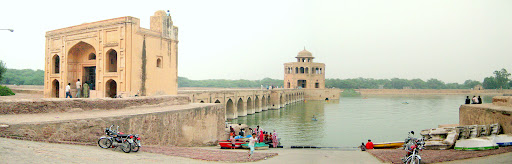
Pool A massive rectangular water-tank pool measuring 229 meters by 273 meters lies at the heart of the complex. At the center of each side of the tank, a brick ramp slopes down to the water, providing access for wild game that were sought by hunters.

Pavilion

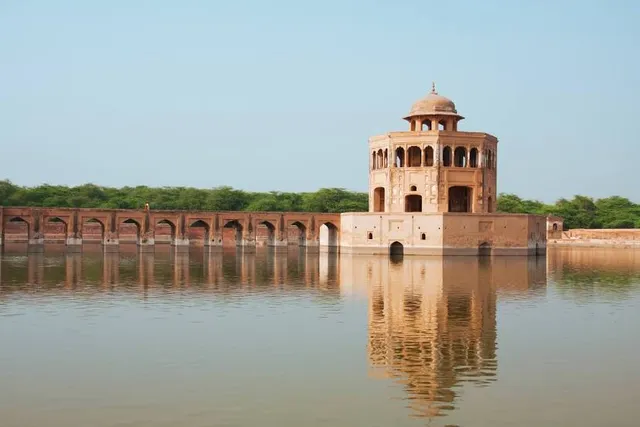
The two-Storey pavilion is topped by stone chhatri. An octagonal pavilion built during the reign of Shah Jahan is at the center of the pool. The pavilion is two-storied and is topped by a rooftop chhatri that served as a stone gazebo. The pavilion's architecture is similar to the Sher Mandal at Delhi's Purana Qila, built by Emperor Humayun.

The pavilion was surrounded not only by the water tank, but also semi-wilderness. The pavilion was thus likely used for recreational purposes.

Causeway A causeway spans the pool to connect the minaret with the pavilion along an axis which passes through a gateway.

Hydraulics Unique features of this particular complex are the antelope's grave and the distinctive water collection system. At each corner of the tank (approximately 750 by 895 feet (273 m) in size), is a small, square building and a subsurface water collection system which supplied the water tank; only one of these water systems is only extensively...

   Read more
Page 1 of 7
Previous
Next

Posts

Your browser does not support the video tag.
anastazjasadventuresanastazjasadventures
Pakistan has some incredible architecture and archeological sites 🇵🇰 This is Hiran Minar, an architectural historical place located in Sheikhupura, in the Pakistani Provence of Punjab. It is approximately 40 Km North West of Lahore. It was originated by the Mughal emperor Jahangir in remembrance of one of his favourite pets, “Mansraj”, as a landmark. This whole area is huge! You can easily spend a few hours here (highly recommend coming during sunset). You can also hire a paddle boat and paddle around the lake. [SAVE this post for your future trip to Pakistan] ✨ Follow @anastazjasadventures for more travel and lifestyle tips, and unique adventures ✨ 📷: @ukhano #HiranMinar #punjab #Sheikhupura #travelpakistan #pakistanioutfit #traveltherenext #visitpakistan
Mr. Victorious Jaffar WattooMr. Victorious Jaffar Wattoo
Hiran Minar (Urdu: ہرن مینار; or "The Deer Tower") is an early 16th-century Mughal era complex located in Sheikhupura, in the Pakistani province of Punjab. The complex was built at the site of a game reserve in honour of Mughal Emperor Jahangir's beloved antelope named Mansraj. The emperor is remembered for his fondness of nature, and his complex embodies the Mughal relationship between humans, pets, and hunting. Location The Hiran Minar complex is located in the city of Sheikhupura, about 40 kilometers northwest of Lahore. The complex is located near the Sheikhupura Fort, which also dates from the early 17th century. Both sites are accessible from Lahore via the M2 Motorway, which connects Lahore to the Islamabad. History Hiran Minar was built during the reign of the Mughal Emperor Jahangir in a hunting reserve used by the Mughal royals. The reserve was built in a scrub forest and allowed Mughal emperors to experience a sense of semi-wilderness near the imperial city of Lahore. The wild reserve was used as a park where visitors could enjoy the sport of hunting. The minaret itself was built in 1606 C.E. as a monument to Emperor Jahangir's beloved pet antelope, Mansiraj, or "Lord of All Animal Beings". The practice of building such tomb-markers over the skulls of game animals is an ancient Persian custom. The minaret and tank were soon accompanied by a larger pavilion, built during the reign of Shah Jahan. Layout The complex consists of a Jahangir-era minaret situated next to a larger Shah Jahan-era complex. Minaret The Jahangir-era minaret stands 110 metres tall and was built in 1606 C.E. as a tomb marker for the emperor's pet antelope, Minsraj. The sides of the minar are inscribed with a eulogy to the pet antelope. Pool A massive rectangular water-tank pool measuring 229 meters by 273 meters lies at the heart of the complex. At the center of each side of the tank, a brick ramp slopes down to the water, providing access for wild game that were sought by hunters. Pavilion The two-Storey pavilion is topped by stone chhatri. An octagonal pavilion built during the reign of Shah Jahan is at the center of the pool. The pavilion is two-storied and is topped by a rooftop chhatri that served as a stone gazebo. The pavilion's architecture is similar to the Sher Mandal at Delhi's Purana Qila, built by Emperor Humayun. The pavilion was surrounded not only by the water tank, but also semi-wilderness. The pavilion was thus likely used for recreational purposes. Causeway A causeway spans the pool to connect the minaret with the pavilion along an axis which passes through a gateway. Hydraulics Unique features of this particular complex are the antelope's grave and the distinctive water collection system. At each corner of the tank (approximately 750 by 895 feet (273 m) in size), is a small, square building and a subsurface water collection system which supplied the water tank; only one of these water systems is only extensively exposed today.
ZAHID ALI JOIYAZAHID ALI JOIYA
Hiran Minar, located in Sheikhupura, Pakistan, is a magnificent and historic site that showcases the grandeur of Mughal architecture. Here is a review of Hiran Minar: Architecture: The architecture of Hiran Minar is breathtaking. Built in the 17th century by Emperor Jahangir in memory of his beloved pet deer, Mansiraj, the complex is a unique blend of Mughal and Persian architectural styles. The minar (tower) stands tall at 100 feet and is adorned with decorative patterns, calligraphy, and intricately carved stone. The surrounding pavilions, water tanks, and causeways create a picturesque scene, making it a paradise for architecture enthusiasts. Location: Hiran Minar is situated in a serene and tranquil environment, surrounded by lush green gardens and a large artificial lake. The picturesque location provides a perfect backdrop for photography and a peaceful atmosphere for visitors to relax and unwind. Historical significance: Hiran Minar has significant historical importance as it was built by Emperor Jahangir, one of the prominent Mughal rulers of the Indian subcontinent. It serves as a testimony to the Mughal era's grandeur and their love for nature and animals. The site also offers insights into the lifestyle and interests of the Mughal royals, making it an interesting destination for history buffs. Recreation and leisure: Hiran Minar offers ample opportunities for recreation and leisure. The large gardens provide a pleasant space for picnics and strolls, while the lake offers boating options. The panoramic view from the top of the minar is awe-inspiring, making it a great spot for photography enthusiasts. The park also hosts cultural events and exhibitions, adding to the overall experience. Accessibility and amenities: Hiran Minar is easily accessible by road and is well-maintained by the local authorities. The site offers ample parking space and is equipped with basic amenities such as restrooms, seating areas, and refreshment stalls. The entry fee is reasonable, making it accessible to a wide range of visitors. Conservation efforts: While Hiran Minar is generally well-maintained, there have been some concerns about conservation efforts and protection of the site. As a historic monument, it is crucial to ensure proper preservation and maintenance to safeguard its heritage value for future generations. In conclusion, Hiran Minar is a stunning architectural masterpiece with historical significance, located in a serene environment. It offers recreational opportunities and is easily accessible, making it a worthwhile destination for visitors interested in history, architecture, and natural beauty. However, continuous efforts need to be made to ensure its conservation and preservation for future generations to enjoy.
See more posts
See more posts
hotel
Find your stay

Pet-friendly Hotels in Sheikhupura Tehsil

Find a cozy hotel nearby and make it a full experience.

Pakistan has some incredible architecture and archeological sites 🇵🇰 This is Hiran Minar, an architectural historical place located in Sheikhupura, in the Pakistani Provence of Punjab. It is approximately 40 Km North West of Lahore. It was originated by the Mughal emperor Jahangir in remembrance of one of his favourite pets, “Mansraj”, as a landmark. This whole area is huge! You can easily spend a few hours here (highly recommend coming during sunset). You can also hire a paddle boat and paddle around the lake. [SAVE this post for your future trip to Pakistan] ✨ Follow @anastazjasadventures for more travel and lifestyle tips, and unique adventures ✨ 📷: @ukhano #HiranMinar #punjab #Sheikhupura #travelpakistan #pakistanioutfit #traveltherenext #visitpakistan
anastazjasadventures

anastazjasadventures

hotel
Find your stay

Affordable Hotels in Sheikhupura Tehsil

Find a cozy hotel nearby and make it a full experience.

Get the Appoverlay
Get the AppOne tap to find yournext favorite spots!
Hiran Minar (Urdu: ہرن مینار; or "The Deer Tower") is an early 16th-century Mughal era complex located in Sheikhupura, in the Pakistani province of Punjab. The complex was built at the site of a game reserve in honour of Mughal Emperor Jahangir's beloved antelope named Mansraj. The emperor is remembered for his fondness of nature, and his complex embodies the Mughal relationship between humans, pets, and hunting. Location The Hiran Minar complex is located in the city of Sheikhupura, about 40 kilometers northwest of Lahore. The complex is located near the Sheikhupura Fort, which also dates from the early 17th century. Both sites are accessible from Lahore via the M2 Motorway, which connects Lahore to the Islamabad. History Hiran Minar was built during the reign of the Mughal Emperor Jahangir in a hunting reserve used by the Mughal royals. The reserve was built in a scrub forest and allowed Mughal emperors to experience a sense of semi-wilderness near the imperial city of Lahore. The wild reserve was used as a park where visitors could enjoy the sport of hunting. The minaret itself was built in 1606 C.E. as a monument to Emperor Jahangir's beloved pet antelope, Mansiraj, or "Lord of All Animal Beings". The practice of building such tomb-markers over the skulls of game animals is an ancient Persian custom. The minaret and tank were soon accompanied by a larger pavilion, built during the reign of Shah Jahan. Layout The complex consists of a Jahangir-era minaret situated next to a larger Shah Jahan-era complex. Minaret The Jahangir-era minaret stands 110 metres tall and was built in 1606 C.E. as a tomb marker for the emperor's pet antelope, Minsraj. The sides of the minar are inscribed with a eulogy to the pet antelope. Pool A massive rectangular water-tank pool measuring 229 meters by 273 meters lies at the heart of the complex. At the center of each side of the tank, a brick ramp slopes down to the water, providing access for wild game that were sought by hunters. Pavilion The two-Storey pavilion is topped by stone chhatri. An octagonal pavilion built during the reign of Shah Jahan is at the center of the pool. The pavilion is two-storied and is topped by a rooftop chhatri that served as a stone gazebo. The pavilion's architecture is similar to the Sher Mandal at Delhi's Purana Qila, built by Emperor Humayun. The pavilion was surrounded not only by the water tank, but also semi-wilderness. The pavilion was thus likely used for recreational purposes. Causeway A causeway spans the pool to connect the minaret with the pavilion along an axis which passes through a gateway. Hydraulics Unique features of this particular complex are the antelope's grave and the distinctive water collection system. At each corner of the tank (approximately 750 by 895 feet (273 m) in size), is a small, square building and a subsurface water collection system which supplied the water tank; only one of these water systems is only extensively exposed today.
Mr. Victorious Jaffar Wattoo

Mr. Victorious Jaffar Wattoo

hotel
Find your stay

The Coolest Hotels You Haven't Heard Of (Yet)

Find a cozy hotel nearby and make it a full experience.

hotel
Find your stay

Trending Stays Worth the Hype in Sheikhupura Tehsil

Find a cozy hotel nearby and make it a full experience.

Hiran Minar, located in Sheikhupura, Pakistan, is a magnificent and historic site that showcases the grandeur of Mughal architecture. Here is a review of Hiran Minar: Architecture: The architecture of Hiran Minar is breathtaking. Built in the 17th century by Emperor Jahangir in memory of his beloved pet deer, Mansiraj, the complex is a unique blend of Mughal and Persian architectural styles. The minar (tower) stands tall at 100 feet and is adorned with decorative patterns, calligraphy, and intricately carved stone. The surrounding pavilions, water tanks, and causeways create a picturesque scene, making it a paradise for architecture enthusiasts. Location: Hiran Minar is situated in a serene and tranquil environment, surrounded by lush green gardens and a large artificial lake. The picturesque location provides a perfect backdrop for photography and a peaceful atmosphere for visitors to relax and unwind. Historical significance: Hiran Minar has significant historical importance as it was built by Emperor Jahangir, one of the prominent Mughal rulers of the Indian subcontinent. It serves as a testimony to the Mughal era's grandeur and their love for nature and animals. The site also offers insights into the lifestyle and interests of the Mughal royals, making it an interesting destination for history buffs. Recreation and leisure: Hiran Minar offers ample opportunities for recreation and leisure. The large gardens provide a pleasant space for picnics and strolls, while the lake offers boating options. The panoramic view from the top of the minar is awe-inspiring, making it a great spot for photography enthusiasts. The park also hosts cultural events and exhibitions, adding to the overall experience. Accessibility and amenities: Hiran Minar is easily accessible by road and is well-maintained by the local authorities. The site offers ample parking space and is equipped with basic amenities such as restrooms, seating areas, and refreshment stalls. The entry fee is reasonable, making it accessible to a wide range of visitors. Conservation efforts: While Hiran Minar is generally well-maintained, there have been some concerns about conservation efforts and protection of the site. As a historic monument, it is crucial to ensure proper preservation and maintenance to safeguard its heritage value for future generations. In conclusion, Hiran Minar is a stunning architectural masterpiece with historical significance, located in a serene environment. It offers recreational opportunities and is easily accessible, making it a worthwhile destination for visitors interested in history, architecture, and natural beauty. However, continuous efforts need to be made to ensure its conservation and preservation for future generations to enjoy.
ZAHID ALI JOIYA

ZAHID ALI JOIYA

See more posts
See more posts