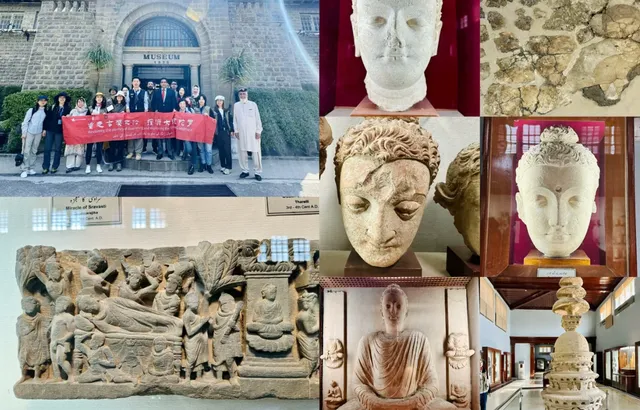
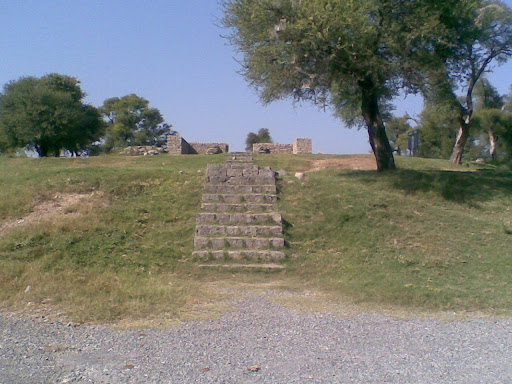
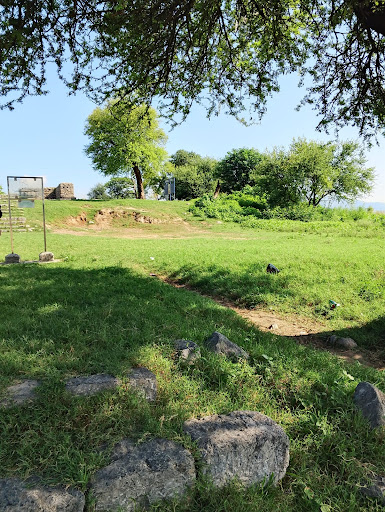
I had a trip to this historical temple. This is quite in better shape. This is info on the board there.
THE JANDIAL TEMPLE HAS BEEN INSCRIBED IN 1980 UPON THE WORLD HERITAGE LIST OF CONVENTION CONCERNING THE PROTECTION OF THE WORLD CULTURAL AND NATURAL HERITAGE. INSORIPTION ON THE LIST CONFIRMS THE EXCEPTIONAL UNIVERSAL VALUE OF A CULTURAL SITE WHICH DESERVES PROTECTION FOR THE BENEFIT OF ALL HUMANITY. JANDIAL REPRESENTS A UNIQUE EXAMPLE OF A MAGNIFICENT ANCIENT CREEK TEMPLE OF ITS OWN KIND IN PAKISTAN. IT IS BUILT ON A 45 FEET HIGH ARTIFICIAL MOUND, FACING SIRKAP THE SECOND CITY OF TAXILA, FOUNDED BY THE GREEKS IN 2nd CENTURY B.C. MR. CHULAM QADIR EXCAVATED THIS TEMPLE IN 1912-13 UNDER THE DIRECTION OF SIR JOHN MARSHALL. IT MEASURES 158 FEET BY 85 FEET AND HAS ALL THE CHARACTERISTICS OF A GREEK TEMPLE LIKE DISTYLE IN ANTIS (PORCH), PRONAOS (ENTRANCE HALL) NAOS (SANCTUARY AND OPISTHODOMOS (BACK CHAMBER OK POSTICUM OF ROMANS). ALL AROUND THE TEMPLE IS A PASSAGE OF UNIFORM SIZE WITH WINDOWS AT REGULAR INTERVAL FOR AIR AND LIGHT. THE BACK CHAMBER IS ENTERED THROUGH TE BACKDOOR, FLANKED BY SEMI-CIRCULAR COLUMNS. A FLIGHT OF STEP FROM THE BACKSIDE ON THE WEST LEADS UP TO THE SOLID MASS, WHICH ONLY DIFFERS THE GREEK CHAMBER. THE FRONT PORCH, RESTED ON FOUR IONIC COLUMNS AND TWO PILASTERS OF DARK BROWN SAND STONE. THE FAMOUS TRAVELER APOLLON:US OF TYANA, WHO CAME TO THE ROYAL COURT OF PARTHIAN KING GONDOPHARES OF SIRKAP (TAXILA) IN 44 A.D., STAYED IN THIS TEMPLE BEFORE MEETING THE KING. HE MENTIONS THAT" JUST OUT SIDE THE CITY WALLS WAS A TEMPLE OF NEAR A HUNDRED FEET, OF PROPHYRY, AND IN IT A SHRINE, SMALL CONSIDERING THE SIZE OF THE TEMPLE AND ITS MANY COLUMNS BUT STILL VERY BEAUTIFUL. AROUND THE SHRINE, HUNG THE PICTURES ON COPPER TABLETS, REPRESTING THE FEATS OF ALEXANDER AND PORUS. THE ELEPHANTS, HORSES, SOLDIERS AND ARMORS WERE PORTRAYED IN A MOSAIC OF SILVEP GOLD AND OXIDIZED COPPER. THEY ALSO TOLD OF THE NOBLE CHARACTER OF PORUS. FOR IT WAS NOT UNTILL AFTER THE DEATH OF ALEXANDER THAT HE PLACED TACI IN THE TEMPLE. THOUGH THEY REPRESENTED ALEXA-IDER AS A CONQUEROR AND HIMSELF AS CONQUERED AND WOUNDED AND RECEIVING FROM ALXANDER THE KINGDOM OF INDIA" BASED ON THE NUMISMATIC EVIDENCE FOUND HERE, THE JANDIAL TEMPLE SEEMS TO HAVE SURVIVED UNTILL THE TIME TAXILA BECAME A VASSEL OF KASHMIR DURING 6t - 7th CENTURY. SUBSEQUENT PERIODS WITNESSED ITS ABANDONMENT AND...
Read moreAncient remains of taxila. Not in very good condition. Taxila is known from references in Indian and Greco-Roman literary sources and from the accounts of two Chinese Buddhist pilgrims, Faxian and Xuanzang. Literally meaning “City of Cut Stone” or “Rock of Taksha,” Takshashila (rendered by Greek writers as Taxila) was founded, according to the Indian epic Ramayana, by Bharata, younger brother of Rama, an incarnation of the Hindu god Vishnu. The city was named for Bharata’s son Taksha, its first ruler. The great Indian epic Mahabharata was, according to tradition, first recited at Taxila at the great snake sacrifice of King Janamejaya, one of the heroes of the story. Buddhist literature, especially the Jatakas, mentions it as the capital of the kingdom of Gandharaand as a great centre of learning. Gandhara is also mentioned as a satrapy, or province, in the inscriptions of the Achaemenian (Persian) king Darius I in the 5th century BCE. Taxila, as the capital of Gandhara, was evidently under Achaemenian rule for more than a century. When Alexander the Greatinvaded India in 326 BCE, Ambhi (Omphis), the ruler of Taxila, surrendered the city and placed his resources at Alexander’s disposal. Greek historians accompanying the Macedonian conqueror described Taxila as “wealthy, prosperous, and well governed.”Within a decade after Alexander’s death, Taxila was absorbed into the Mauryan empire founded by Chandragupta, under whom it became a provincial capital. However, this was only an interlude in the history of Taxila’s subjection to conquerors from the west. After three generations of Mauryan rule, the city was annexed by the Indo-Greek kingdom of Bactria. It remained under the Indo-Greeks until the early 1st century BCE. They were followed by the Shakas, or Scythians, from Central Asia, and by the Parthians, whose rule lasted until the latter half of the 1st century CE.
According to early Christian legend, Taxila was visited by the apostle Thomas during the Parthian period. Another distinguished visitor was the neo-Pythagorean sage Apollonius of Tyana (1st century CE), whose biographer Philostratus described Taxila as a fortified city that was laid out on a symmetrical plan and compared it in size to Nineveh(ancient city of the...
Read moreThe only Greek temple in the subcontinent was at Jandial, 700 meters North of the Sirkap North-gate. It was built in the mid-second century BC by the Bactrian Greeks, and ruined during the earthquake of 30 AD.
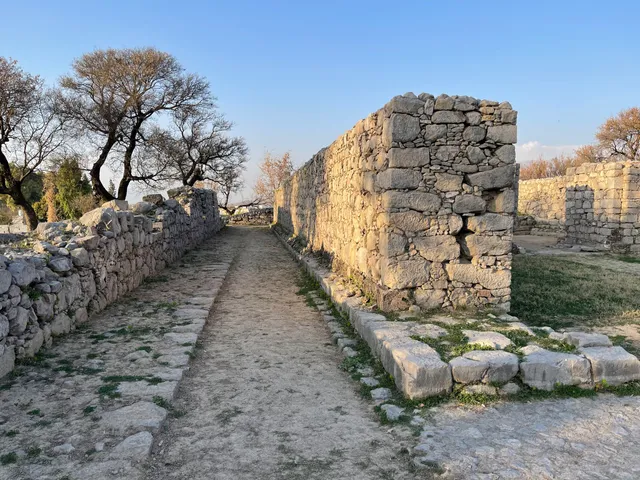
A front porch supported on four Ionic columns lead into an antechamber. A heavy wood and iron door divided the antechamber from the sanctuary, where statues of various Greek gods stood on the platform, no remains were found. Behind the sanctuary, a solid mass of masonry indicates a tower foundation, which is deep enough to support a tower 13 meters high. To one side of the tower was a back porch and around the temple was a peristyle in typical Greek style. Two variations are noted in temple layout at Jandial: Firstly, the temple roof was supported by a wall that had 20 windows instead of the Greek colonnade, because of lack of suitable stone at Taxila. Secondly, the place of the of the tower was traditionally reserved...
Read more