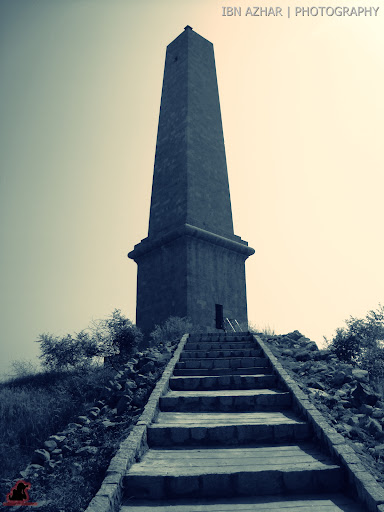
Around 40km from Islamabad on the Rawalpindi-Peshawar section of G.T. Road near Margalla Pass, there stands a monument built in memory of a British army commander.
Brigadier-General John Nicholson (1822-57) was considered as one of the finest officers of the Victorian era. Built in 1868, the approximately 40 feet tower, Nicholson’s Obelisk, is located on top of Margalla hill near Margalla or Tarnol Pass on the left side of Grand Trunk Road. It can be seen from a distance while travelling on GT road to and fro Rawalpindi and Peshawer . It is an important landmarks of the colonial period in the region.
John Nicholson was born on December 11, 1822, in Lisburn, Northern Ireland.
During his services for the British East India Army, he distinguished himself in four wars. He participated in his first combat action in the first Afghan War (1839-42).After the Anglo-Afghan War, he was appointed Political Officer in Kashmir and then District Commissioner in the Sangar area of Sindh.
During 2nd Anglo Sikh War during the Anglo-Sikh War of 1849, Nicholson joined by the majority of Muslims from Taxila, Wah, Fatehjang, Hasan Abdal and environs, defeated a Sikh garrison who held the Margalla Pass at this same location. John Nicholson was also wounded while fighting Sikhs. This freedom of Muslims from 'Sikha Shahi ' was seen as a great victory.
After the Second Anglo-Sikh War (1848-49), Nicholson was appointed the deputy commissioner of Bannu from 1852-54. For his bravery and services towards British government, a tablet in a church at Bannu carries the following caption: “Gifted in mind and body, he was as brilliant in government as in arms. The snows of Ghazni attest his youthful fortitude; the songs of the Punjab his manly deeds; the peace of this frontier his strong rule. The enemies of his country know how terrible he was in battle, and we his friends have to recall how gentle, generous, and true he was.”
Nicholson was also known as “Hero of Delhi” for his role and planning during what the British called Indian mutiny of 1857. Leading the assault on Delhi, he was critically injured and died nine days later on September 23, 1857, at the age of 34, and was buried in Delhi. The interesting fact about the monument is that it is located next to the old G.T. Road. It is said that Alexander the Great also passed through the same route. A staircase leads towards the monument at the top.
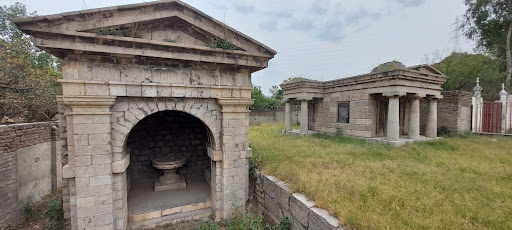
There is a door in the monument, more than 10 feet high from the base of the tower, which is apparently kept locked. The area around the monument shows that this place is not frequently visited by tourists. John
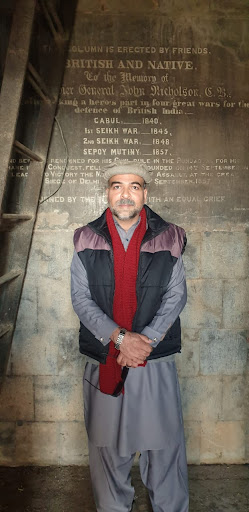
The plaque inside the room at Nicholson’s monument reads as “This column is erected by friends, British and Native to the memory of Brigadier General John Nicholson, taking a hero’s part in four great wars for the defence of British India. Cabul 1840, First Siekh War 1845, Second Seikh War 1848, Sepoy Mutiny 1857”
Nicholson is mentioned in several literary works, including • Rudyard Kipling’s novel ‘Kim’
in which a native veteran of
the Great Uprising of 1857
sings a “song of Nikal Seyn
before Delhi”.
• by by George MacDonald
Fraser in his book Flashman in
the Great Game.
• In James Leasor's novel about
the Indian Mutiny Follow the
Drum
• In James Leasor's history of
the siege, 'The Red Fort'.
• His biography written by
Lionel J Trotter (1897)
• Conspicuous mention in the
book Soldier-Sahibs:The Men
who made the North-West
Frontier (2001) by...
Read more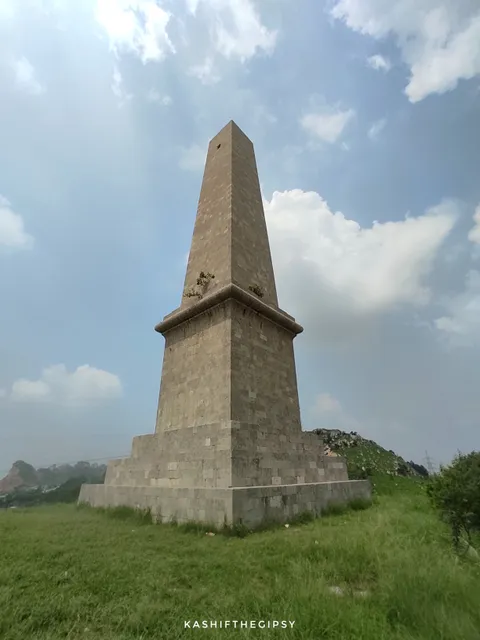
 Learn more insights from Wanderboat AI.