The etymology of Paracas:
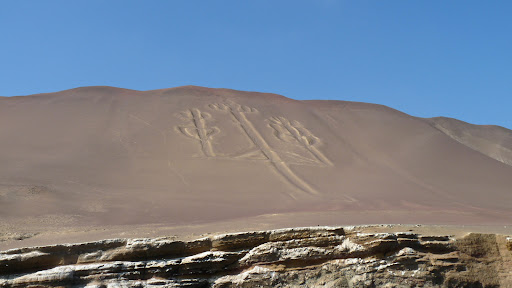
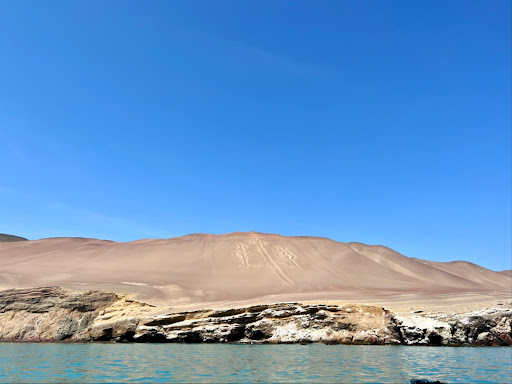
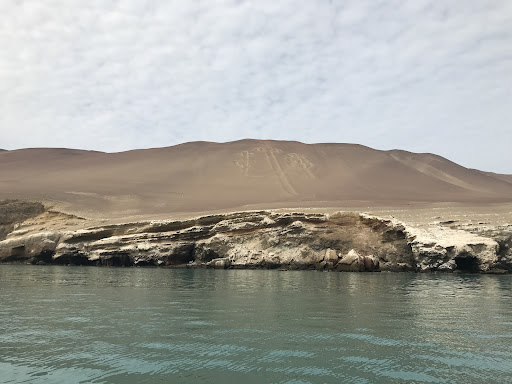
The name Paracas has a Sanskritic nuance. So lets first take a look at the name 'Paracas'. A direct translation of its Sanskrit cognate 'prakash' (प्रकाश्) is 'light', 'lustre', or 'brightness'. Thousands of years back the Trident etched on the mountain shone brightly due to the peculiarity of the mineral composition of the mountain. In ancient times, the shining trident would have been visible from high up in the skies, therefore it sometimes is regarded as a guiding beacon for ancient UFOs or 'vimanas'.
Another, and even closer, cognate of 'Paracas' is the Sanskrit 'parakash' (पराकाश) which means 'distant view', also appropriate for the 'Paracas Trident' is visible from the high skies even to this day, when the lustre of the shining mineral has eroded considerably.
The evidence in Valmiki Ramayana:
In the Vedic and Hindu tradition, the Trident has a prominent place. Lord Shiva wields the Trident (Trishul). Goddess Durga also holds the Trishul, as one of her many weapons. The Trident in Hinduism represents Creation, Maintenance and Destruction. It also represents Time - Past, Present and Future. In the ancient annals of Peru, the Trident of Paracas is associated with God Viracocha. His name itself is a distortion of the name Virochana, a Vedic god who's lore appears along with Indra.
However, the biggest clue and proof lies in the Valmiki Ramayana itself. In the Kishkindakanda, after Goddess-Queen Sita is abducted, Sugreeva readies four vanara-commando search parties to scour for Sita around the world. The party that heads east from India crosses many oceans, travels through Java and Sumatra, Shalmalidweepa (Australia)and many oceans ahead from there.
Once the mighty 'Soft Water Ocean', which has been identified as the Pacific, has been crossed the 'vanaras' are told by Sugreeva that they would then reach the Udaya Mountains where they will see Jaat-Shila-Rupa (which translates as Golden Rock Peak), etched on which is a 'golden pylon resembling a palm tree with three branches with a golden podium'.
Sugreev continues, "That pylon of palm tree is constructed as the easterly compass by celestial gods beyond which lies the Udaya Adri." (Verse 4-52). The Udaya Adri mountains are the Andes of South America. And in the Andes range of Peru is the 'Shining or Golden Trident'. Today it is known as the 'Paracas Trident'. It shines to this day and is visible from the skies.
Jai Shri Ram Jai...
Read moreThis sign is discribe in Valmiki Ramayana in Hindu Scripture. as per thet discription this sign is made before 12202 BCE Ramayana describes 4 teams of Vanaras(humans with tails who wander in the forest) going in 4 different directions to find King Rama’s kidnapped wife Seeta. Vanara king Sugreeva describes to the team that traveled towards the east, that first they will have to cross the sea and would land up in Yava(Java) island. Then would cross another island and reach a sea with red/yellow water (coral sea of Australia). Then they would see the pyramid (today’s Gympie Pyramid near the west coast of Australia). Through Sugreeva, writer Valmiki further describes that after crossing this huge island (Shalmali Dwipa/Austalia), they would see Mount Rishabha (ऋषभ) which looks like a ‘White cloud with a pearl necklace of waves rippling on the shores below‘. Near to that, they would spot the Sudharshana Lake with ‘silvery lotuses which have fibrils of gold‘ and where ‘kingly swans scamper around‘ Valmiki could be referring to Mount Cook & Lake Pukaki of New Zealand, which match these...
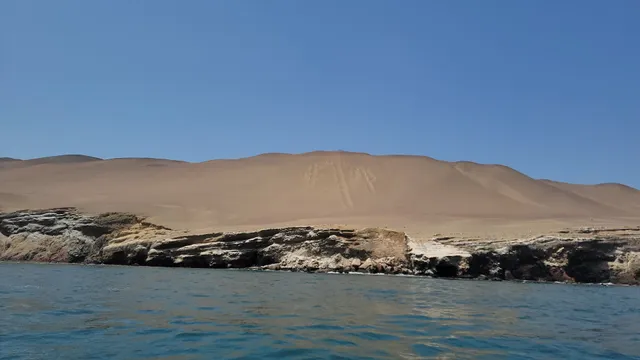
Read moreCANDELABRO DE PARACAS. Paracas, podría ser una distorsión de Prakash (luz-brillo), así como también de Parakash (vista distante).
Motivados por los sabios ancianos, continuamos el estudio de los símbolos color púrpura para iniciar un viaje hacia Perú, específicamente a la provincia de Pisco, donde se encuentra Paracas, una región costera que contiene una escultura en forma de candelabro. Son numerosas las especulaciones acerca de su origen y propósito, pero lo único indudable es que este enigmático dibujo montañoso se encuentra en las laderas de la costa norte de la península de Paracas. En el lugar del extraño y enigmático dibujo con forma de candelabro en la cara de una montaña se encuentra una de las entradas hacia la tierra de los inmortales. Esta hipótesis es reforzada porque la colina donde se asienta la ciudad de los sabios es conocida como montaña del ombligo. El dibujo que se observa desde alta mar, a gran distancia es un candelabro descomunal trazado hace siglos en la inmensidad de un desierto, sin que el tiempo lo haya borrado. El misterio de su origen, lo pone en el saco de las dudas, uno de los grandes misterios de la naturaleza, solo comparado en grandeza con las civilizaciones acuáticas en la Atlántida o el palacio de Cleopatra bajo el mar de Egipto. Estas líneas cristalizadas al paso de los siglos tienen un sinfín de connotaciones. Algunos dicen que era un sistema de regadío y otros lo comparan con algún tipo de puerto sideral o cosmódromo y otros opinan que indican líneas telúricas, las mismas teorías que existen sobre las Líneas de Nazca. El dibujo es en realidad, un candelabro con varias ramas destinadas a cargar velas para iluminarnos. Si retrocedemos en la historia, este aparece en pasajes de la Biblia descrito como un utensilio hecho del oro más puro. Homero, en la Odisea, escribe sobre candelabros de oro en forma de joven sobre un altar y en sus manos antorchas encendidas. Según la cosmovisión inca, esta misma constelación era considerada la versión tangible de Wiracocha, el dios de los báculos. La leyenda cuenta que este dibujo fue realizado por el dios Wiracocha, un hombre con larga barba y melena que llegó desde el oeste, promulgando el amor y el bien, enseñando los oficios y curando las enfermedades. Otros, y esta es la hipótesis más creíble, consideran que sea una especie de faro (Prakash- Parakash), porque si se escarba unos 10 o 15 centímetros aparecerá una costra blanquecina muy típica en la zona, que se supone que era el suelo original. Esta, al ser impactado por el sol, resplandecería y podría ser apreciado a larga distancia por los marinos para guiarlos por sus periplos, así como una estrella polar, la antigua centinela y guía de los hombres de mar. El árbol, el símbolo de la vida, el medio que tenían los dioses de comunicarse con el hombre, está presente en todo el planeta, como símbolo eterno del principio de la vida." En la antiguedad ciertas fechas singulares, recordaban un principio vivo, el nacimiento de un dios que vivió en una...
Read more