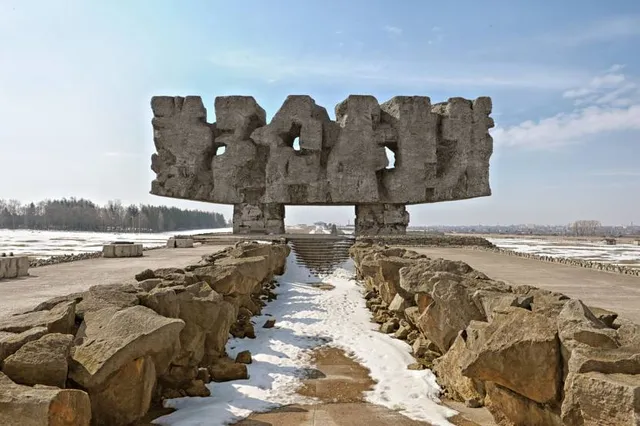
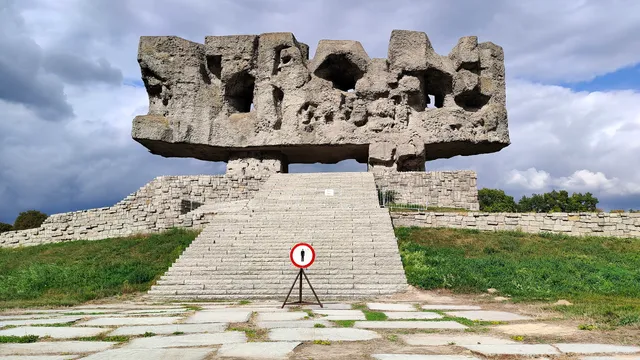
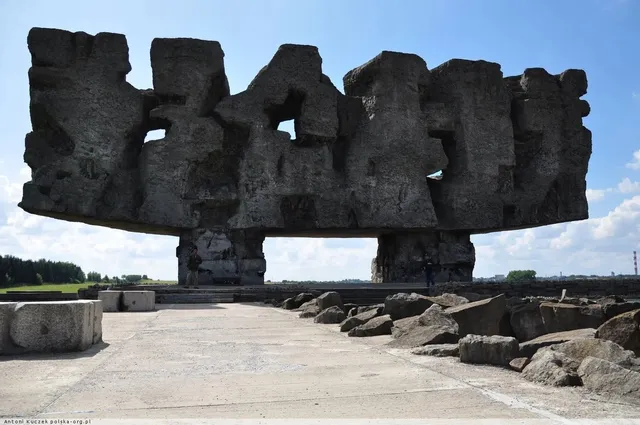
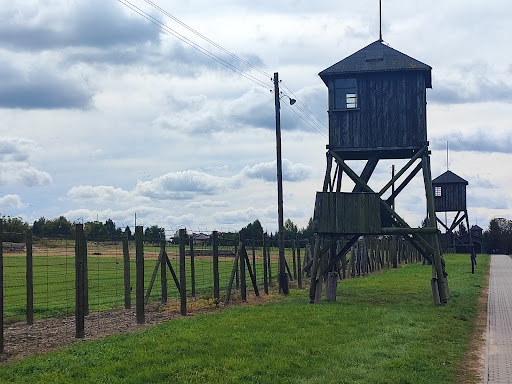
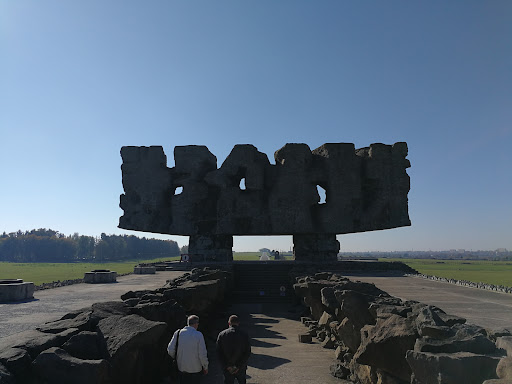
State Museum at Majdanek – German Nazi Concentration and Extermination Camp (1941–1944) – a martyrdom museum established in 1944 on the grounds of the former Nazi concentration camp KL Lublin . It is an institution directly subordinate to the Ministry of Culture and National Heritage . The museum conducts exhibition, educational and scientific activities. Since 2004, the branch of the State Museum at Majdanek has been the Museum – Memorial Site in Bełżec , and since 2012 – the Museum of the Former Extermination Camp in Sobibór . The museum is organized on a part of the former camp (approx. 90 ha). Among its most important monuments are the partially preserved economic part, the third field of the prisoner camp, the bathhouse buildings with gas chambers, the "new" and "old" crematorium buildings . The area of the memorial site also includes the Monument to Struggle and Martyrdom at Majdanek complex by Wiktor Tołkin . The collected and stored post-camp archives and the collection of museum exhibits are particularly rich. The Museum has a permanent main exhibition and organizes temporary exhibitions.
Since June 29, 2018, the full name of the institution is "State Museum at Majdanek. German Nazi Concentration and Extermination Camp (1941-1944)" In the first years of its activity, the Museum focused mainly on work related to the conservation and reconstruction of historical objects, as well as searching for and organizing documents from the period of the camp's operation. In 1945, the first permanent museum exhibition was opened. At that time, the Majdanek Week was also organized, the main goal of which was to commemorate the victims of KL Lublin , but in later periods it also took the form of anti-war rallies and was subordinated to propaganda purposes. The implementation of the first spatial development plan for the Museum was also started, as part of which the ashes of the camp victims were secured [ 4 ] .
The 1950s were marked by intensive popularization activities – lectures and traveling exhibitions were organized. Archival research was also initiated, which laid the foundations for large-scale scientific research conducted since the 1960s. Already in 1965 , it resulted in the publication of Volume I of " Zeszyty Majdanka ". At that time, another spatial development project for the Museum was also implemented, of which the Monument of Struggle and Martyrdom – one of the most recognizable elements of the Lublin landscape – became an important part .
The establishment of close contacts with former Majdanek prisoners was the result of competitions for diaries and memorabilia from the occupation period. In the 1970s and 1980s, they were guests at numerous scientific sessions devoted to the history of the Majdanek camp and the German occupation in the Lublin region, organized by the State Museum at Majdanek, and their memories were also recorded. Exhibitions of contemporary art, including painting and graphics, were very popular. In the years 1983–2004, the State Museum at Majdanek organized them as part of the International Art Triennial [ 5 ] .
On June 9, 1987 , John Paul II visited the museum during his third pilgrimage to his homeland . The plan of his stay included a visit to Majdanek, prayer at the ashes of those murdered in the Mausoleum, and a meeting with former prisoners.
The 1990s were opened by the publication of the camp monograph "Majdanek 1941–1944". For a dozen or so years, the scientific research of the Museum staff has focused not only on the history of KL Lublin, but also on museum practice, especially education at memorial sites. The subject of the extermination of Jews in the General Government has also become of interest to historians , especially since the Museum at Majdanek takes care of the areas of the former extermination camps in Bełżec (since 2004) and Sobibór (since 2012). Similar themes, as well as presentations of museum collections, have been subordinated to exhibitions organized in recent years, among which the latest historical exhibition "Prisoners...
Read moreI highly recommend visiting Majdanek to anyone with an interest in modern history. Majdanek was a German concentration and extermination camp located on the outskirts of Lublin, Poland, established by the Nazis during World War II. Initially intended to hold Soviet prisoners of war, it later expanded to imprison Jews, political prisoners, and other groups deemed undesirable by the Nazi regime. Majdanek operated between 1941 and 1944, and unlike many other concentration camps, it was not hidden away but situated within sight of the city, serving as a grim reminder of the horrors of the Holocaust.
At its peak, Majdanek held over 25,000 prisoners, and an estimated 78,000 people were murdered there, with the majority being Jewish victims. The camp is unique in that it remains largely intact today, offering visitors a sobering and direct glimpse into the atrocities committed during the Holocaust. The well-preserved gas chambers, barracks, crematoria, and personal artifacts of the victims create a powerful and emotional experience.
Visiting Majdanek is not only a lesson in history but also a stark reminder of the consequences of hatred and intolerance. The museum provides valuable educational exhibits and guided tours to help understand the tragic events that unfolded there. It’s a must-visit for anyone looking to gain a deeper understanding of World War II and...
Read moreMajdanek, just like Auschwitz, was preserved until this day. Even so, Majdanek receives much less attention in the eyes of tourists and visitors, as compared to the larger, Auschwitz. However, popularity does not mean greater richness in History. Majdanek still holds great historical value and still is a must visit place.
Starting off you'll see a big monument in front of Majdanek. Enter the camp and you'll be faced with coldness, bitterness and silence. Indeed the remains of Majdanek have been well preserved, and the general lack of tourism here gives a more enriching experience.
Tour guides are very friendly, have great linguistic skills and can speak multiple languages, English is one of them of course. Open to questions, the tour guides will be able to enhance what you learn and experience here, as well as smoothly guide you through the grounds of this concentration (later extermination) camp.
Some of the things you'll see here include evidence of the use of "Zyklon B ", barracks and even a well preserved crematorium. This are only a few of many things that is left behind in Majdanek.
A quiet place as compared to that of Auschwitz, Majdanek is certain to leave a lasting impression on you. The greater ability to feel and connect with those sent here is the strongest point Majdanek possesses.
Pay a visit here and experience it...
Read more