The "Fort of Nossa Senhora da Graça", also referred to as "Fort da Graça" or "Fort Conde de Lippe", is located in the parish of Alcáçova, about a kilometer north of the city of Elvas, municipality of the same name , Portalegre district, in Portugal.
In a dominant position over Monte da Senhora da Graça, it was part of the defense of the Elvas square, which it complemented.
It is currently part of the "Fronteiriça and Garrison City of Elvas and its Fortifications" complex, classified as World Heritage by UNESCO since June 30, 2012.
Features
An example of modern military architecture, it is considered a masterpiece both for the originality of the solutions presented there, and for its monumentality.
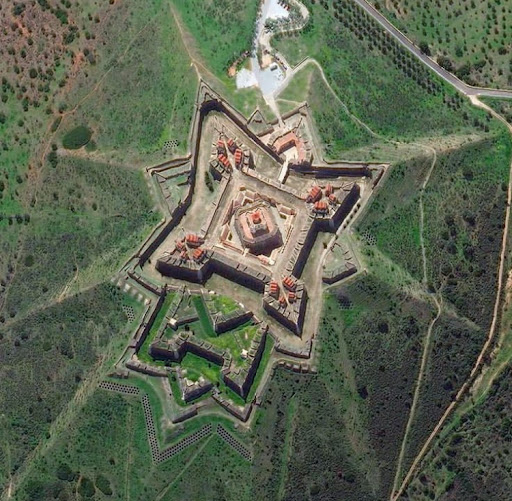
At a height of 404 meters above sea level, it is composed of three distinct defensive, interdependent lines, separated by deep moats: the Reduto, Magistral and exterior works.
The structure, of a quadrangular plan with one hundred and fifty meters on the side, is completed by pentagonal bastions at the vertices (from the SO bastion, clockwise, invoked respectively by Santo Amaro, Malefa, Badajoz and Cidade). Four small revelins cover the curtains, in the middle of which insert the monumental gate (Porta do Dragão) and three poternas. Over the main gate, there is the coat of arms of Portugal and an evocative plaque of the visit of D. José I in the year 1756, in the company of the marquis of Pombal and the count of Lippe.
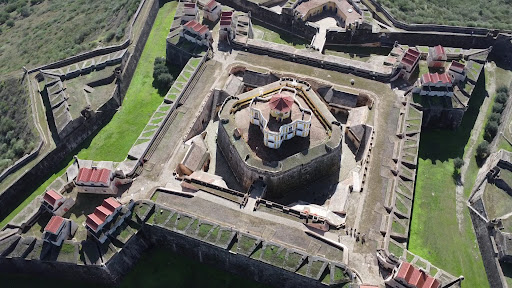
The central body of the square has a high, circular plan, with two vaulted floors:
the lower cruciform planimetry, with a chapel in one of the smaller arms, next to the doors leading to the Palace. There are four elliptical tribunes that could be transformed into gunboats to defend the four doors that give access to the chapel and the Redoubt. Below the chapel, excavated in the living rock, a cistern is one of his most notable works.
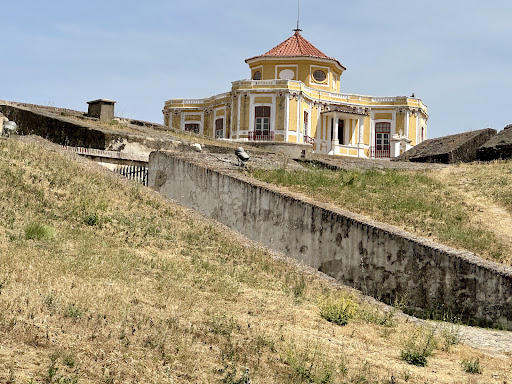
the superior, in the Governor's House. Here, the central room on the 4th floor has murals of historical evocation, with portraits of Count de Lippe and Colonel Valleré; the central room on the 5th floor is all white, with neoclassical decoration in mass works.
Externally, the structure is completed by a hornaveque with its revelim and poterna, and by a dry moat, ten...
Read more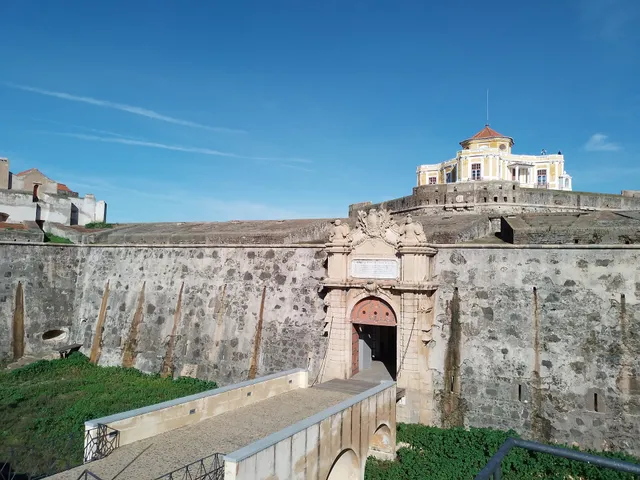

 Learn more insights from Wanderboat AI.