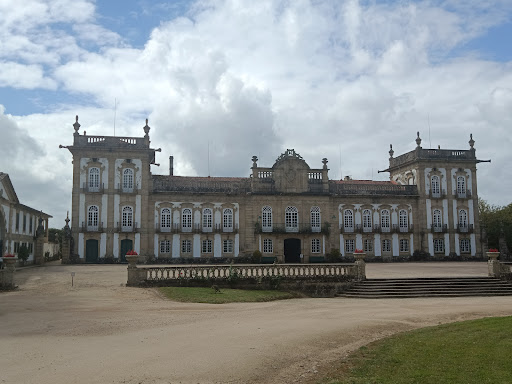
It was built in the first years of the 19th century, with the works lasting until 1834. Although there is no clear evidence about who was the author of its project, it has been attributed to Carlos Amarante, at the time, one of the most important architects working in the country. north of the country, and there are still those who defend that the architect could have been José da Costa e Silva, the author of the project for Palácio da Ajuda, in Lisbon, given the similarities between the two palaces.
It initially belonged to Luís Pereira Velho de Moscoso, born on November 29, 1767 and married to Maria Cleófa Pereira Caldas, from Badim. The existing palace in Largo do Caldas in Lisbon was owned by the family. Not belonging to the nobility, Luís de Moscoso could not build a palace with four towers and, for that purpose, he asked the king for permission to build the third tower. Luís de Moscoso died in 1837. The works continued under the direction of his second son, Simão Pereira Velho de Moscoso (1805-1881), and it is estimated that they cost around 400 contos de réis. This one died without issue. For lack of close relatives, the palace was inherited by the Caldas de Lisboa family. It is known that D. Joana Caldas was its third owner. Times of abandonment and degradation follow.
Around 1901, the palace was sold at public auction to Pedro Maria da Fonseca Araújo (1862-1922), president of the Commercial Association of Porto, who carried out extensive restoration works, designed by the architect Ventura Terra. The property was enriched with a palatine chapel and a theater, the walls of the atrium and the staircase were covered with tiles, the gardens and the grove were renovated, in addition to the construction of a lake. The works in the gardens and different areas of the farm were carried out by the Porto horticulturist and gardener Jacinto de Matos.
On June 23, 1910, it was classified as a National Monument.
With the death of Pedro Araújo in 1922, decadence returned to the palace.
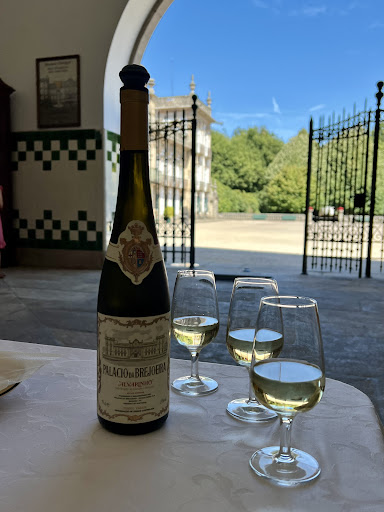
In 1937, the building was sold to Francisco de Oliveira Pais, from Lisbon, its fifth owner. In the 1960s, due to his bankruptcy, the palace was acquired by his daughter's partner, Feliciano dos Anjos Pereira, who built a modern wine cellar and, in 1977, launched his own brand, Alvarinho wine, with great success. "Brejoeira Palace".
The Palace belonged to Maria Hermínia Oliveira Paes (January 21, 1918 – December 30, 2015 (97 years old)), daughter of Francisco Paes. Maria Hermínia was married to Feliciano dos Anjos Pereira (2 October 1894-July 1981). They had no descendants. Feliciano dos Anjos Pereira, secondly married to Maria Hermínia, had offspring from his first marriage to Maria Marta Assunção (who died in June 1979).
In 2010 the palace opened to the public on guided tours.
In 2021 it is for sale for 25 million euros
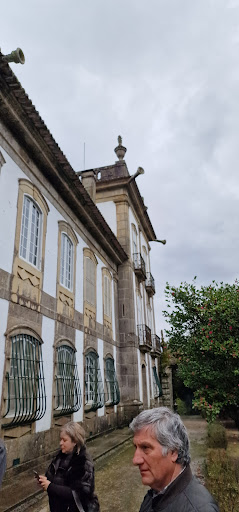
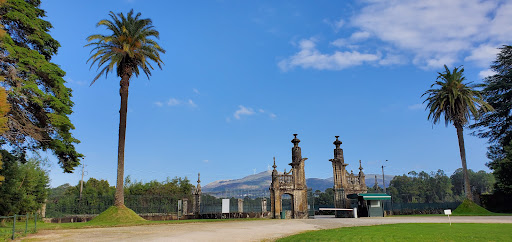
Built in neoclassical style and with an "L"-shaped plan, however, it features rococo style ornaments. Its four facades are bordered by three turrets that add a distinctive presence and are reminiscent of the Palácio Nacional da Ajuda, in Lisbon. The central body is almost entirely covered in granite and has an enlarged portal in the center, projecting from the side bodies, this central body is still crowned by the familiar coat of arms between two balustrades. In the body perpendicular to the noble façade, the decoration becomes more severe, without, however, breaking the harmony of the whole.
Inside, it still preserves some interesting rooms, in which the decoration is neoclassical, highlighting the sumptuous halls with valuable paintings (including a portrait of D. João VI protected by a canopy with valances and side curtains), frescoes and distinctive decor.
At the entrance, grand noble staircase, launched from a spacious atrium. On the walls are tile panels by Jorge Pinto, executed in the 20th century, as well as many of the works and alterations that took place at the beginning of this century. It also has a chapel and a theater[6], the latter with a strong classicist influence, marked by the use of fluted...
Read more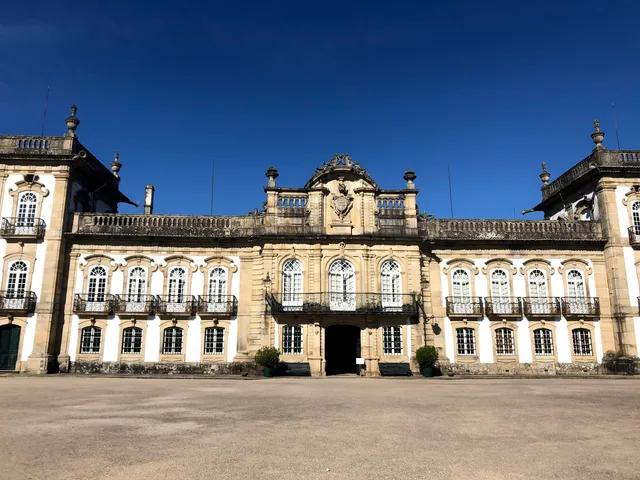

 Learn more insights from Wanderboat AI.