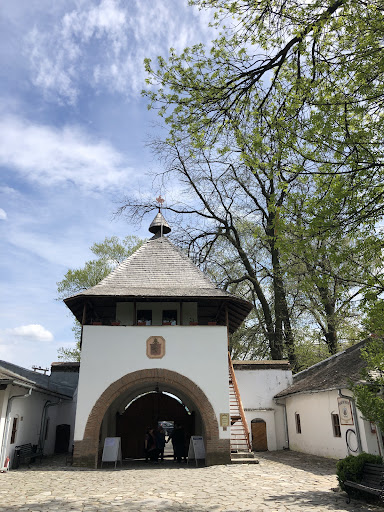
Salonul de Oaspeti (secolul al XIX-lea)
Prima incapere, situata in partea dreapta a holului central, este o camera spatioasa, destinata primirii oaspetilor si dotata cu mobilier baroc original.
Aici sunt expuse tablourile Banului Radu Golescu, ale fiilor sai: Nicolae, Iordache, Dinicu si al Zincai Golescu, sotia carturarului Dinicu Golescu. In coltul vestic, se afla pianul cu coada inalta, la care a cantat compozitorul si pianistul Franz Liszt, in 1847, presupusul tata al doctorului Carol Davila.
Sunt remarcabile brocarturile originale care imbraca ferestrele, cutia muzicala de epoca, soba inalta din olane de ceramica, caracteristica interioarelor boieresti din secolul al XVIII-lea.
Camera Zincai Golescu
Incaperea detine mobilier Biedermayer, precum si o vitrina in care sunt expuse obiecte personale ale Zincai Golescu, sotia lui Dinicu si mama celor patru frati: Stefan, Nicolae, Alexandru si Radu, oameni politici de vaza la 1848, 1859 si in vremea lui Carol I. Zinca a predat la Scoala sloboda obsteasca de la Golesti, redeschizand scoala dupa moartea sotului ei.
Tabloul dintre ferestre o reprezinta pe Marioara Balaceanu, sotia lui Iordache Golescu, caruia i-a daruit 23 de copii, cel mai cunoscut fiind Alexandru Negru.
Camera Orientala
Pe latura nord-estica, in vecinatatea pridvorului orientat spre parc, se gaseste camera orientala a conacului.
Mobilierul fin, sculptat si decorat cu intarsii de sidef, este completat de tesaturi decorative din fire vopsite natural, expuse pe pereti, tavi ornamentale, sofa acoperita cu saluri de matase, lampadar cu semiluna, carpeta aurie decorata cu fragmente din Coran si doua vitrine cuprinzand obiecte cu specific oriental: ciubuce, narghilea, matanii, paftale din argint si alte obiecte decorative orientale, care au apartinut familiei Golescu.
Camera Anica si Carol Davila
Medic francez, presupus fiu al Contesei d' Agoult si al lui Franz Liszt, Carol Davila a intrat in familia Golescu prin casatoria cu Ana, nepoata lui Dinicu Golescu, la 1861.
Medic-general, sef al Serviciului Sanitar Militar, Carol Davila a pus bazele invatamantului medical din Romania, infiintand Facultatea de Medicina si Farmacie Bucuresti, Societatea Crucea Rosie din Romania, Azilul Elena Doamna din Bucuresti, Serviciul de Ambulante, Gradina Botanica Bucuresti, primele publicatii medicale,...
Read more

 Learn more insights from Wanderboat AI.