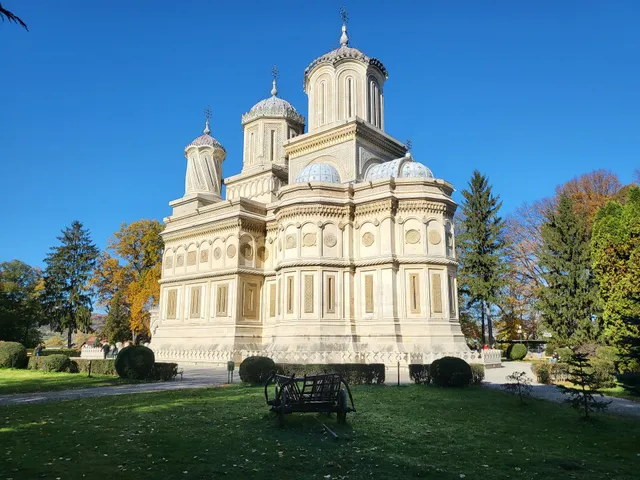
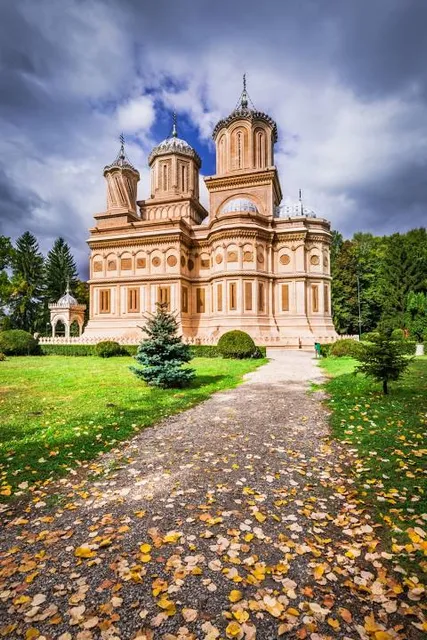
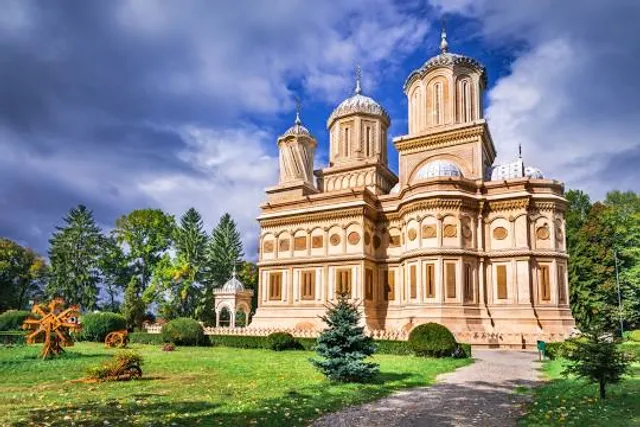
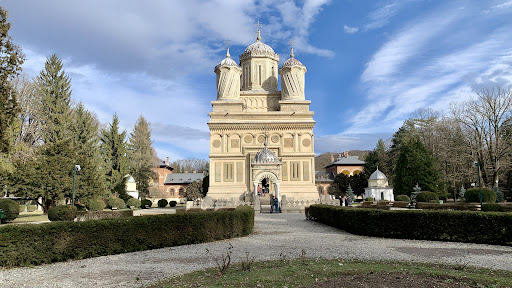
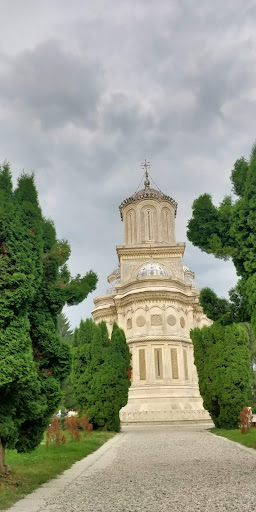
Curtea de Argeș Monastery is an Orthodox monastery in Romania, located in the city of Curtea de Argeș, built between 1515-1517 by Neagoe Basarab. The ensemble includes the episcopal cathedral, one of the most famous architectural monuments in Wallachia. The cathedral is included in the List of historical monuments in Romania, having the classification code AG-II-a-A-13628. During the time of Carol I, the cathedral was transformed into a necropolis for the royal family of Romania. Apart from the royal tombs, the Curtea de Argeș Monastery also houses the relics of Saint Filofteia.
If in 1857 the monastic complex was preserved in its entirety, two fires in 1866 and 1867 destroyed the buildings of the seminary, respectively the dwellings, the chapel and the entrance tower. At the initiative of Charles I, the church was restored starting in 1875 by the French architect Lecomte du Noüy, which resulted in the replacement of the original fresco with a new painting and other radical changes to the interior structure. In 1886, the restoration of the church was finished and the construction of the royal palace on the eastern side of the complex began, which would later be transformed into the episcopal palace.
In 2009, the construction of a new cathedral began for the seat of the Archdiocese of Argeș and Muscel, as well as the tombs of the members of the Royal Family of Romania and the relics of Saint Filofteia. The future Archbishop's and Royal Cathedral from Curtea de Argeș was consecrated on December 7, 2018, being expected that with its definitive consecration, it will also take over from the Argeș Monastery church the function of the...
Read moreA must visit when around (coming from/to Transfăgărășan) as this monastery is among the basic 4 myths of Romanians: the sacrifice for creation.
It is said that master Manole was hired to build the greatest monasteries of all time for Neagoe Basarab, but there were many obstacles. One night, he dreams that for the completion of his work he'll have to sacrifice a human and decided with his workers that the first wife to arrive with food will be sacrificed inside the walls... Unfortunately for Manole, that was his wife, Ana. After it's completion, the king Neagoe came to see the monastery and found it outstanding, so for it to be unique, he trapped Manole on the roof with no posibility of descending. Manole, being smart and desperate, built wings made of the remaining wood and tried to fly back to the ground, but died in the attempt. It is said that where he died a fountain appeared.
On another note, the monastery keeps its beauty over the centuries, even if the time left traces on it and the paint is wearing off. But the park is very...
Read moreA beautiful monastery built between 1514-1517 with amazing architecture. This 16th-century Episcopal cathedral is considered one of the most beautiful religious monuments in Romania, frequently compared to an elaborately decorated cake, made with marble and studded with mosaics. There are several legends about the master builder and stonemason, Manole, responsible for the project. The legend said everything he was building during the day was crushing over night. One night he had a dream about building his own wife (who was very much alive at the time) into the walls of the church (a tradition meant to ensure that the victim's ghost would forever protect the building). Manole was left on the roof without means of escape, as the king wanted to ensure that no other similar church would ever be built. Insane with grief the poor man apparently tried to fly from the roof, only to crash and die on the spot now marked by the famous Manole's Well. Despite this legend, this place is unique and one of the attractions from...
Read more