On a flat map, it appears that flying east over Russia would be the quickest way to get from India (or most of Asia) to the USA. However, the Earth is a sphere, and that makes a big difference! Here's why airplanes don't typically fly east over Russia to reach the USA:
Shortest Distance on a Sphere: Imagine stretching a string across a globe between India and the USA. The shortest distance wouldn't be a straight line across the Pacific, but rather a curved path that goes further north. This "great circle route" takes advantage of the Earth's curvature.
Jet Streams: High in the atmosphere, there are fast-moving air currents called jet streams. These can significantly impact flight times. Often, jet streams flow west to east. By flying eastward with the jet stream, airlines can significantly reduce flight time and fuel consumption compared to flying westward against it.
Available Infrastructure: Commercial air travel relies on a network of airports for refueling, maintenance, and emergencies. Flying a long stretch over the vast Pacific Ocean with limited airport options is less desirable from a safety standpoint. The route westward offers more potential landing sites throughout Europe and the Middle East. While technically an eastward route over Russia is possible, it would be:
Slower: Due to the reasons mentioned above, flying westward with the jet stream and utilizing existing infrastructure is generally faster.
Less Efficient: Fighting against headwinds (westerly jet streams) would require more fuel.
Less Safe: The vast distance over the Pacific with fewer landing options creates a higher risk in case of emergencies. Overall, flying westward offers a more efficient, faster, and safer route for airlines traveling from...
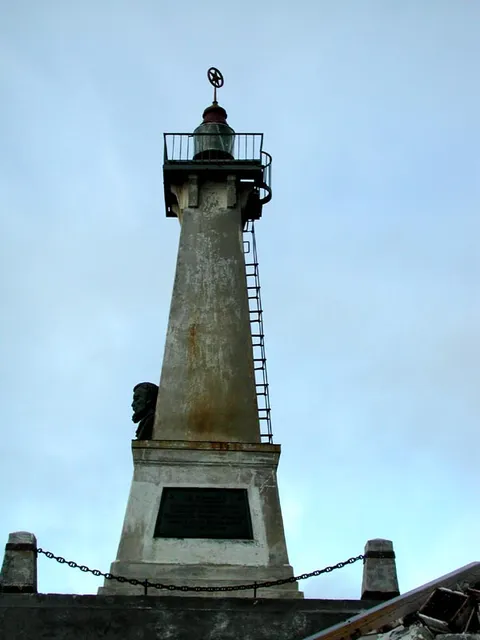
Read moreTranslation of the plaque inscription:
"Monument-lighthouse to the explorer and navigator Semyon Ivanovich Dezhnev" (1955)
SEMYON IVANOVICH DEZHNEV (1605 – 1672)
An outstanding Russian navigator. In 1648, he passed through and discovered the strait separating Chukotka and Alaska, which later became known as the Bering Strait.
There is no place dearer to the heart than the Motherland. It helps not to lose one's way.
In accordance with the Resolution of the Council of Ministers of the RSFSR dated 30.08.1960 No. 1327 on further improvement of the protection of cultural monuments in the RSFSR, the beak monument was included in the list of historical monuments subject to protection as a monument of national significance, and on the basis of Art. 64 of the Federal Law "On Cultural Heritage Sites (Historical and Cultural Monuments) of the Peoples of the Russian Federation" it was included in the Unified State Register of Cultural Heritage Sites (Historical and Cultural Monuments) of the Peoples of the Russian Federation as a cultural heritage site of federal significance. It is federally owned. Certificate of state registration of rights dated 28.06.2012 NIST AA 025191. The owner of the beak monument (navigational sign) is the "Hydrographic Enterprise". FSUE
In memory of the monument-cross erected in 1910 and subsequently lost in honor of S.I. Dezhnev, a village cross was erected 45 m north of the lighthouse monument.
(Google translate so probably...
Read moreMy native American ancestors crossed the land bridge here at this amazing point to populate the North & South American continents. Due to climate change, there is no longer a land bridge. I highly recommend a ferry ⛴️ service across the Bering Strait over to Wales and Tin City for better economic development. It's too far to kayak or to swim across to shake our Russian neighbors hands as a welcoming gesture. ...
Read more