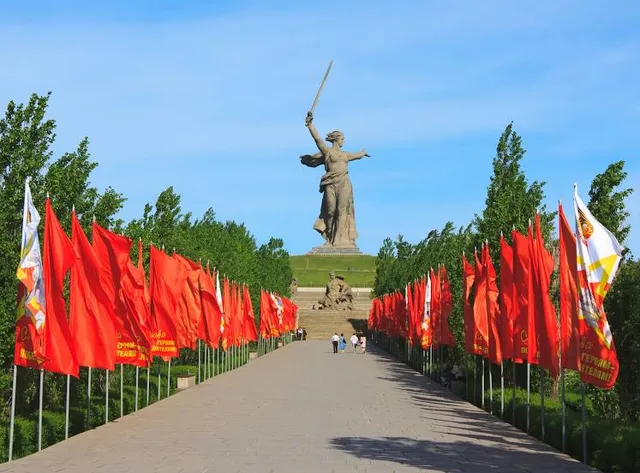
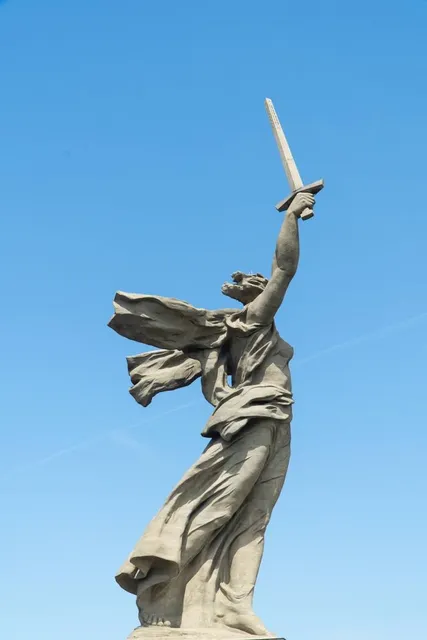
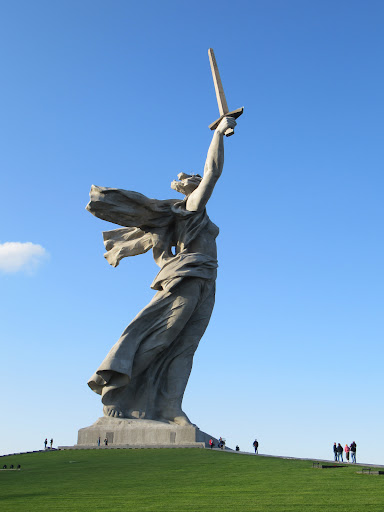
Mamayev Kurgan (Russian: Мамаев курган) is a dominant height overlooking the city of Volgograd (formerly Stalingrad) in Southern Russia. The name in Russian means "tumulus of Mamai".[1] The formation is dominated by a memorial complex commemorating the Battle of Stalingrad (August 1942 to February 1943). The battle, a hard-fought Soviet victory over Axis forces on the Eastern front of World War II, turned into one of the bloodiest battle in human history.[2] At the time of its installation in 1967 the statue named The Motherland Calls on Mamayev Kurgan formed the largest free-standing sculpture in the world;[3] as of 2016 it is the tallest sculpture of a woman in the world.
Commemorative coin When forces of the German Sixth Army launched their attack against the city centre of Stalingrad on 13 September 1942, Mamayev Kurgan (appearing in military maps as "Height 102.0") saw particularly fierce fighting between the German attackers and the defending soldiers of the Soviet 62nd Army. Control of the hill became vitally important, as it offered control over the city. To defend it, the Soviets had built strong defensive lines on the slopes of the hill, composed of trenches, barbed-wire and minefields. The Germans pushed forward against the hill, taking heavy casualties. When they finally captured the hill, they started firing on the city centre, as well as on the city's main railway station under the hill. They captured the Volgograd railway station on 14 September 1942.
On the same day, the Soviet 13th Guards Rifle Division commanded by Alexander Rodimtsev arrived in the city from the east side of the river Volga under heavy German artillery fire. The division's 10,000 men immediately rushed into the battle. On 16 September they recaptured Mamayev Kurgan[4] and kept fighting for the railway station, taking heavy losses. By the following day, almost all of them had died. The Soviets kept reinforcing their units in the city as fast as they could. The Germans assaulted up to twelve times a day, and the Soviets would respond with fierce counter-attacks.
The hill changed hands several times. By 27 September, the Germans again captured half of Mamayev Kurgan.[5] The Soviets held their own positions on the slopes of the hill, as the 284th Rifle Division defended the key stronghold. The defenders held out until 26 January 1943, when the counterattacking Soviet forces relieved them. The battle of the city ended one week later with an utter German defeat.
When the battle ended, the soil on the hill had been so thoroughly churned by shellfire and mixed with metal fragments that it contained between 500 and 1,250 splinters of metal per square meter. The earth on the hill had remained black in the winter, as the snow kept melting in the many fires and explosions. In the following spring the hill would still remain black, as no grass grew on its scorched soil. The hill's formerly steep slopes had become flattened in months of intense shelling and bombardment. Even today, it is possible to find fragments of bone and metal still buried deep throughout the hill.
Memorial complex
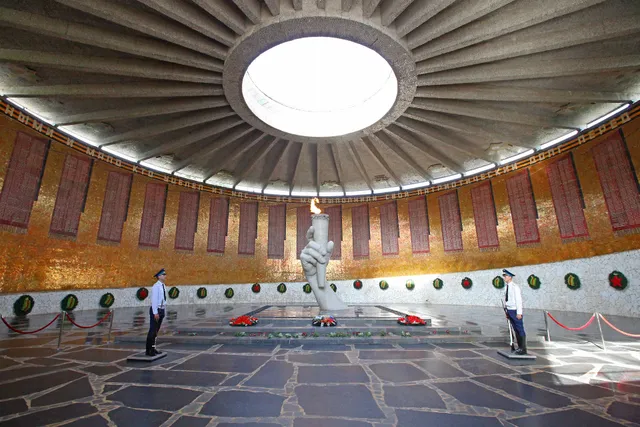
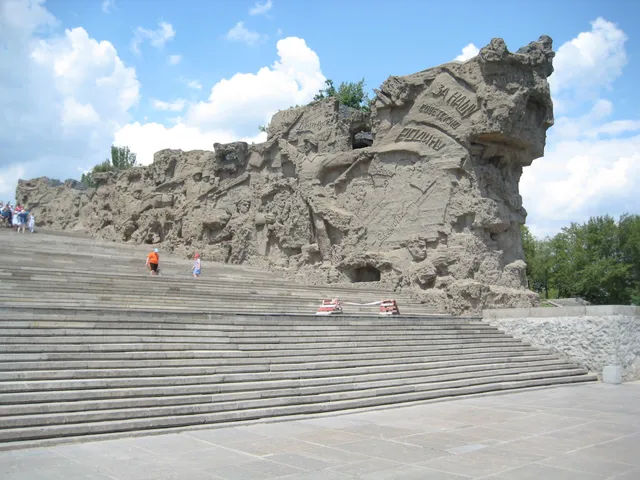
Eternal Flame After the war, the Soviet authorities commissioned the enormous Mamayev Kurgan memorial complex. Vasily Chuikov, who led Soviet forces at Stalingrad, lies buried at Mamayev Kurgan, the first Marshal of the Soviet Union to be buried outside Moscow. Soviet sniper Vasily Zaytsev was also reburied there in 2006.
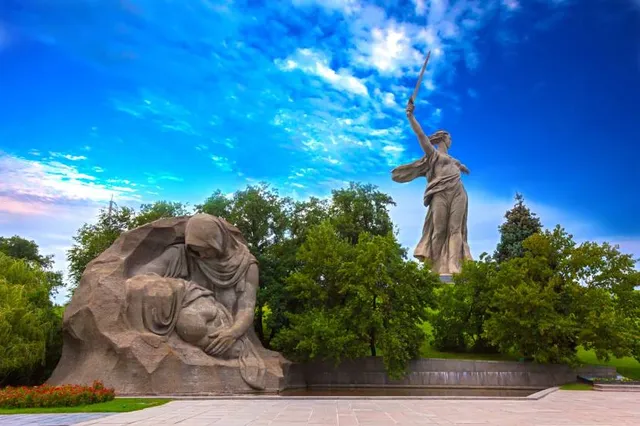
The monumental memorial was constructed between 1959 and 1967, and is crowned by a huge allegorical statue of the Motherland on the top of the hill. The monument, designed by Yevgeny Vuchetich, has the full name The Motherland Calls! (Russian: Родина-мать зовёт! Rodina Mat Zovyot!). It consists of a concrete sculpture, 52 metres tall, and 85 metres from the feet to the tip of the 27-metre sword, dominating the skyline of the city of Stalingrad (later renamed...
Read moreMamayev Kurgan is a hill in Volgograd named after Mamaya, famous Tatar khan who was buried here (Kurgan is a resting place in Tatar). In more recent history this hill (among many other sites around) is famous for one of the most important battles in WWII, which changed the course of it in Europe. There are several things to explore here, and I'll list them here and explain in a separate review. Count on at least 3 hours for a visit. You can reach Mamayev Kurgan in 2 ways, depending if you want a more relaxed or more impressive approach. More impressive is taking a taxi or speed tram that will take you to the hill foot, close to the Volga river, and then climb 200 steps (200 days lasted the battle). Climbing them the statue becomes bigger and bigger and you visit other monuments along the way - reflection pool, huge stone reliefs, Eternal flame and Hall of Glory,....Beware, this requires 200 steps uphill climb plus spaces in between them. More relaxed means taking a taxi which will take you to the top of the hill where's the Motherland Calls statue, seeing it first and then descending downhill and seeing other attractions in the opposite way. The complex is totally free to visit, and I suggest coming in the morning, as the sun is shining at the statue and whole complex then, so you will have better light on your pics. We were late afternoon and the sun was...
Read moreМамаев курган
В дни Сталинградской битвы Мамаев курган стал местом самых тяжелых и кровопролитных боев. Он являлся ключевой позицией в обороне города. На фронтовых картах обозначался как Высота 102,0. Расположенный в центре города, он занимал господствующее положение: сверху хорошо были видны переправы, промышленные объекты, железнодорожный вокзал, речной порт, просматривались также Волга и Заволжье, где располагались в те дни резервы, штабы и госпитали наших войск. В боях на Главной высоте России, как ее стали называть, принимали участие более 36 частей и соединений. По 10-12 раз в день враг атаковал советские позиции. Бывали дни, когда его вершина несколько раз в день переходила из рук в руки. 135 дней здесь не утихали бои. 26 января 1943г Мамаев курган был полностью освобожден от врага.
Генерал-лейтенант В.И.Чуйков в своей книге «Сражение века» писал: «Противник понимал, что завладев Мамаевым курганом, он будет господствовать над городом, заводскими поселками и над Волгой. Для достижения этой цели он не жалел ни сил, ни средств. Мы, в свою очередь, решили во что бы то ни стало удержать Мамаев курган. Здесь были разгромлены многие танковые и пехотные полки и дивизии противника, и не одна наша дивизия выдержала жесточайшие бои, бои на истребление, невиданные в истории по своему упорству и жестокости».
После битвы Мамаев курган назвали железным: больше, чем земли, было на его склонах металла – разорванных танковых башен, разбитых орудий, обгоревших машин, искореженных самолетов, прокопченных гусеничных траков, осколков снарядов, авиабомб.
Сегодня Мамаев курган известен в первую очередь своим главным монументом "Родина-мать зовет!". Величественный монумент создавался в течение трех лет. Общая высота скульптуры с мечом составляет 85м. Но по первоначальному проекту холм должна была венчать двухфигурная композиция: Родина-мать со знаменем Победы в правой руке и снопами колосьев в левой и солдат с автоматом, преклонивший колени и целующий колосья. Потом авторский замысел изменился.
Красивое, конечно, и очень значимое место. Я апплодирую стоя архитекторам и проектировщикам этого мемориального комплекса и парка. Все очень достойно, величественно и...
Read more