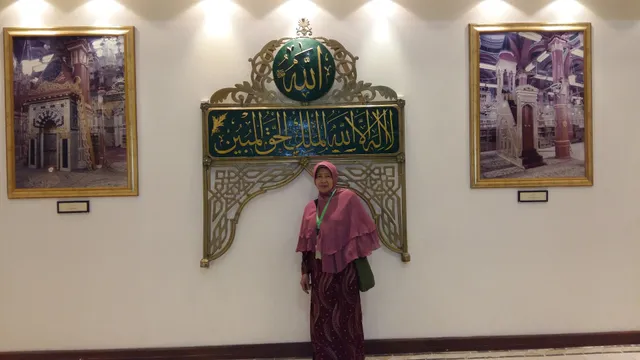
The exhibition (معرض عمارة الحرمين الشريفين), is nestled amid the hills of Mecca’s Umm Al-Joud area, not far from the Kiswa factory. The exhibition is divided into seven sections and includes artefacts dating back to the era of Abdullah ibn Zubair, circa 685 CE/65 Hj. The museum consists of seven halls that include models of the Two Holy Mosques; antiquities; inscriptions; models of the Kaaba cladding (Kiswa); the old door of the Kaaba; rare photos for the Two Holy Mosques; and a copy of Uthman's collection of the Quran (Mushaf Uthman).
The main entrance to the complex. Established in 1999 by the late Prince Abdul Majeed, governor of Mecca, the museum project cost more than SR 15 million. Some photographs, given as a gift by the late Crown Prince Sultan, are worth SR 10 million. It highlights the cultural and historical aspects of the Two Holy Mosques.
Brass head of the pulpit made during the reign of Sultan Suleiman al-Qanoony, circa 10th century Hejrah. The Ottoman minbars usually were executed in two distinctive fashions, one of which was a wooden one with and elongated conical cap like this one.
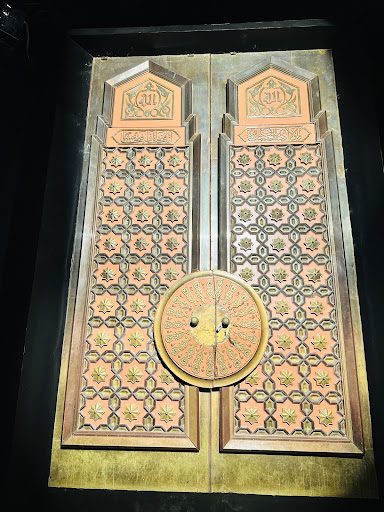
The door of Kaaba that was used until 1937/38 (inspect) CE. There's an inscription on the door that suggests that it was first fitted to the Kaba in 1636. Over the centuries the Kabah has been fitted with elaborately decorated doors like this one. The door also bears an inscription of the Shahadah (inspect) in Arabic in it's upper part. It's an iconic symbol of Arabia's Islamic History.
A replica of the sundial used to calculate the prayer timings and the age of the day. It was a mid-day timer used to determine prayer times before the printing of Hijri Calendar. It may have functioned somewhat like the sundial designed by ibn Shattir for the Umayyad Mosque in Damascus.
Cassing of Maqam Ibrahim (station of Abraham) used up until the time of King Fahad's (bin Abdulaziz) expansion of Masjid al-Haram. The Maqām Ibrāhīm (مَـقَـام إِبْـرَاهِـيْـم) is a stone associated with Abraham, Ishmael and their rebuilding of the Ka'bah. According to Islamic tradition, the imprint on the stone came from Abraham's feet, it appeared when Abraham stood on the stone while building the Kaaba.
Inscription on marble slab, marking the date for the construction of the Mataf during the reign of Abbaid caliph abi Ja'far al-Mansur al-Muntasir Billah in the year 611 Hj. The Mataf area has been rebuilt, redeveloped and expanded over the centuries. Several
A teak-wood stair case, used to enter Kaba, is placed near the main entrance to the museum complex. The floor of Kabah and the entrance is about 2.2 meters (7.2 feet) higher than the Mataf area, consequently a staircase is needed to enter the sacred shrine. Over the centuries several of these were built by Muslim rulers or other prominent Muslims to be used in Masjid al-Haram. This staircase dates back to the reigh of Ottoman Sultan Mahmud II.
An inscription on marble marking the date of the construction of the door and parts of the Holy Mosque that were damaged by fire during the reign of the Mamluk Sultan An-Nasir Faraj bin Bargog in 804H (1402).
Mouth-piece of Bir e Zam Zam (ZamZam Well) with outer ring and covering. The pully at the top dates back to the end of the fourteenth century Hijrah (circa. 1970 CE). The bucket made of brass dates back to the early decade of fourteenth century Hijrah (circa. 1900 CE).
A door belonging to Prophet's Mosque at Medina (large door at the right), dating back to the reign of King Abdul Aziz al-Saud. The door panels of an Ottoman era pulpit (smaller green door to the left with inlaid golden patterns) in Prophet's Mosque, made at the orders of Sultan Murad III. The grill on the wall in the middle belongs to the Masjid an-Nabawi's first Saudi construction.
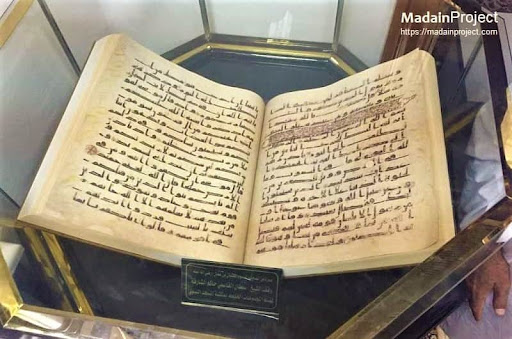
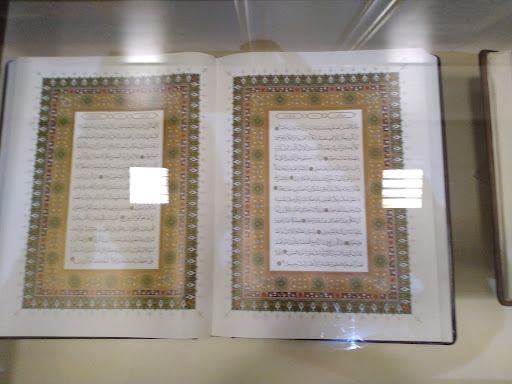
A copy of Mushaf e Uthmani (Quran bearing the blood of third caliph Uthman) produced during Era of Uthman ibn Affan. The original is preserved in the Topkapi palace, Istanbul, Turkey. According to tradition the original manuscript of this copy bears the marks of the blook of the third Caliph...
Read more
 Learn more insights from Wanderboat AI.