HTML SitemapExplore

The Garden And Masjid Of Salman Al Farsi Ring Of Imam ALI — Attraction in Medina Province

Name
The Garden And Masjid Of Salman Al Farsi Ring Of Imam ALI
Description
Nearby attractions
Nearby restaurants
Nearby hotels
فندق شقق زوايا الماسية ( فرع العوالي )
حي, العوالي, طريق على بن ابي طالب قربان, Madinah 42223, Saudi Arabia
Related posts
Keywords
The Garden And Masjid Of Salman Al Farsi Ring Of Imam ALI tourism.The Garden And Masjid Of Salman Al Farsi Ring Of Imam ALI hotels.The Garden And Masjid Of Salman Al Farsi Ring Of Imam ALI bed and breakfast. flights to The Garden And Masjid Of Salman Al Farsi Ring Of Imam ALI.The Garden And Masjid Of Salman Al Farsi Ring Of Imam ALI attractions.The Garden And Masjid Of Salman Al Farsi Ring Of Imam ALI restaurants.The Garden And Masjid Of Salman Al Farsi Ring Of Imam ALI travel.The Garden And Masjid Of Salman Al Farsi Ring Of Imam ALI travel guide.The Garden And Masjid Of Salman Al Farsi Ring Of Imam ALI travel blog.The Garden And Masjid Of Salman Al Farsi Ring Of Imam ALI pictures.The Garden And Masjid Of Salman Al Farsi Ring Of Imam ALI photos.The Garden And Masjid Of Salman Al Farsi Ring Of Imam ALI travel tips.The Garden And Masjid Of Salman Al Farsi Ring Of Imam ALI maps.The Garden And Masjid Of Salman Al Farsi Ring Of Imam ALI things to do.
The Garden And Masjid Of Salman Al Farsi Ring Of Imam ALI things to do, attractions, restaurants, events info and trip planning
The Garden And Masjid Of Salman Al Farsi Ring Of Imam ALI
Saudi ArabiaMedina ProvinceThe Garden And Masjid Of Salman Al Farsi Ring Of Imam ALI

Basic Info

The Garden And Masjid Of Salman Al Farsi Ring Of Imam ALI

4323 طريق علي بن ابي طالب، 6448, Qurban، 6448, Madinah 42316, Saudi Arabia
4.7(1.0K)
Open 24 hours
Save
spot

Ratings & Description

Info

Cultural
Outdoor
Scenic
Family friendly
Accessibility
attractions: , restaurants:
logoLearn more insights from Wanderboat AI.
Website
islamiclandmarks.com

Plan your stay

hotel
Pet-friendly Hotels in Medina Province
Find a cozy hotel nearby and make it a full experience.
hotel
Affordable Hotels in Medina Province
Find a cozy hotel nearby and make it a full experience.
hotel
The Coolest Hotels You Haven't Heard Of (Yet)
Find a cozy hotel nearby and make it a full experience.
hotel
Trending Stays Worth the Hype in Medina Province
Find a cozy hotel nearby and make it a full experience.

Reviews

Get the Appoverlay
Get the AppOne tap to find yournext favorite spots!
Wanderboat LogoWanderboat

Your everyday Al companion for getaway ideas

CompanyAbout Us
InformationAI Trip PlannerSitemap
SocialXInstagramTiktokLinkedin
LegalTerms of ServicePrivacy Policy

Get the app

© 2025 Wanderboat. All rights reserved.

Reviews of The Garden And Masjid Of Salman Al Farsi Ring Of Imam ALI

4.7
(1,002)
avatar
5.0
2y

A Serene Oasis of Spirituality and Tranquility

I recently had the privilege of visiting The Garden and Masjid of Salman Al Farsi, located within the Ring of Imam Ali, and I was captivated by the sheer beauty and serenity of this place. It truly felt like an oasis of spirituality and tranquility amidst the bustling city.

Upon entering the garden, I was immediately greeted by lush greenery, vibrant flowers, and beautifully manicured pathways. The meticulous attention to detail in maintaining the garden is truly commendable. It's an ideal place to escape the noise and chaos of everyday life and find solace in nature.

The Masjid of Salman Al Farsi, nestled within the garden, is a masterpiece of architectural brilliance. The intricate designs and exquisite craftsmanship are a testament to the rich history and cultural heritage associated with this sacred place. As I stepped inside the mosque, I was enveloped by a sense of profound peace and spirituality. The peaceful atmosphere encourages contemplation and reflection, allowing visitors to connect with their inner selves.

The staff at the garden and masjid were welcoming, knowledgeable, and eager to share the history and significance of the place. Their passion for preserving and promoting the spiritual essence of the site was evident in their interactions. They were more than happy to answer any questions and provide guidance, enhancing the overall experience.

What makes this place even more special is its association with Salman Al Farsi, a revered companion of Imam Ali. Learning about their profound friendship and shared teachings added a deeper layer of appreciation for this site. It's a place where history and spirituality converge, leaving visitors with a sense of reverence and awe.

I highly recommend visiting The Garden and Masjid of Salman Al Farsi Ring of Imam Ali to anyone seeking solace, spiritual enrichment, and a deeper understanding of Islamic history. Whether you are a devout Muslim or someone interested in exploring different cultures and traditions, this place will undoubtedly leave a lasting impression on your heart and mind.

A visit to this oasis of spirituality is a reminder of the importance of preserving our heritage and cherishing the wisdom of the past. It is a true gem that deserves recognition and...

   Read more
avatar
5.0
5y

A large number of pilgrims visit the exhibition during Umrah and Hajj seasons. (SPA)

A number of manuscripts can be seen for the first time, written over different eras in various forms and images

Manuscripts in their original form as well as a Kaaba cover dating back 140 years among those shown in exhibition

An exhibition of the Qur’an in Madinah, held next to the western squares of the Prophet’s Mosque, highlights the greatness of the book of Allah and the importance of its glorification and history. It aims to introduce visitors to the holy book in a museum-like presentation.

The sub-goals include the call for learning and teaching Qur’an; highlighting the greatness of the Qur’an; understanding the history of Qur’an, displaying the special technologies of the Qur’an; and demonstrating the efforts of the Kingdom in caring for the Qur’an.

Raja bin Ayesh Al-Juhani, exhibition director, told the Saudi Press Agency that articles in the exhibition — open from 9 a.m. till 2 p.m. and then after the afternoon prayer till 9 p.m. — are in Arabic, English, Urdu, French, Indonesian, Turkish and Hausa.

About 22 people work at the exhibition, divided between guides and translators, to highlight the historic and modern efforts of the Kingdom to take care of the Qur’an and old manuscripts, as well as talk about calligraphy, photos and items related to the holy book.

The exhibition is divided into a number of halls, including one displaying a short film about the content of the exhibition and how to be guided through it.

Al-Juhani said that the exhibition tackles the phases of the revelation of the Qur’an, aspects of its Suwar, Verses … It also describes how the Qur’an has been collected and arranged since the time of the Prophet and the Rashidun Caliphs, and how it came to be printed the way it is now.

The exhibition shows how it is examined, organized and maintained to control the Qur’an text without errors or misinterpretation. Visitors will learn about how the Qur’an is currently being written.

The Kingdom’s efforts are shown through the King Fahd Glorious Qur’an Printing Complex in Madinah and the diversity of its publications through audio and video clips,...

   Read more

avatar
5.0
18w

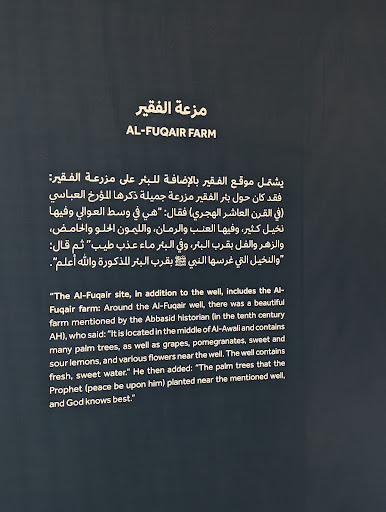
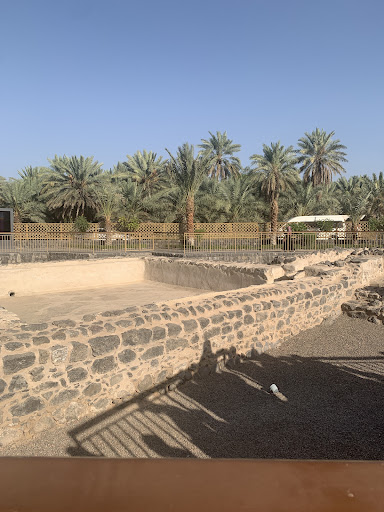
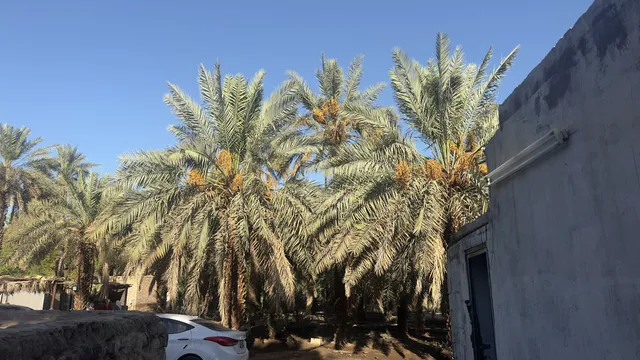
This site is associated with Salman Al Farsi (ra), one of the earliest and closest companions of the Holy Prophet (PBUH). It contains a small museum with posters, a well and a spot where Salman (ra) is said to have prayed along with nearby date farms which are a visual reminder of how things were here back in time. The site is located on the Ali ibn Abi Talib (as) road.

The word Fuqair in its name comes from the word Tafqeer which means to dig a hole to plant a date seedling. This is associated with the miracle of the Prophet (PBUH) which led to the freedom of Salman (ra). He had been advised by a monk to go to a land with palm trees as that's where a prophet would emerge. He left his native Persia and eventually ended up as a slave to a Jew in Madinah. When Salman (ra) accepted Islam and asked for his freedom, the Jew asked for 300 (in some traditions 500) date seedlings to be planted and bear fruit in return (as well as an amount of gold in some traditions).

Salman (ra) went back to the Prophet (PBUH) with this who asked Salman (ra) to get the terms in writing so that the Jew does not renege on his agreement. Once that was done, he asked Salman (ra) to bring the seeds and gave them to Hazrat Ali (as). Together they went to the farm. The Prophet (PBUH) would dig a hole (do Tafqeer), ask Salman (ra) to plant the seed and then cover it up. As soon as he did this, water would spring up to allow the seed to germinate and take root. In this way, the trees were all planted and eventually bore fruit which allowed Salman (ra) to be freed from the slavery of the Jew. In the traditions which talk about the Jew also demanding a quantity of gold, the Prophet (PBUH) lifted a stone which turned to the amount of gold demanded. He then gave it to secure Salman's (ra) freedom.

Sites like this remind us of the power of Allah and that He will provide us a way out of our troubles if we trust in Him and seek proximity...

   Read more
Page 1 of 7
Previous
Next

Posts

MOHAMMED NISHAN KONNOLAMOHAMMED NISHAN KONNOLA
A Serene Oasis of Spirituality and Tranquility I recently had the privilege of visiting The Garden and Masjid of Salman Al Farsi, located within the Ring of Imam Ali, and I was captivated by the sheer beauty and serenity of this place. It truly felt like an oasis of spirituality and tranquility amidst the bustling city. Upon entering the garden, I was immediately greeted by lush greenery, vibrant flowers, and beautifully manicured pathways. The meticulous attention to detail in maintaining the garden is truly commendable. It's an ideal place to escape the noise and chaos of everyday life and find solace in nature. The Masjid of Salman Al Farsi, nestled within the garden, is a masterpiece of architectural brilliance. The intricate designs and exquisite craftsmanship are a testament to the rich history and cultural heritage associated with this sacred place. As I stepped inside the mosque, I was enveloped by a sense of profound peace and spirituality. The peaceful atmosphere encourages contemplation and reflection, allowing visitors to connect with their inner selves. The staff at the garden and masjid were welcoming, knowledgeable, and eager to share the history and significance of the place. Their passion for preserving and promoting the spiritual essence of the site was evident in their interactions. They were more than happy to answer any questions and provide guidance, enhancing the overall experience. What makes this place even more special is its association with Salman Al Farsi, a revered companion of Imam Ali. Learning about their profound friendship and shared teachings added a deeper layer of appreciation for this site. It's a place where history and spirituality converge, leaving visitors with a sense of reverence and awe. I highly recommend visiting The Garden and Masjid of Salman Al Farsi Ring of Imam Ali to anyone seeking solace, spiritual enrichment, and a deeper understanding of Islamic history. Whether you are a devout Muslim or someone interested in exploring different cultures and traditions, this place will undoubtedly leave a lasting impression on your heart and mind. A visit to this oasis of spirituality is a reminder of the importance of preserving our heritage and cherishing the wisdom of the past. It is a true gem that deserves recognition and appreciation.
Taha ZaidiTaha Zaidi
This site is associated with Salman Al Farsi (ra), one of the earliest and closest companions of the Holy Prophet (PBUH). It contains a small museum with posters, a well and a spot where Salman (ra) is said to have prayed along with nearby date farms which are a visual reminder of how things were here back in time. The site is located on the Ali ibn Abi Talib (as) road. The word Fuqair in its name comes from the word Tafqeer which means to dig a hole to plant a date seedling. This is associated with the miracle of the Prophet (PBUH) which led to the freedom of Salman (ra). He had been advised by a monk to go to a land with palm trees as that's where a prophet would emerge. He left his native Persia and eventually ended up as a slave to a Jew in Madinah. When Salman (ra) accepted Islam and asked for his freedom, the Jew asked for 300 (in some traditions 500) date seedlings to be planted and bear fruit in return (as well as an amount of gold in some traditions). Salman (ra) went back to the Prophet (PBUH) with this who asked Salman (ra) to get the terms in writing so that the Jew does not renege on his agreement. Once that was done, he asked Salman (ra) to bring the seeds and gave them to Hazrat Ali (as). Together they went to the farm. The Prophet (PBUH) would dig a hole (do Tafqeer), ask Salman (ra) to plant the seed and then cover it up. As soon as he did this, water would spring up to allow the seed to germinate and take root. In this way, the trees were all planted and eventually bore fruit which allowed Salman (ra) to be freed from the slavery of the Jew. In the traditions which talk about the Jew also demanding a quantity of gold, the Prophet (PBUH) lifted a stone which turned to the amount of gold demanded. He then gave it to secure Salman's (ra) freedom. Sites like this remind us of the power of Allah and that He will provide us a way out of our troubles if we trust in Him and seek proximity to Him alone.
Navas nTvNavas nTv
Spiritual place .. Salman Farsi (Persian: سلمان فارسی; Arabic: سَلْمَان ٱلْفَارِسِيّ) was a Persian religious scholar and one of the companions of Muhammad. As a practicing Zoroastrian, he dedicated much of his early life to studying to become a magus, after which he began travelling extensively throughout Western Asia to engage in constructive dialogue with non-Zoroastrian groups. His quests eventually prompted his conversion to Christianity and later his conversion to Islam, which occurred after he met and befriended Muhammad in the city of Yathrib. He was a prominent non-Arab companion and one of Muhammad's closest friends; Muhammad had once stated to a gathering of his followers that he regarded Salman as a part of his family.[4] In meetings with the other companions, he was often referred to by the kunya Abu ʿAbdullah. Prior to the Battle of the Trench in 627, Salman suggested to Muhammad and the other early Muslims that a large trench be dug around Yathrib (citing a technique commonly used by the Sasanian army) in order to help defend against the Quraysh, who were marching from Mecca in order to besiege the city.[5] After Muhammad's death in 632, Salman became closely associated with Muhammad's cousin and son-in-law Ali ibn Abi Talib and is claimed to have participated in the Muslim conquest of Persia, aiding the territorial expansion of the Rashidun Caliphate outside of the Arabian Peninsula.[6]
See more posts
See more posts
hotel
Find your stay

Pet-friendly Hotels in Medina Province

Find a cozy hotel nearby and make it a full experience.

A Serene Oasis of Spirituality and Tranquility I recently had the privilege of visiting The Garden and Masjid of Salman Al Farsi, located within the Ring of Imam Ali, and I was captivated by the sheer beauty and serenity of this place. It truly felt like an oasis of spirituality and tranquility amidst the bustling city. Upon entering the garden, I was immediately greeted by lush greenery, vibrant flowers, and beautifully manicured pathways. The meticulous attention to detail in maintaining the garden is truly commendable. It's an ideal place to escape the noise and chaos of everyday life and find solace in nature. The Masjid of Salman Al Farsi, nestled within the garden, is a masterpiece of architectural brilliance. The intricate designs and exquisite craftsmanship are a testament to the rich history and cultural heritage associated with this sacred place. As I stepped inside the mosque, I was enveloped by a sense of profound peace and spirituality. The peaceful atmosphere encourages contemplation and reflection, allowing visitors to connect with their inner selves. The staff at the garden and masjid were welcoming, knowledgeable, and eager to share the history and significance of the place. Their passion for preserving and promoting the spiritual essence of the site was evident in their interactions. They were more than happy to answer any questions and provide guidance, enhancing the overall experience. What makes this place even more special is its association with Salman Al Farsi, a revered companion of Imam Ali. Learning about their profound friendship and shared teachings added a deeper layer of appreciation for this site. It's a place where history and spirituality converge, leaving visitors with a sense of reverence and awe. I highly recommend visiting The Garden and Masjid of Salman Al Farsi Ring of Imam Ali to anyone seeking solace, spiritual enrichment, and a deeper understanding of Islamic history. Whether you are a devout Muslim or someone interested in exploring different cultures and traditions, this place will undoubtedly leave a lasting impression on your heart and mind. A visit to this oasis of spirituality is a reminder of the importance of preserving our heritage and cherishing the wisdom of the past. It is a true gem that deserves recognition and appreciation.
MOHAMMED NISHAN KONNOLA

MOHAMMED NISHAN KONNOLA

hotel
Find your stay

Affordable Hotels in Medina Province

Find a cozy hotel nearby and make it a full experience.

Get the Appoverlay
Get the AppOne tap to find yournext favorite spots!
This site is associated with Salman Al Farsi (ra), one of the earliest and closest companions of the Holy Prophet (PBUH). It contains a small museum with posters, a well and a spot where Salman (ra) is said to have prayed along with nearby date farms which are a visual reminder of how things were here back in time. The site is located on the Ali ibn Abi Talib (as) road. The word Fuqair in its name comes from the word Tafqeer which means to dig a hole to plant a date seedling. This is associated with the miracle of the Prophet (PBUH) which led to the freedom of Salman (ra). He had been advised by a monk to go to a land with palm trees as that's where a prophet would emerge. He left his native Persia and eventually ended up as a slave to a Jew in Madinah. When Salman (ra) accepted Islam and asked for his freedom, the Jew asked for 300 (in some traditions 500) date seedlings to be planted and bear fruit in return (as well as an amount of gold in some traditions). Salman (ra) went back to the Prophet (PBUH) with this who asked Salman (ra) to get the terms in writing so that the Jew does not renege on his agreement. Once that was done, he asked Salman (ra) to bring the seeds and gave them to Hazrat Ali (as). Together they went to the farm. The Prophet (PBUH) would dig a hole (do Tafqeer), ask Salman (ra) to plant the seed and then cover it up. As soon as he did this, water would spring up to allow the seed to germinate and take root. In this way, the trees were all planted and eventually bore fruit which allowed Salman (ra) to be freed from the slavery of the Jew. In the traditions which talk about the Jew also demanding a quantity of gold, the Prophet (PBUH) lifted a stone which turned to the amount of gold demanded. He then gave it to secure Salman's (ra) freedom. Sites like this remind us of the power of Allah and that He will provide us a way out of our troubles if we trust in Him and seek proximity to Him alone.
Taha Zaidi

Taha Zaidi

hotel
Find your stay

The Coolest Hotels You Haven't Heard Of (Yet)

Find a cozy hotel nearby and make it a full experience.

hotel
Find your stay

Trending Stays Worth the Hype in Medina Province

Find a cozy hotel nearby and make it a full experience.

Spiritual place .. Salman Farsi (Persian: سلمان فارسی; Arabic: سَلْمَان ٱلْفَارِسِيّ) was a Persian religious scholar and one of the companions of Muhammad. As a practicing Zoroastrian, he dedicated much of his early life to studying to become a magus, after which he began travelling extensively throughout Western Asia to engage in constructive dialogue with non-Zoroastrian groups. His quests eventually prompted his conversion to Christianity and later his conversion to Islam, which occurred after he met and befriended Muhammad in the city of Yathrib. He was a prominent non-Arab companion and one of Muhammad's closest friends; Muhammad had once stated to a gathering of his followers that he regarded Salman as a part of his family.[4] In meetings with the other companions, he was often referred to by the kunya Abu ʿAbdullah. Prior to the Battle of the Trench in 627, Salman suggested to Muhammad and the other early Muslims that a large trench be dug around Yathrib (citing a technique commonly used by the Sasanian army) in order to help defend against the Quraysh, who were marching from Mecca in order to besiege the city.[5] After Muhammad's death in 632, Salman became closely associated with Muhammad's cousin and son-in-law Ali ibn Abi Talib and is claimed to have participated in the Muslim conquest of Persia, aiding the territorial expansion of the Rashidun Caliphate outside of the Arabian Peninsula.[6]
Navas nTv

Navas nTv

See more posts
See more posts