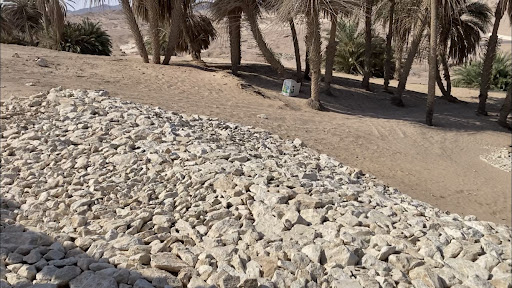
The wells of Moses:
Maqna is a charming coastal town located on the Gulf of Aqaba that faces Egypt and the Sinai mountains, clearly visible from it. But the town is famous for its wells that witnessed an important episode in the life of the Prophet Moses.
The territory bordering the eastern shore of the Gulf of Aqaba is the ancient land of Madyan (or Midian) whose capital was probably in today’s city of Al-Bada’, where monumental tombs were later sculpted by the Nabatean people. Madyan is the land where Moses spent ten years in voluntary exile after fleeing from Egypt following an altercation with an Egyptian that was beating an Israelite.
It is believed that Moses crossed the Red Sea and arrived in Maqna and went to a well called Bir Al-Sa’idani to drink. There he saw two girls collecting water for their cattle and he offered to help. The girls reported this gentle move to their father, the prophet Shu’ayb, who went to meet Moses, recognized his pure soul, and decided to marry one of his daughters to him. Thus, Moses settled in Madyan and lived there for ten years with his wife and father-in-law.
Later when Moses brought the people out of Egypt through the Red Sea, they are supposed to have reached the land of Madyan at Tayeb Al-Ism which is located just 15 kilometers north of Maqna, and also bears witness to him, as it is called the Valley of Moses.
During the first years of Islam an important event took place in Maqna as it was there the troops of the Prophet Mohammed signed a treaty with the people of Judham, the tribe controlling this area that converted to Islam.
Even today there is a well in Maqna where crystal clear water comes out of the ground in several places as if by magic. The well is surrounded by beautiful palm trees and its water runs downhill towards a lush palm grove. On the north of the well is an archeological site that is believed to date back to the early Islamic era.
As the well is located on a hill one kilometer away from the Gulf of Aqaba it offers a stunning viewpoint on the blue waters of the Gulf that separates the ancient land of Madyan from the impressive Sinai mountains that are visible from the well. The road that heads towards Tayeb Al-Ism and runs along the irregular hilly shore with beaches where the blue become turquoise is...
Read moreMaqna, located 235 km from the Tabuk city, is famous for its spectacular sceneries, among them are views of the Gulf of Aqaba, which can be seen between two large mountains.
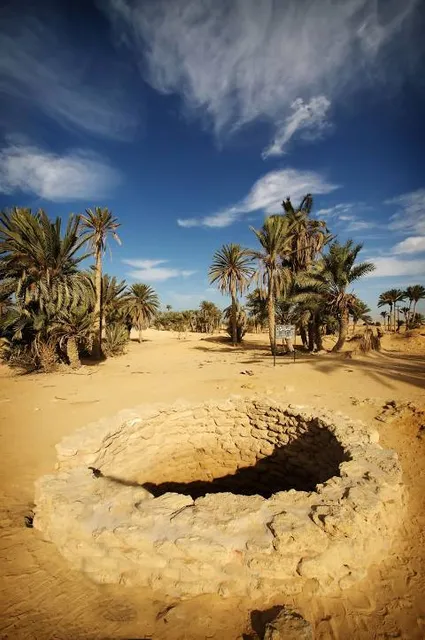
In the valley of Maqna, a few kilometers before the coast, the palm trees intersect around small springs, and these include the “Springs of Moses”. These springs pump water in the famous valley of Maqna, through six sand holes driven by water that flows from the ground.
These ancient springs that take their origin from the middle of sands and their water flow through date palm farms that made Maqna a favorite spot for both land and sea tourists from within the Kingdom and outside. Wadi Tayyib, a narrow passage located between huge mountains, is situated 20 km from Ain Musa.
Bir al Saidni, which is known as the well of the Moses (Prophet Musa’s well), where crystal clear water comes out of the ground in several places as if by magic. The well is surrounded by beautiful palm trees and its water runs downhill toward a lush palm grove. On the north of the well is an archeological site that is believed to date back to the early Islamic era. It is on the top of a mountain surrounded by date palm trees as well as other trees.
The well witnessed an important episode in the life of the Prophet Moses. As the well is located on a hill one kilometer away from the Gulf of Aqaba, it offers a stunning viewpoint on the blue waters of the Gulf of Aqba that separates the ancient land of Madyan from the impressive Sinai Mountains that are visible from the well. The road that heads toward Wadi Tayyib and runs along the irregular hilly shore with beaches where the blue becomes turquoise is...
Read moreThis place in Magna, 40 minutes driving distance by a car from Al Bad', where you can see Jethro's caves,Tabuk province is very near to Red Sea but the spring water is clean and not salty. Local people call this place Ain Musa. Some people think this place is Elim where Moses and his Israeli 2~3 million people stayed after Exodus from Egypt 3500 years ago. I am sure they stayed there because there are many palm trees and more than 15 springs. And that this place is entrance part leading to Al Bad', one of towns in Midyan, where Moses's family lived for 40 years. And that there is another historical place nearby Ain Musa which is not open to public yet. But on Google map, the actual location of Elim is indicated at the another place , north side, very far place from this Ain Musa. Refer to "You Tube" -...
Read more