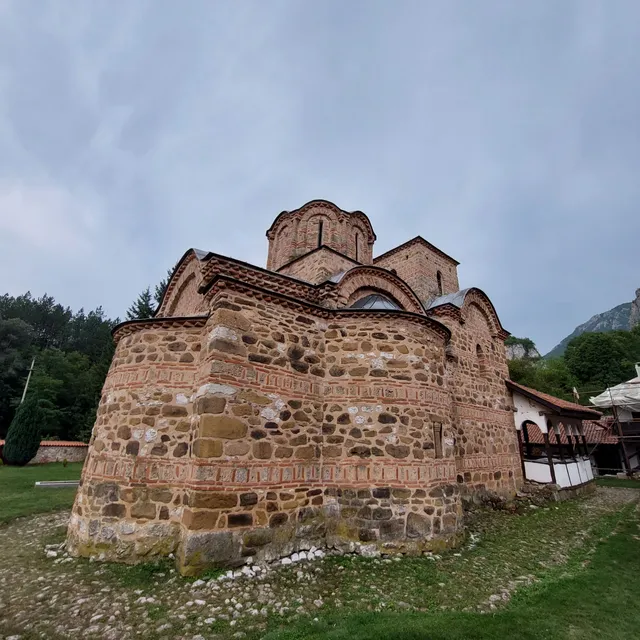
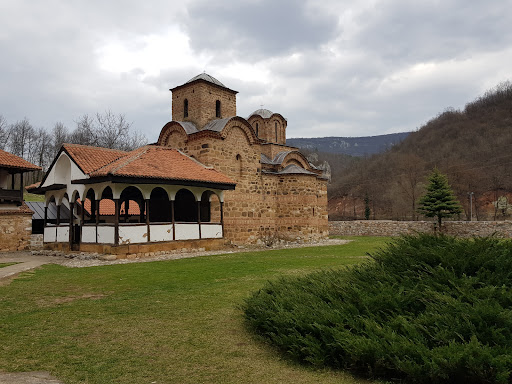
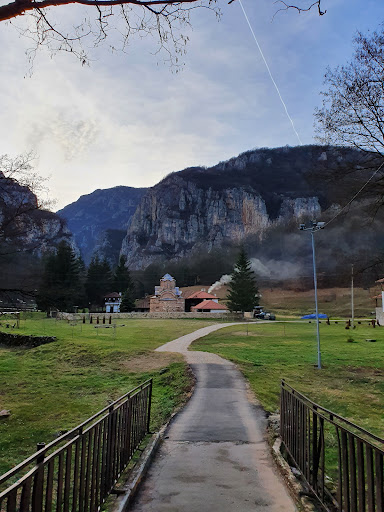
It is ten kilometers away from the Nis-Sofia highway, along the valley of the Jerma River, which in the seventies indicated the route of the former narrow-gauge railway. Thanks to its inaccessible position (until 1927, until the construction of the narrow-gauge railway for the needs of coal mines, Jerme's climb was completely impassive) remained for centuries relatively undamaged by the hands of various conquerors.
The old name of the city, and even the monastery itself was "Dobroshevo", and the Turks converted it to Poganovo. The name Dobroševo was officially returned to the village in January 1934, by the decision of the competent ministry. M. Milojević (1881) calls this monastery "Dobroševski". About the past of the monastery near the village of Dobroseva, there are three round stone with inscriptions, embedded on the west side of the temple. On them are the names: Jovan Bogoslov (patron), Mr. Constantine and Mrs. Jelena. During the Second World War, the Bulgarians plundered the Poganovo Monastery and took the iconostasis (from 1620) with the miraculous icon of the Virgin, preserved and located in the Sofia National Museum.
On the left bank of the river Jerma, near the village of Poganovo, there is a monastery dedicated to St. John the Baptist. The national tradition connects this monastery to the holy Emperor Constantine and his mother Jelena. Prota Theodore Titov mentions the old record on the parchment, according to which the Serbs erected this monastery before 1130, and in Proskomidia there is an old icon painted with the names of the Serbian rulers from the earliest times. However, recent historiography revealed more precise data on the time of the monastery's creation. The monastery was erected at the end of the 14th century (1395) and a lively, rich thematic program, only 100 years later, more precisely in 1499, by artists from the area of northern Greece. Founded and raised by the Serbian nobleman Konstantin Dejanović Dragash, the sister of the Emperor Dusan and dedicated to him by Sv. Jovan Bogoslov The castor of the temple is also Constantine's daughter, Jelena Dragash, who was married to the Byzantine emperor Manojl II Paleolog. The monastery was completed after the death of her father, now as a hippopotaman. One of the famous clerics of the monastery was Constantine, the grandson of Grand Duke Desimir. He gave the book a monastery of "St. John the Theologian." Due to the location of the monastery, accessibility, until 1927, was inconceivable, because the Jerma riverbed was completely impenetrable. As a result, the monastery remained undamaged through centuries, because it is well known that conquerors, when they are overthrown, destroyed everything from cultural features, while they could not even here because they did not know it existed. However, in 1917, the Bulgarians took a great deal of monastic valuables, which are now located in the Sofia-based church of Alexander Nevsky. With the art connoisseurs and the vassalologists themselves, this monastery became famous and became very famous for its icons. Some of them are:
a double-sided icon with a miracle in the Latomas Monastery on the one hand and the figures of the Virgin and the Holy Virgin. Ivan Bogoslov from the other, which originated in the second half of the 14th century, which after the First World War was confiscated by Bulgaria and taken to Sofia. This icon was the gift of empress Jelena, the wife of Byzantine emperor Manojl II Paleologist in memory of Father Konstantin Dejan;
icon with a bust of the dead Jesus Christ, which was founded in the late 15th century, located...
Read more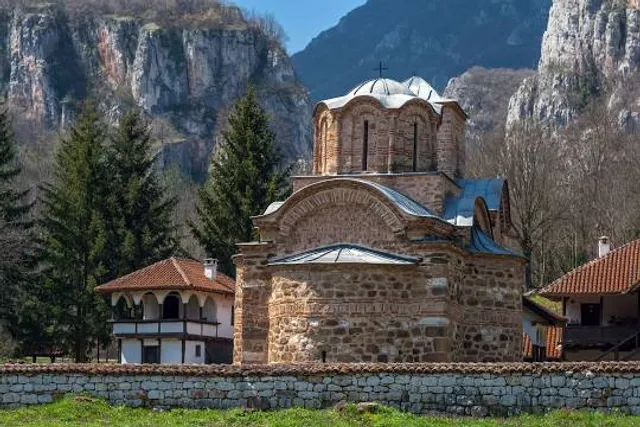
 Learn more insights from Wanderboat AI.