Quick Takeaways
🏛️ Built in 1912 to honour Cecil John Rhodes (1853–1902), British colonialist, mining magnate, and politician.
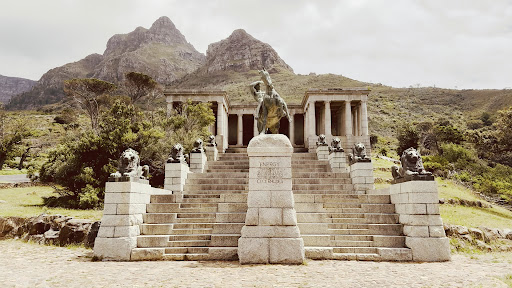
🐎 The imposing horseman statue (Physical Energy by George Frederic Watts) symbolises ambition and imperial vision.
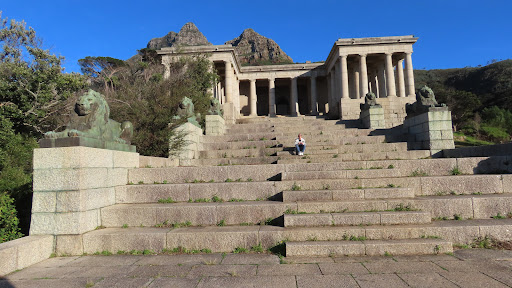
🦁 Eight bronze lions flank the staircase, representing calm strength and guardianship.
🪜 49 granite steps — one for each year of Rhodes’s life.
🧱 Classical U-shaped structure made from Cape granite, designed by Sir Herbert Baker and Sir Francis Macey.
📜 Inscription: “To the spirit and life work of Cecil John Rhodes who loved and served South Africa. 1853–1902.”
♿ Access: well signposted and easy to reach, but limited for wheelchair users — steps are the only way to the main terrace.
⚖️ Once a monument to imperial ambition, now a symbol of reflection on colonial legacy.
⏰ Open 24/7 365 days a week but best seen during a clear, and prefferably sunny, day
Review
Well signposted and easy to reach, the Rhodes Memorial sits high above Cape Town, reached via a long, winding road that leads to a large, open car park. It’s a desolate, windswept place. As you step out, the side of the monument rises above the trees — vast, solid, and commanding. Walking closer, you’re met with a structure that dominates the hillside, both impressive and imposing.
At the base stands the bronze statue Physical Energy by George Frederic Watts — a man on horseback, one hand raised to his brow as though scanning the horizon. This horseman is not Rhodes himself, but a symbol of boundless ambition and exploration: the drive to push forward, to conquer, to expand — qualities that Rhodes admired and embodied. From there, broad granite stairs rise, flanked by eight bronze lions sculpted by John Macallan Swan, each representing strength and silent guardianship.
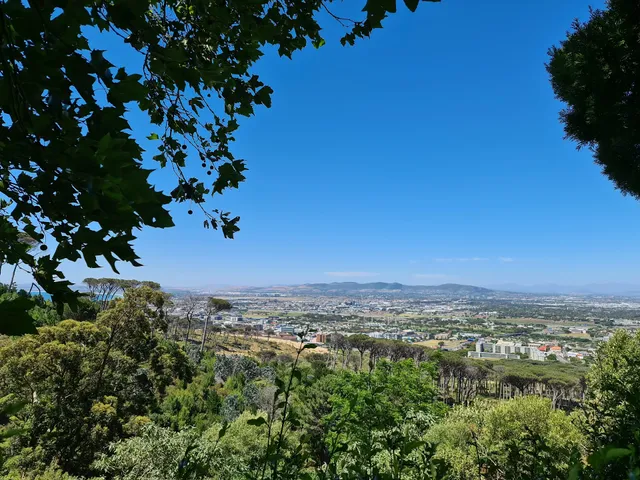
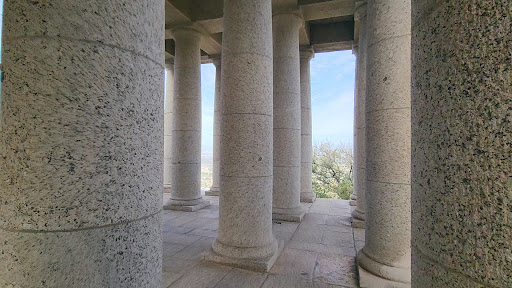
At the top, 49 granite steps, one for each year of Rhodes’s life, lead to the main structure — a grand, classical U-shaped building designed by Sir Herbert Baker and Sir Francis Macey. The tall Cape granite columns frame the bust of Cecil John Rhodes, whose relaxed and contemplative pose looks out toward the plains below, as though surveying the lands he once claimed. The main inscription reads:
“To the spirit and life work of Cecil John Rhodes who loved and served South Africa. 1853–1902.”
Below are lines from Rudyard Kipling’s poem Burial, describing Rhodes as “the immense and brooding spirit” of the land — capturing how he was once idolised as a hero of empire.
Unveiled in 1912, ten years after his death, the memorial was funded by public subscription to celebrate Rhodes’s achievements in expanding British rule over more than 1.1 million square miles of southern Africa — territory that would later become Zambia and Zimbabwe. It was designed to inspire awe and pride in a man considered, at the time, a visionary.
Today, that legacy feels far more complex. The stonework is grimy, weeds grow in the cracks, and the bust bears the marks of vandalism. Trees encroach on one side, and the site feels both majestic and forgotten — a relic of an age whose ideals have eroded.
Accessibility is reasonable but limited for wheelchair users, as the only way to the main terrace is via the stone staircase. There are no ramps or alternate safe routes, restricting full access for some visitors.
At the rear once stood a restaurant, but it now lies in ruins — roofless, graffitied, and abandoned — leaving the monument itself as the sole focus.
Standing before the memorial, you can feel both its grandeur and its fading relevance. It was built to glorify an empire-builder, but now stands as a silent reminder of ambition, exploitation, and the shifting narratives of history. The wind, the quiet, and the creeping decay make it both haunting and thought-provoking — a physical dialogue between the past and the present.
In its scale and solitude, the Rhodes Memorial captures the story of a nation still reckoning with its past: a monument of stone and shadow, reflecting not only the life of one man, but the rise and reconsideration of an...
Read more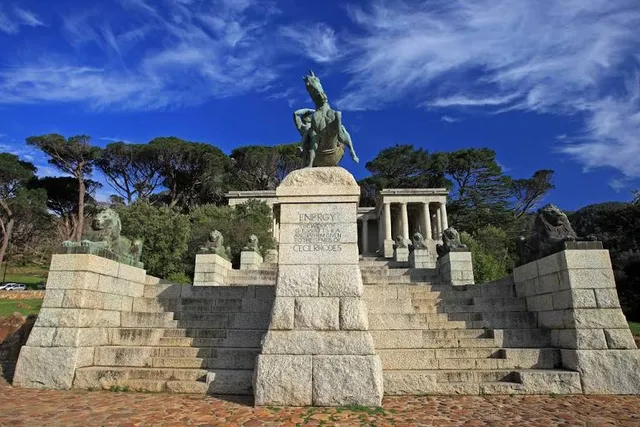
 Learn more insights from Wanderboat AI.