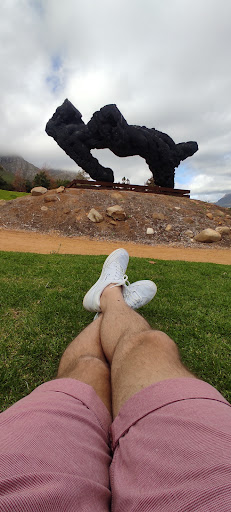
Dylan Lewis' sculpture garden in the sweeping meadows, in the shadows of the Rocky Mountains in Stellenbosch. Lewis conceptualised this sanctuary in 2009, inspired by Claude Monet, Henry Moore and Niki de Saint Phalle, all of who created gardens alongside their artwork, Lewis went on to incorporate elements of Japanese gardens, combining water bodies, ellipses, curves, and a sense of spirituality. There is also a zen pavilion designed by Enrico Daffonchio.
Dylan collaborated with designer Franchesca Watson on the 'initial broad brushstrokes of the garden' and with indigenous plant expert Fiona Powrie. Together, they carved out lakes, ponds and streams. Rocks were placed in the Japanese-inspired garden as a powerful reflection of the surrounding landscape. They made grass-fringed walkways, sweeps of indigenous fynbos, streams and a central lake.
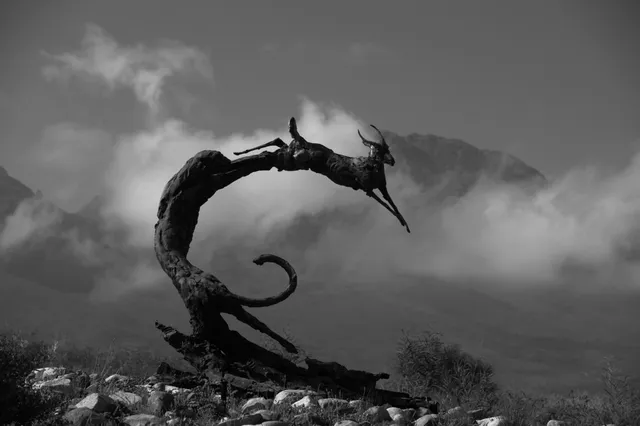
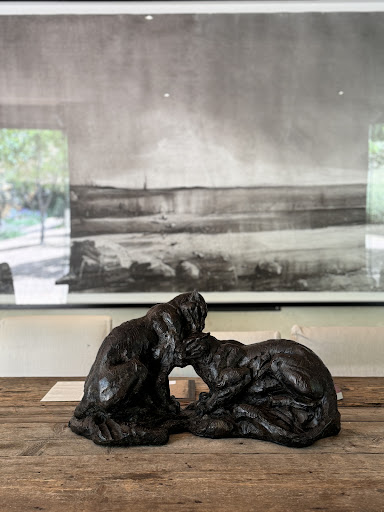
Lewis is fascinated by the tension between explosive movement and quiet balance- so the vision for the garden was for it to become progressively more naturalised the further it extended beyond the domestic buildings, to ultimately merge with the indigenous fynbos vegetation and mountains beyond. The sculpture, too, becomes increasingly wild the further one walks through the garden, moving from intimately observed bronze animal representations to rust-coloured monumental, fragmented and truncated animal/ human forms.
The entire garden area sets up a magnificent tension between proximity and distance, masculine and feminine, civilisation and wilderness, and there is nothing superfluous here: all elements have been consciously placed. Dylan's process of garden making, like that of his sculpture, is intuitive. There is a profound sense of being in the moment in this garden, an awareness that the light and the season will change, as will the landscape, but the experience comes from being there right now. The sculptures, so evocatively positioned, have been captured by the artist in just that moment to allow us a hushed sighting into...
Read moreToday was my second visit to this beautiful place, and it certainly won't be my last. It is not only a national treasure, but it should be on every international visitor's list of top five things to see in Cape Town. The garden and it's strategically positioned sculptures are collectively a creative masterpiece. From smaller sculptures tucked away in leafy alcoves or brushing the tops of feathery reeds, to gigantic figures emerging from the landscape, everywhere you look is an awe-inspiring feast for the eye. And the longer you look, the more wonderment you feel. Today I saw many of the sculptures differently to my first visit. I saw that some figures were made out of composite bits of other figures. And that different approaches from alternate directions elicit other responses. Oh the magic of this place! The setting against the mountains, the view over the ponds, I can't say which is my favourite part. Both times I went, I was glad to have been with other appreciative friends. There is a saying "A joy that's shared is a joy that's doubled". But next time I go I want to go alone, to savour each part without another soul in sight. I did a bit of this today and it was like a religious experience. The staff so cleverly and generously allow only a few people in at a time, meaning that your senses can focus totally on the wonder before you. Thank you, thank you,...
Read moreWhat else could be said about this amazing place that has not been put into words yet? Its got an outstanding rating, and this review will just be another one of those who applaud the extraordinary. Even now, I ponder whether I should just stop here without sending this review. This sculpture garden and studio are just so out of this world that I dont want it to be inundated by too many people. But then again, Id like others to have the same incredible experience. The landscape itself is a sculpture. The shape of the land, the extraordinary richness of vegetation, so well placed like in a Japanese zen garden, enhance the experience of the sculptures. It might be a bit inappropriate to call them beautiful. They are in their own way. They arecertainly perfect in themselves. And they speak. So, it might be more appropriate to call them powerful. And some people, definitely myself and my wife, on numerous visits to the garden, have felt that power as a strong presence. If you dont feel it, I am sure you will see the exceptional beauty. If you do feel it, you might call the garden the same as us: a spiritual place of immense power. Something else, if you are looking for excellent coffee, don`t just walk past the long stone building between parking and park entry. And just to make sure you have a perfect experience, call them and make a reservation....
Read more