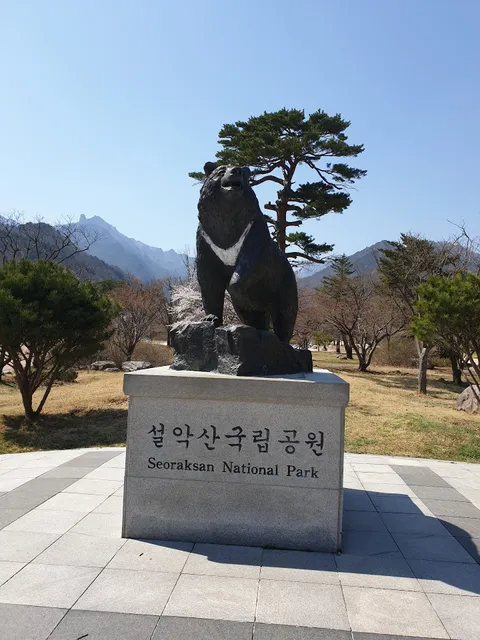
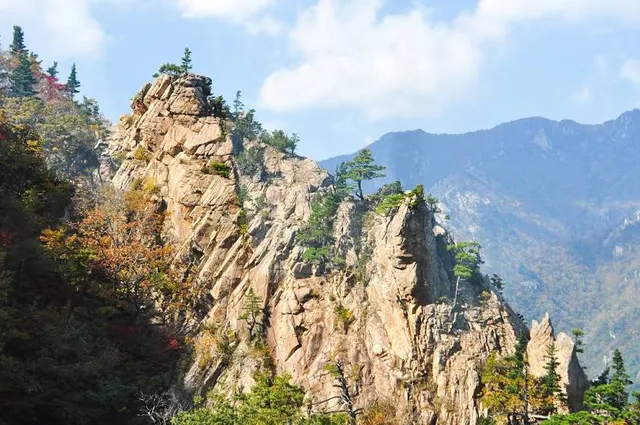
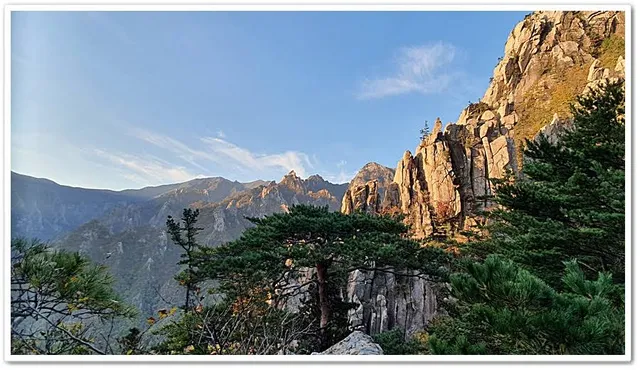
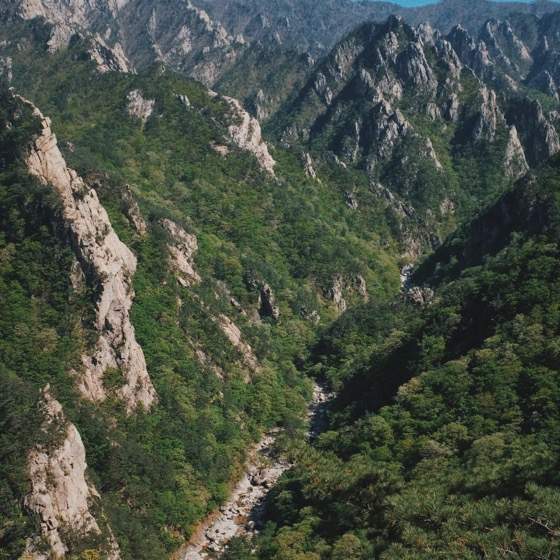
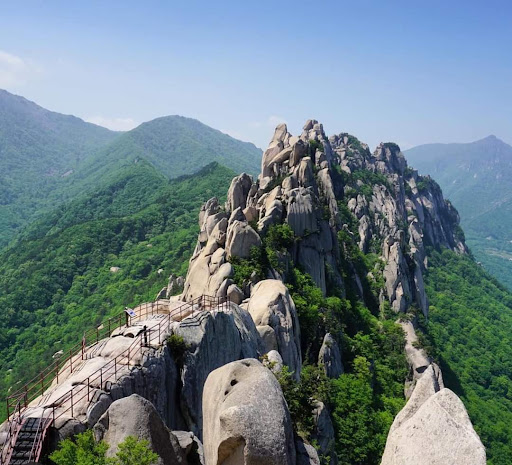
Seoraksan National Park (Korean: 설악산국립공원, 雪嶽山國立公園; RR: seoraksan-gungnipgong-won), also Mount Sorak National Park or Mount Sorak Biosphere Reserve, is a national park in South Korea. It is listed by the South Korean government with UNESCO as a tentative World Heritage Site. The government designated the area as a nature reserve in 1965 and UNESCO designated it as a biosphere reserve in 1982. It was also the first Korean national park to be named under the National Park Law in 1970. Located on the east-central Korean peninsula, the reserve includes the Dinosaur Ridge, Injegun, Yanyanggun, and Sokchosi. It is popular with tourists and nature enthusiasts. It is home to many rare taxa of flora and fauna.
The reserve has an area of 163.6 square kilometres (63.2 sq mi) and includes many mountain peaks measuring over 1,200 metres above sea level, the tallest being Daecheongbong, at an altitude of 1,708 metres (5,604 ft). The ranges are composed largely of dissected granite and gneiss. The annual precipitation is about 1,000 mm (39 inches) in Inner Soraksan and 1,300 mm (51 inches) in Outer Soraksan.
The park is valued for its floral diversity. There are about 1,013 species of plants known, with 822 vascular plant species. Pine trees such as the Siberian pine are abundant on the southern slope while the northern slopes of the mountain range are characterized by oaks and other deciduous trees. Thuja grow in the deep valleys. Dwarf pines and yews grow on low and high slopes. Juniper, hawthorn, and Manchurian fir can be found. Other plants include forsythias and saw-worts. Rare plants in the reserve include Hanabusaya asiatica.
1,562 animal species have been classified so far. Local fauna include otters, Siberian flying squirrel, kestrel, Chinese sparrowhawk, lenok, Chinese minnow, and spotted barbel. Endangered animal taxa include Tristram's woodpecker, Korean goral, and Korean musk deer.
Cultural landmarks in the reserve include the Buddhist...
Read moreSeoraksan Mountain is one of Korea's most famous tourist destinations that stretches across several areas including Sokcho, Goseong, Inje, and Yangyang in Gangwon-do. It was designated as Korea's fifth national park in 1970 after the designation of Hallyeohaesang National Park, and as Korea's first UNESCO Biosphere Reserve in 1982. It has been also registered in the IUCN Green List of Protected and Conserved Areas, which is the global standard of best practice for area-based conservation. Having Daecheongbong Peak as the mountain's main peak, Seoraksan National Park, with a total area of 398 km², is divided into the outer section ("Oeseorak," eastern section), the inner section ("Naeseorak," western section), and the southern section ("Namseorak"). Daecheongbong Peak (1,708 m) is the third highest peak in Korea after Hallasan Mountain and Jirisan Mountain, and as the peak is covered with snow for five to six months of the year, the mountain got the name "Seorak" (meaning a snowy peak). The summit of Daecheongbong Peak commands the magnificent natural landscape of Seoraksan Mountain and the East Sea. In particular, it is known for the fantastic views of the sunrise and sunset. In addition to Daecheongbong Peak, Seoraksan Mountain has some 30 grand peaks, such as Socheongbong, Hwachaebong, and Jungcheongbong. The mountain is also full of hidden scenic views of Biryongpokpo Falls, Ulsan Peak, Heundeulbawi Rock, and Geumganggul Cave. By using the cable car near Seoraksan Small Park, the disabled and the elderly can go up to the top and enjoy a panoramic view of...
Read moreSorak San National Park is a stunning and picturesque national park located in the northeastern part of South Korea, near the city of Sokcho. The park is known for its breathtaking natural scenery, diverse plant and animal life, and numerous hiking trails, making it a popular destination for nature lovers and outdoor enthusiasts.
One of the standout features of Sorak San National Park is its impressive mountain range, which includes the iconic Mount Sorak. Visitors can hike to the summit of Mount Sorak for stunning panoramic views of the surrounding landscape, or take a leisurely stroll through the park's many scenic trails and pathways.
In addition to its natural beauty, Sorak San National Park is also home to several important cultural and historical sites, including several Buddhist temples and shrines. Visitors can explore the park's many historic sites and learn more about the region's rich cultural heritage.
For those interested in wildlife and nature, Sorak San National Park offers a diverse range of plant and animal life, including several endangered species. Visitors can spot rare birds and animals in their natural habitat, or take a guided tour to learn more about the park's ecology and conservation efforts.
Overall, Sorak San National Park is a must-visit destination for anyone traveling to South Korea. Whether you're a nature lover, a culture enthusiast, or simply looking for a peaceful and relaxing day out in nature, you won't be disappointed by a visit to this stunning and scenic...
Read more