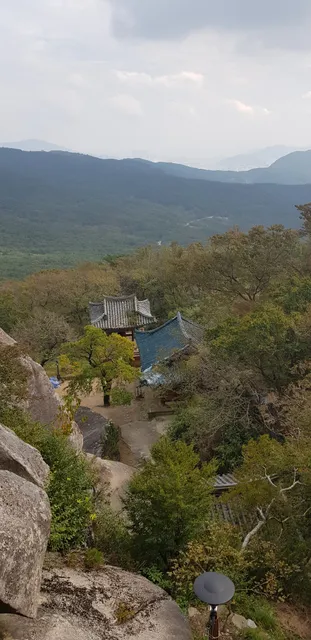
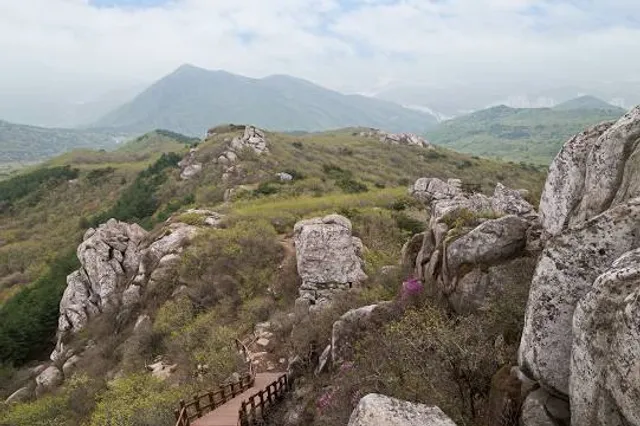
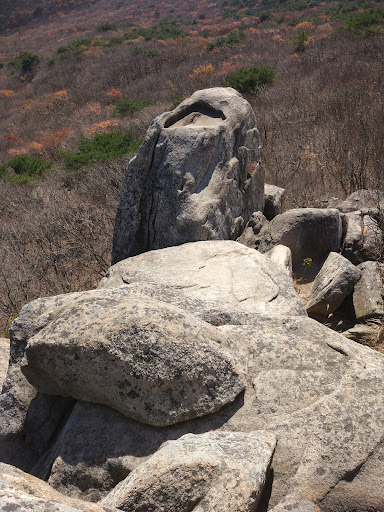
Geumjeongsanseong is the largest mountain fortress in the Republic of Korea today. It is located on Geumjeongsan in the Busan Metropolitan City. Following the Japanese invasion of 1592 and the Manchu invasion in 1627 and again in 1637, awareness of the necessity of national defence was heightened, especially against attacks from the sea. As a result of this awareness, this fortress was built in the 29th year (1703) of the reign of King Sukjong. The inner and the outer walls were mainly built of natural stones, but weak portions were reinforced with artificially worked square stone blocks. The walls are about 17 kilometers in length and from 1.5 meters to 3 meters in height. The area surrounded by the fortress is about 8.2 square kilometers.
It is clear that fortresses had been already built on this site before 1700. Yi Chi-hong, a naval commander, left a record in 1667 in which he mentions traces of an old fortress on the site. The construction of the fortress began in 1701 at the recommendation of Jo Tae-dong, the Governor of Gyeongsang-do, and was completed in 1702. In 1707 the walls were built around the main structure of the fortress. This fortress fell to disuse because it was too large to maintain. After lying empty for a century, it was repaired in 1807, the seventh year of the reign of King Sunjo. Oh Han-won, the Dongnae Magistrate, took the responsibility for building the west gate in 1807, and the other gates the following year. There is a stele recording the building of the gates.
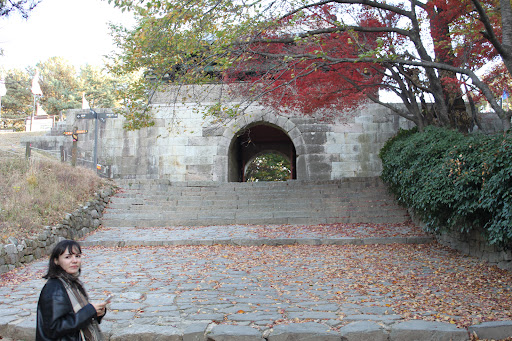
The fortress was destroyed during the Japanese occupation (1910-1945), but began to be restored in 1972. The East, West and South gates were restored by 1974 and the north gate was rebuilt in 1989. Today, thanks to the restoration efforts, much of the walls and the four gates still stand. Of the 4 existing observation towers, the tower number 1 located on the south-west side was destroyed by the typhoon Rusa on the morning of September 1, 2002. The area around the South Gate is a popular resting place. The West Gate, even though it is the most impressive of the four, is the less frequented one due to its lack of...
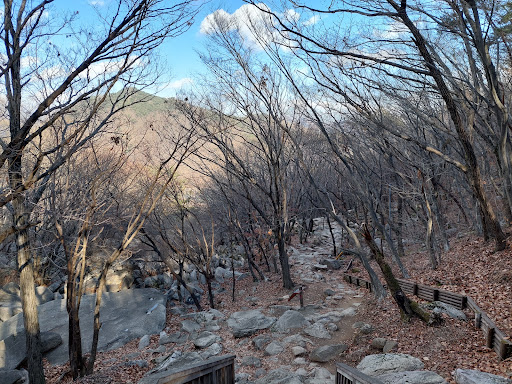
Read moreI hiked 9km from Geumgang cable car station to Beomeosa temple in 3 hours. To get to Geumgang park, you can take line 1 metro to Dongnae+bus+walk or oncheonjang+walk. The cable car costs 6000 won one way or 9000 won return. It was snowing a bit and the ground was hard/frozen. The trail is a bit challenging but easy to find. The first 2km has not much view because it goes through the forest. There are a few spots which is rocky and a bit steep. The view starting from the second half of the trail is amazing! You can see 360 degree of Busan city, ocean and mountains. It is super windy and cold despite the sun. There are no tourist and only a few local hikers. When I get to the southern gate, there is an option to hike up to the highest peak or turn right to Beomeosa temple. From here, the descend to the temple took me 30 min and I find the rocky path...
Read moreIf you are interested in hiking you will definitely like this Fortress; First, There are four gates for this Fortress to help you do a complete tour, you just have to look for each compass direction (look for signs that point to 남문, south gate etc). The trek around the entire fortress is about 9km. Be sure to bring some water and snacks because it's going to be a long journey! so so worth it you will be able to see beautiful scenery and take...
Read more