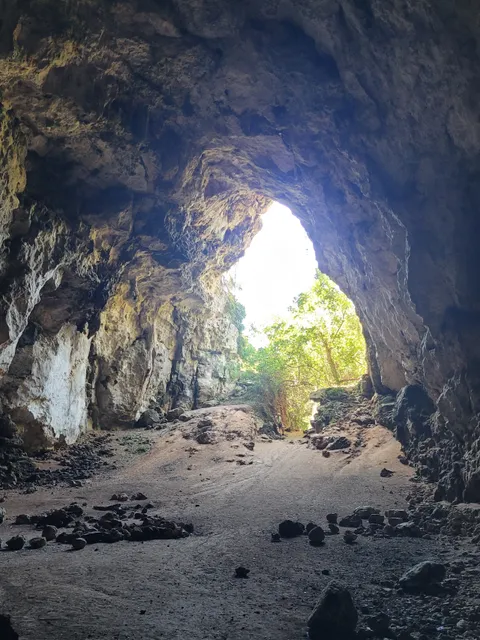
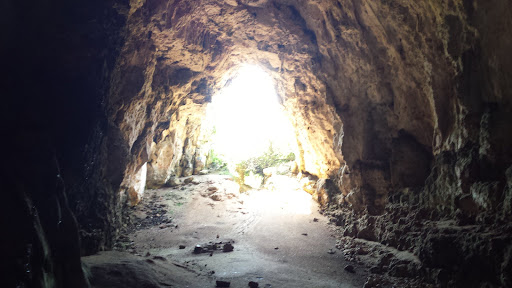
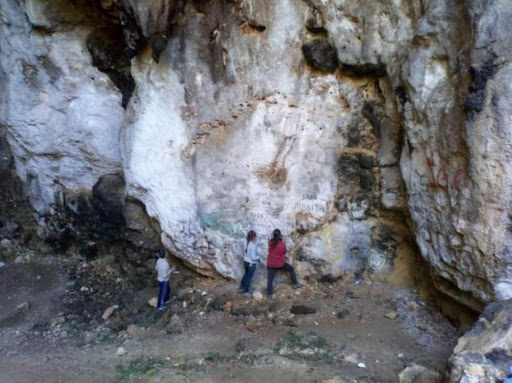
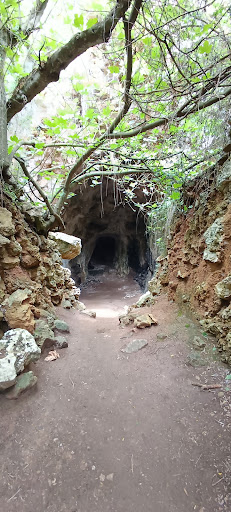
We walked here from Es Migjorn Gran - we parked near the school and the talayots. The initial part of the walk, along the road as far as the rural hotel was OK (no shade) but the road beyond the hotel is very rocky and then when you leave the road/track it is extremely rocky and hard going underfoot. There are no arrows or any way markers to help you navigate from the road. You barely have any phone signal but a satellite image that had already loaded on my phone helped us go the right way a few times. It took us 45 minutes to walk from Es Migjorn to the cave (with 2 children, 7 and 9). At least 2 information signs have been completely vandalised which is very disappointing especially given how remote it is. The cave itself is very impressive but me and my husband agreed that the trek there and back (especially the conditions underfoot and the lack of signage) outweighed the cave itself which is full of pigeons (not all alive) and quite smelly. I think some love needs to go back to this area with some new information signs, some proper way markers and possibly look to put a small car park in near the...
Read moreI walked here from Binigaus beach and I 100% recommend making the effort. From the far end of Binigaus beach, stand with your back to the sea and you will see a couple of shelters on the left. Start walking into the sand dunes in front of you and bear left walking with the sea still directly behind you - you will find a path. Keep walking along the path now with the sand dunes to your right. Eventually you will come to a gate. Go through the gate and bear right. Now you just keep walking along the path to the cave (I recommend finding the path on Google maps and taking a GPS as it's quite a large forest and you wouldn't want to get lost in the heat! Take some water with you) it's a fairly level 30 minute walk. About half way there you come to a T junction, bear right. There is another cave en route that was gated shut when I visited. Further along you will come to the main cave. From the info sign head left up a steep path and you will come to the cave. It's really amazing and nice and cool...
Read moreEsta cueva es conocida como "Cova des Coloms" por la gran cantidad de palomas silvestres que vivían aquí tiempo atrás, de las cuales hoy sólo pueden verse unos pocos ejemplares. Se trata de una cueva de origen cárstico, igual que la mayor parte de las cuevas naturales de Menorca, que se formó con la circulación de corrientes de agua subterránea, que fueron erosionando la roca calcárea. Esta cueva se diferencia de las demás por sus dimensiones: unos 25 m de altura, unos 20 m de amplitud y unos 110 m de longitud. El prehistoriador francés Émile Cartailhac ya cita la cueva en su obra sobre las Baleares, de 1892. En el fondo de la cueva, delimitando el espacio donde llega menos la luz natural, se encuentran los restos de un muro construido por la mano del hombre. Entre los años 1914 y 1915 el profesor A. Vives Escudero y el propietario de la finca, Bartomeu Sturla, realizaron excavaciones dentro de la cueva y encontraron algunos materiales que permiten deducir que esta cavidad fue utilizada en época prehistórica como lugar de enterramiento. Entre los objetos hallados destacan 2 astas de buey, fabricadas en bronce, que pueden vincularse con la creencia en un dios relacionado con dicho animal. Sea como sea, es fácil imaginar que las dimensiones de la cueva ya debieron impresionar a los menorquines de la época prehistórica, sobre todo si tenemos en cuenta que, para ellos, los espacios subterráneos tenían una simbología especial en sí mismos. Dentro de la cueva hay evidencias de movimientos de tierra realizados durante los últimos siglos. Es posible que parte de la tierra fuese extraída para crear las terrazas para el cultivo, abandonadas en la actualidad, que se observan en el barranco. Esta cueva fue declarada bien de interés cultural, el máximo nivel de protección del patrimonio histórico. Dañarla mediante cualquier procedimiento (pintadas o excavaciones ilegales, por ejemplo) puede castigarse, según el Código Penal, con...
Read more